Why Most Web Designers Struggle to Attract High-Paying Clients
Let me guess: you’re tired of clients who haggle over every $50, disappear after getting a quote, or expect a complete website redesign for the price of a decent dinner.
You’re not alone. Most web designers find themselves stuck in what I call the “race to the bottom”—constantly competing with designers willing to work for peanuts, endlessly scrolling through Upwork hoping for a decent project, or begging friends-of-friends for referrals that never quite materialize.
Here’s the thing nobody tells you when you’re starting out: being good at design isn’t enough anymore. You can master Figma, understand color theory better than Pantone themselves, and create pixel-perfect layouts that would make Dribbble swoon. But if you’re still attracting clients who see you as an expense rather than an investment, none of that technical skill matters.
There’s a massive difference between busy designers and well-paid designers. Busy designers are drowning in revisions, juggling multiple small projects, and working evenings to hit deadlines. Well-paid designers have fewer clients, charge 5-10x more, and actually enjoy what they do.
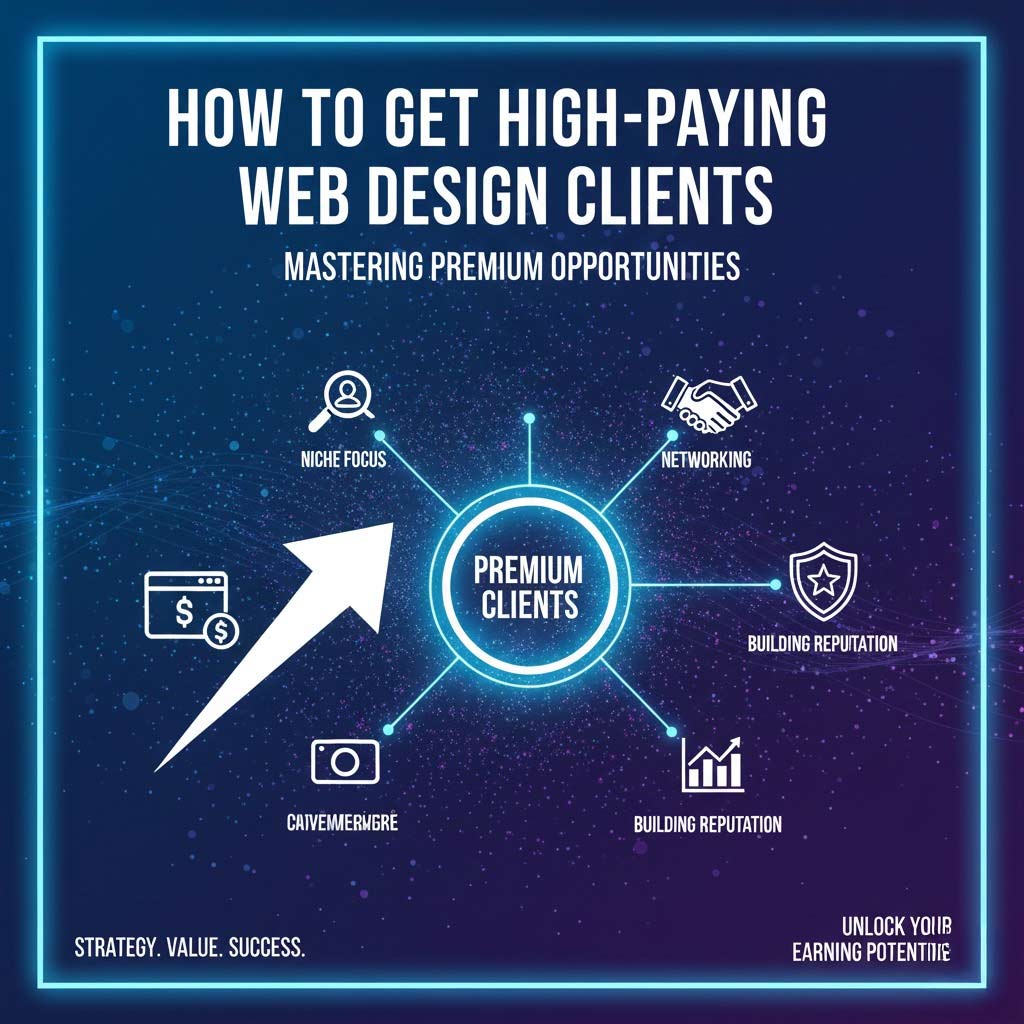
The secret? High-paying clients aren’t chased—they’re attracted. They come to you because of how you position yourself, how you communicate value, and where you show up. This isn’t about getting lucky or having connections. It’s about understanding what premium clients actually want and building a system that consistently brings them to your door.
In this guide, you’re going to learn the exact positioning strategies, pricing frameworks, and client acquisition systems that separate five-figure designers from the rest. No freelancing platforms. No gimmicks. Just the strategic approach that actually works when you want to build a sustainable, profitable web design business.
What High-Paying Web Design Clients Actually Want
Here’s a truth bomb that might sting a little: high-paying clients don’t actually care about your website designs.
I know, I know. You spent hours perfecting that hero section. The typography is chef’s kiss. The color palette? Absolutely stunning. But here’s what your ideal client is thinking when they look at your portfolio: “Will this make me money?”
Premium clients don’t buy websites. They buy outcomes. They buy more leads flowing into their sales pipeline. They buy increased conversion rates that turn visitors into customers. They buy authority and credibility that positions them as the obvious choice in their market.
Think about the difference between someone with a $500 budget and someone with a $10,000 budget. The $500 client is thinking: “I need a website because everyone has one.” They’re measuring success by whether the site looks professional and doesn’t embarrass them at networking events.
The $10,000 client is thinking: “I need a website that generates $50,000 in additional revenue this year.” They’re measuring success by leads, conversions, and ROI. They have a growth problem, and they need someone who can solve it.
This is why aesthetics alone don’t justify premium pricing. A beautiful website that doesn’t convert is just expensive art. Your high-paying client doesn’t want art—they want a business asset that works as hard as they do.
Consider the difference between a small hobby blogger asking for a site refresh versus a SaaS founder who needs a website that converts trial signups. The blogger is spending their personal money and hoping for the best. The SaaS founder is making an investment decision based on expected returns. They’ve done the math: if the new website increases conversions by 2%, it pays for itself in three months.
This mindset shift changes everything. When you understand that you’re not really selling web design—you’re selling business growth, lead generation, and revenue acceleration—you stop being a designer and become a growth partner. And growth partners don’t compete on price. They compete on results.
Why You’re Currently Attracting Low-Paying Clients (Hard Truths)
Time for some brutal honesty. If you’re constantly attracting clients who nickel-and-dime you, it’s not bad luck. It’s the signals you’re sending.
Your positioning probably sounds like this: “I design beautiful, modern websites for businesses.” So does every other designer. When you’re indistinguishable from the crowd, clients default to the only metric they can compare: price. And you’ll lose that game every time to someone in a country with a lower cost of living.
Maybe you’re showcasing a portfolio that screams “generalist.” E-commerce site, personal blog, restaurant menu, real estate listing—you’ve done it all. To you, that shows versatility. To a high-paying client, it shows you don’t really specialize in anything. Why would they pay premium rates to someone who treats their industry like just another portfolio piece?
Or perhaps your portfolio looks pretty but says nothing about results. Gorgeous screenshots with captions like “Modern redesign for local bakery.” Cool—did it increase their online orders? Drive foot traffic? Build their email list? If you can’t answer those questions, you’re selling the wrong thing.
Here’s another hard truth: if you’re competing on platforms designed for cheap labor, you’ll attract clients shopping for cheap labor. Fiverr, Upwork, 99designs—these platforms train clients to expect rock-bottom prices and treat designers like interchangeable commodities. You can’t build a premium business in a discount marketplace.
Most designers also make the fatal mistake of talking about features instead of results. “I’ll design five pages with custom animations and mobile optimization” versus “I’ll create a conversion-optimized website that turns your traffic into qualified leads.” One sounds like a task. The other sounds like a solution.
And then there’s pricing. If you’re charging based on how long something takes you, you’re capping your income at your hourly rate. You’re being paid for effort, not value. The faster you get at design, the less you make. That’s backwards.
The emotional cost of all this? Feeling chronically undervalued. Burnout from working twice as hard for half as much. Inconsistent income that makes you anxious every month. You didn’t get into design to feel this way, but here we are.
The good news? Once you identify these patterns, you can break them.
Step 1: Position Yourself as a Specialist, Not a Generalist
If I told you I needed heart surgery, would you want a “general surgeon who does everything” or a cardiac specialist who’s performed your exact procedure 200 times? Obviously, the specialist.
Your clients think the same way. Specialization is the foundation of premium pricing because specialists can charge more, attract better clients, and actually do better work.
When you’re positioned as “I design websites for everyone,” you’re competing against thousands of other designers. When you’re positioned as “I design conversion-focused websites for B2B SaaS companies raising their Series A,” you’re competing against maybe a dozen people—and clients in that niche will seek you out specifically.
There are different ways to specialize. You can niche down by industry (healthcare, real estate, professional services), by business model (e-commerce, SaaS, coaching), or by problem (conversion optimization, rebranding, lead generation). The key is choosing something specific enough to be meaningful but broad enough to sustain your business.
Let’s look at strong positioning examples. “Web designer for personal trainers launching online coaching programs” tells me exactly who you serve and what transformation you provide. “Conversion-focused websites for B2B service companies” immediately signals you understand my business model and my goals. “Premium web design for luxury hospitality brands” attracts a specific type of client with a specific budget expectation.
So how do you choose? Look for three factors. First, budget—does your niche have money to spend? Personal bloggers probably don’t. VC-backed startups probably do. Second, urgency—does your niche need this solution now? A business about to launch has urgency. Someone with an okay-ish website they might update eventually doesn’t. Third, decision-making power—can your ideal client actually say yes? Speaking directly to founders and executives is easier than navigating corporate procurement.
Common mistakes? Choosing a niche because you think you “should” rather than because you have genuine interest or insight. Picking something too narrow (“websites for vegan dog food companies in Portland”). Or refusing to niche at all because you’re afraid of missing opportunities—which ironically causes you to miss the best opportunities.
Here’s a simple positioning statement formula: “I help [specific type of client] achieve [specific outcome] through [your specific approach].” For example: “I help sustainable fashion brands build authority and drive online sales through conversion-optimized Shopify stores that tell their story.”
That’s not limiting. That’s powerful. And it’s the first step toward attracting clients who pay what you’re worth.
Step 2: Build a Portfolio That Sells Value, Not Visuals
Your portfolio is doing it wrong. I can say that with confidence because 95% of designers make the same mistake: they showcase pretty pictures and hope clients get it.
They don’t get it.
High-paying clients don’t hire you because your work looks good on Behance. They hire you because they believe you can solve their specific, expensive problem. And your portfolio needs to prove that you can.
This means your portfolio shouldn’t be a gallery—it should be a collection of case studies that demonstrate business results. Instead of just showing the final design, you need to tell the story of transformation.
Here’s what premium clients look for when they’re evaluating your portfolio. First, they want context. Who was this client? What industry? What stage of business? This helps them see themselves in your work. Second, they want to understand the problem. What wasn’t working? What was the client struggling with? This shows you think strategically, not just aesthetically. Third, they want to know your strategy. Why did you make specific design decisions? How did you approach conversion optimization? This demonstrates expertise. Finally, and most importantly, they want to see outcomes. Did traffic increase? Did leads double? Did the bounce rate drop by 40%?
A proper case study reads like this: “XYZ Coaching was struggling to convert website visitors into consultation bookings. Their old site looked professional but didn’t communicate their unique methodology or build trust with their target audience. We redesigned their site with a clear value proposition, strategic social proof placement, and a frictionless booking flow. Result: consultation bookings increased 156% in the first 90 days.”
Compare that to: “Clean, modern website design for a coaching business. Built with WordPress.”
See the difference?
Now, you might be thinking, “But I don’t have big clients yet with impressive results.” That’s okay. You can still craft value-focused case studies with the clients you have. Did your cousin’s photography business get three inquiries from their new website? That’s a 300% increase from zero—talk about that. Did you help a local restaurant improve their online ordering experience? Interview the owner about the impact.
When you don’t have client work, you can create spec projects—choose a real business with a weak web presence, redesign it (without actually building it), and outline the strategic improvements you’d recommend. Just be clear that it’s a conceptual project.
Portfolio layout matters too. Put your strongest, most results-driven case study first. Use clear headlines that emphasize outcomes, not services. Include specific numbers whenever possible—percentages, dollar amounts, time saved. And for the love of design, make it easy to navigate. Premium clients are busy. Respect their time.
Your portfolio messaging should consistently reinforce your positioning. If you specialize in e-commerce conversion, every case study should highlight revenue impact, cart abandonment rates, or average order value. If you focus on brand authority, emphasize press coverage, industry recognition, or audience growth metrics.
When your portfolio sells value instead of visuals, price objections disappear. Because now you’re not asking them to pay $8,000 for a pretty website. You’re asking them to invest $8,000 in a system that will generate $80,000 in new revenue. That’s an easy decision.
Step 3: Price Like a Professional, Not a Freelancer
Let’s talk about the moment that makes most designers sweat: presenting your price.
If you’re still charging hourly, you’re leaving massive amounts of money on the table. Hourly pricing punishes efficiency—the better you get at your craft, the less you earn. Plus, it commoditizes your expertise. You’re selling time instead of transformation.
High-paying clients don’t think in hours. They think in value. When a SaaS company pays you $15,000 for a website that increases their trial conversions by 3%, they’re not wondering how many hours you worked. They’re calculating that the increase adds $200,000 to their annual recurring revenue. Your fee is a rounding error.
This is value-based pricing, and it’s how professionals charge. Instead of calculating your costs and adding a margin, you’re pricing based on the worth of the outcome you deliver. A website that generates leads worth $100,000 to your client should cost significantly more than a website that’s just “nice to have.”
Price anchoring psychology works in your favor here. When a business owner is comparing your $8,000 proposal to their current situation (losing deals because their website looks outdated, watching competitors capture market share, missing out on $50,000+ in potential revenue), your price seems reasonable. When they’re comparing your $8,000 proposal to a $500 template they saw on ThemeForest, it seems expensive.
This is why positioning and value-focused portfolios matter—they frame the comparison correctly.
Speaking of numbers, let’s talk ranges. Entry-level premium projects typically start around $3,000-$5,000. This is for simpler sites with clear scope, often for established small businesses or solopreneurs who understand the value of professional web presence. Mid-tier projects range from $5,000-$10,000, usually involving more complex functionality, strategic positioning work, or conversion optimization for growing companies. Premium projects start at $10,000 and go up from there—we’re talking comprehensive digital presence builds for funded startups, established corporations, or high-revenue businesses where the website is a critical business asset.
The key word in all those ranges? “Start.” Never present pricing as a ceiling. When you say “starting at $8,000,” you’re signaling that this is the minimum investment for your expertise, and the actual project might cost more depending on scope.
Here’s how you confidently present pricing. First, thoroughly discuss their goals, challenges, and expected outcomes. Ask about budget expectations early (not to match them, but to ensure you’re both playing in the same ballpark). Then, frame your proposal around value and outcomes, not deliverables. “This investment will create a lead generation system that works 24/7 to grow your business” hits different than “You’ll get a five-page website with a contact form.”
When you present the number, don’t apologize or justify. State it clearly and shut up. “The investment for this project is $12,000” followed by silence gives them space to process. Nervous designers fill that silence with justifications that undermine their authority.
Common objections? “That’s more than I expected” gets answered with, “I understand. What were you expecting, and what outcomes were you hoping to achieve with that budget?” Often, they haven’t thought it through. “I can get it cheaper elsewhere” gets, “You absolutely can, and you’ll get cheaper results. My clients hire me because they need this to actually work.” And “I need to think about it” deserves, “Of course. What specific concerns should we address to help you make this decision?”
Remember: confident pricing closes deals. When you believe in your value, clients believe in it too.
Step 4: Where High-Paying Web Design Clients Actually Come From
Here’s what doesn’t work for attracting premium clients: posting your services on Fiverr and hoping for the best.
Platforms like Fiverr, Upwork, and 99designs are race-to-the-bottom marketplaces. They’re designed to connect clients seeking cheap, commoditized work with providers willing to compete on price. Sure, some designers claim they’ve landed good clients there, but for every success story, there are hundreds of designers stuck doing $200 websites for demanding clients.
The marketplace conditions you. Clients expect to pay little and get a lot. You’re compared directly to competitors based primarily on price. The platform takes a cut. Reviews become everything, so you over-deliver to mediocre clients just to avoid bad ratings. It’s exhausting and unprofitable.
So where do high-paying clients actually hang out? LinkedIn. Not LinkedIn jobs—LinkedIn content and networking. When you consistently share insights about web design strategy, conversion optimization, or industry-specific challenges, decision-makers notice. They’re on LinkedIn researching solutions, and your content positions you as the expert they need.
Referrals are the gold standard. A referred client comes pre-sold on your value because someone they trust vouched for you. They’re less price-sensitive and more likely to say yes. The key is making your current clients so successful and happy that referring you becomes natural. Ask for introductions specifically: “I’m looking to work with more B2B SaaS companies—do you know anyone in your network facing similar challenges?”
Personal brand development is a longer game but compounds over time. When you build authority through content, speaking, or teaching, clients approach you already convinced of your expertise. You’re not selling—you’re qualifying. This could mean writing articles, creating YouTube videos, speaking at conferences, or even just being active in industry communities.
Cold outreach, when done right, still works. Notice those qualifiers: “when done right.” Spray-and-pray messaging doesn’t work. But highly personalized, value-focused outreach to carefully selected prospects absolutely does. We’ll cover this more in the next section.
The strategic difference between inbound and outbound: inbound (content, SEO, referrals) takes time to build but brings you pre-qualified leads who are ready to buy. Outbound (cold outreach, direct networking) generates faster results but requires more active effort. The best approach? Use outbound to land clients now while building inbound systems for consistent flow later.
Authority-building always beats lead-chasing. When you’re seen as an authority, people come to you. When you’re chasing leads, you’re in a weak negotiating position. Invest in being known for something specific in your niche, and watch how the sales conversation changes.
The channel that works best depends on your personality and strengths. If you’re a strong writer, content marketing and LinkedIn might be your jam. If you’re a natural networker, referrals and direct relationships could be your path. If you’re strategic and research-oriented, targeted cold outreach might be surprisingly effective.
Just stay away from the platforms that commoditize you. You’re worth more than that.
Step 5: Outreach That Attracts Premium Clients (Without Sounding Desperate)
Most cold outreach fails because it reeks of desperation and self-interest. “Hi, I’m a web designer and I noticed your website could use an update. I’d love to redesign it for you.”
Delete. Delete. Delete.
Here’s why that doesn’t work: it’s about you, not them. It offers no value. It’s generic and could be sent to anyone. And it asks for something (their business) without giving anything first.
Premium clients get dozens of these messages every week. They’ve developed immunity to bad outreach. If you want to break through, you need an entirely different approach.
Start with deep personalization. Don’t just use their name—reference something specific about their business. “I saw your recent podcast episode about scaling service businesses, and your point about client acquisition costs really resonated” shows you’ve actually paid attention. It’s not scalable to send 100 of these per day, but that’s the point. Quality over quantity.
Focus on outcomes, not services. Instead of “I design websites,” try “I noticed your current site doesn’t have any clear path for visitors to book consultations. With the amount of traffic you’re driving from your content, you could be converting 20-30 additional leads per month.” You’re diagnosing a problem and hinting at a solution.
The best outreach framework follows this structure: specific observation about their business, insight or idea (give value first), soft suggestion for conversation. For example: “Your product is clearly resonating with mid-market SaaS companies based on your recent case studies. One thing I noticed: your pricing page doesn’t address the specific objections that CFOs typically have in this segment. I’ve helped similar companies restructure their pricing communication to address this—happy to share what’s worked if you’re open to a quick conversation.”
What NOT to say: “I can make you a website for cheap.” “Your website looks outdated.” “We’re offering a special discount this month.” Any of these variations signals that you’re competing on price, not value.
Follow-up matters, but most people do it wrong. Don’t just bump your original message. Add new value. Share an article relevant to their industry. Reference a recent development in their business. “Saw you just announced Series A funding—congrats. Growing companies often hit inflection points where their website becomes a bottleneck. Here’s an article on scaling conversion infrastructure that might be timely.”
And here’s the mature approach to rejection: accept it professionally. “No problem at all—thanks for the response. If anything changes or you know someone in your network who might benefit, I’d appreciate the introduction.” Graceful rejection responses have led to referrals and clients reaching back out six months later.
The mindset shift that changes everything: you’re not begging for work. You’re offering an opportunity to solve an expensive problem. High-paying clients respect confidence, not desperation.
Step 6: How to Close High-Paying Clients on Sales Calls
The sales call isn’t where you pitch your services. It’s where you diagnose whether you can actually help this client achieve their goals—and whether they’re someone you want to work with.
This reframe is crucial. When you approach sales calls as discovery conversations, your entire energy changes. You’re not a desperate designer hoping they say yes. You’re a consultant evaluating fit.
Start by asking strategic questions. What prompted you to look for a new website right now? What’s working with your current site? What’s not? If your website was performing perfectly, what would be different in your business? What’s your timeline, and what’s driving that timeline? These questions help you understand context, urgency, and whether they’re serious.
The best question you can ask: “What does success look like for this project, and how will you measure it?” If they can’t answer this, they’re not ready to hire anyone. If they say something like “we’ll have 30% more qualified leads in the pipeline,” now you’re speaking the same language.
Shift the conversation from price to impact. When someone says, “How much does this cost?” don’t give a number yet. Instead, respond with, “It depends on scope and outcomes. Before we talk budget, help me understand what you’re hoping this investment will generate for your business.” Get them talking about revenue goals, growth targets, and what’s at stake if they don’t solve this problem.
The “too expensive” objection usually means one of three things: they don’t understand the value, they weren’t the real decision-maker, or they genuinely can’t afford you. Your response: “I appreciate you being direct. When you say expensive, are you comparing to a specific number you had in mind, or does the ROI not make sense yet?” This reopens the conversation and helps you diagnose the real issue.
Know when to walk away. If someone is overly focused on price, demands spec work, has unrealistic expectations, or gives off bad-client energy, politely decline. “Based on what you’re looking for, I don’t think we’re the right fit. Here’s another designer who might be better aligned with your needs and budget.” Turning down bad clients protects your time for good ones.
Confidence closes deals because it signals certainty. When you know you can solve their problem, when you’ve seen these results before, when you’re genuinely unbothered by whether they say yes or no (because you have other opportunities), clients pick up on that. Desperation repels. Authority attracts.
The close itself should be natural. After you’ve discussed their goals, confirmed fit, and presented your approach, simply ask: “Does this sound like the solution you’re looking for?” If yes, “Great—I’ll send over a proposal tomorrow. Are there any concerns we should address first?”
Sales isn’t sleazy. Sales is helping the right people solve expensive problems. When you approach it that way, closing premium clients becomes significantly easier.
Common Mistakes That Keep Designers Stuck at Low Income
Even with all this knowledge, designers still sabotage themselves. Let’s call out the patterns that keep you stuck.
Undercharging to “gain experience” is the biggest trap. You think you need more projects before you can charge real rates, but undercharging attracts the wrong clients who give terrible projects. You’re gaining experience with bad clients, not good ones. Meanwhile, designers with half your skill are charging triple because they positioned themselves correctly from day one.
Copying competitors blindly seems smart until you realize you’re copying what they show publicly, not what actually works. That designer posting about Fiverr gigs might be making their real money through private referrals they don’t mention. That agency showcasing their process might have a totally different sales approach. Build your strategy based on principles, not mimicry.
Over-delivering to bad clients is the “nice designer” curse. You think being extra helpful will turn them into advocates, but it just teaches them to expect more for less. Your best clients don’t need hand-holding—they respect your process and pay for your expertise. Over-delivering doesn’t create loyalty; boundaries do.
Avoiding sales conversations because they feel uncomfortable keeps you dependent on whatever work randomly comes your way. Sales is a skill. Like design, it improves with practice. The difference between a $30,000/year designer and a $150,000/year designer usually isn’t design skill—it’s sales skill.
Not investing in positioning or skills beyond design is how you commoditize yourself. The market doesn’t need another person who can push pixels around Figma. It needs people who understand business strategy, conversion psychology, user research, content strategy, and brand positioning. Your design skills get you in the door. Your strategic skills command premium rates.
These mistakes compound. Each underpriced project makes it harder to charge more next time. Each generic positioning statement attracts more of the wrong clients. Each avoided sales conversation means less practice and growth. Break the patterns now.
The Long-Term System for Consistent High-Paying Clients
Quick wins are great, but sustainable income comes from building systems that consistently deliver high-quality opportunities.
Building authority over time means consistently showing up with valuable insights in your niche. Write articles. Create case studies. Share lessons learned. Speak at events. When someone in your niche thinks “I need a website,” your name should come to mind immediately. That takes time, but it compounds.
Personal brand leverage makes every other effort more effective. Your outreach gets higher response rates. Your referrals carry more weight. Your pricing faces less resistance. People pay premiums to work with known experts, and building your personal brand is how you become one.
Content as a lead engine works when you focus on the problems your ideal clients actually have. Don’t create content about what you do—create content about what they’re struggling with. SEO-optimized articles answering their specific questions. LinkedIn posts sharing insights from client projects. YouTube videos walking through strategy frameworks. Every piece of valuable content is a lead generation asset that works while you sleep.
Compounding trust means your reputation builds on itself. Happy clients refer others. Those clients refer others. Your portfolio gets stronger. Your positioning gets sharper. Your prices go up. Each success makes the next one easier. But you have to be patient enough to let it compound.
Consistency beats hacks every time. The designer who writes one helpful article per week for a year will build more authority than the designer who tries ten different growth hacks and gives up on each after two weeks. Pick your channels, commit to showing up, and trust the process.
This is how you stop trading time for money and start building a business that works for you.
Becoming the Designer High-Paying Clients Want to Hire
You’re not the same person who started reading this article. You’ve gone through a transformation—or at least, you’re aware one needs to happen.
The shift from generalist to specialist. From selling designs to selling outcomes. From competing on price to competing on value. From chasing leads to attracting opportunities. From order-taker to strategic consultant.
These aren’t just tactical changes. They’re identity shifts.
High-paying clients don’t hire designers who see themselves as service providers hoping for scraps. They hire consultants who understand business, communicate confidence, and deliver measurable results. The question isn’t whether you have the design skills—you probably do. The question is whether you’re positioning yourself in a way that lets clients see your value.
Start with one change. Pick a niche. Rewrite your portfolio to focus on outcomes. Raise your prices on the next proposal. Send five highly personalized outreach messages this week. Just start somewhere, because perfection is the enemy of progress.
The designers making $10,000+ per project aren’t working harder than you. They’re not more talented than you. They just figured out the game you’re playing isn’t about design—it’s about value, positioning, and strategy. Once you understand that, everything changes.
Your current clients don’t define your worth. Your past pricing doesn’t lock you in. You can decide today that you’re done competing on price and ready to build the web design business you actually want.
The clients are out there. They’re frustrated with cheap designers who don’t deliver. They’re ready to pay for someone who understands their business and can drive real results. They’re looking for you—you just need to make sure they can find you.
So what’s your next move?