
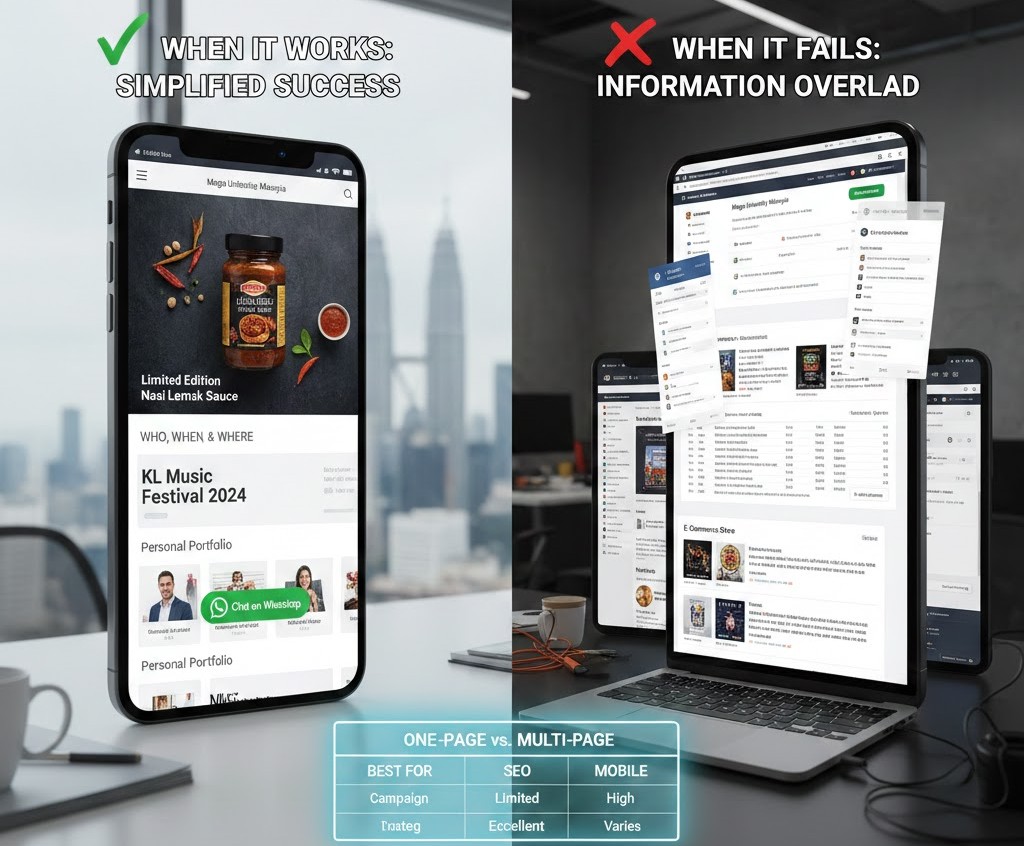
Most Malaysian SMEs don’t need more pages — they need more clarity. If you’ve been shopping around for a web package, you’ve probably heard agencies pitch one-page websites as the affordable, fast-to-launch option. And they’re not wrong. A well-built one-page website can generate WhatsApp leads, booking enquiries, and sales conversions far better than a bloated five-page site with no clear direction.
But here’s the part agencies don’t always tell you: one-page websites can also kill your SEO, confuse buyers, and bottleneck your business growth if used in the wrong situation.
This guide covers exactly when a one-page website works best in Malaysia, when it fails (and why), a practical decision framework, and the ideal structure for lead generation. If your goal is WhatsApp leads or bookings, read this before choosing your web package.
What Exactly Is a One-Page Website? (And What It Isn’t)
A one-page website is a single URL with multiple scrollable sections — typically organised as Hero, Offer, Proof, FAQ, and Contact. The visitor doesn’t click between pages; they scroll through everything on one continuous layout.
This is different from a “landing page with no navigation” (which has no scrollable sections, just a single conversion goal) and from a Single Page Application (SPA) in the technical development sense, which uses JavaScript frameworks like React or Vue to simulate page transitions.
Malaysians tend to gravitate toward one-page websites for three practical reasons: most browsing happens on mobile, buying decisions happen on WhatsApp, and paid ad traffic needs fast message-to-page alignment. A single scrollable page fits all three realities well — when the business model supports it.
Why One-Page Websites Convert Well (Malaysia Buyer Psychology)
Malaysian buyers decide fast and message fast. WhatsApp isn’t just a communication tool here — it’s a sales channel. When someone lands on your website from a Facebook ad or an Instagram story, they’re not looking to read a 2,000-word service page. They want to know: what do you do, can you solve my problem, and how do I reach you?
One-page websites answer all three questions in a single scroll. Mobile scrolling is natural and frictionless. Clicking between menu links — especially on a slow connection — creates drop-off points at every step. With one page and one clear goal, you reduce the chances of losing a visitor before they hit your CTA.
This “less navigation = less leakage” principle is especially powerful for social and paid traffic. When someone taps your TikTok ad, they’re not in research mode. They’re in impulse mode. A one-page site that matches the ad’s message and leads directly to a WhatsApp button fits that psychology perfectly. The same logic applies to time-sensitive promotions like Ramadan deals, Merdeka sales, or year-end packages.
When One-Page Website Design Works in Malaysia
You Have ONE Primary Offer
One-page sites shine when your business is built around a single, clearly defined service. An aircond servicing company that offers installation and monthly maintenance contracts is a perfect example. The offer is focused, the decision is straightforward, and the entire page can be structured around moving a visitor from “I have a problem” to “I’m messaging you now.”
You’re Running Paid Traffic (FB/IG/Google)
When you’re spending on Facebook, Instagram, or Google Ads, message match is critical. Your ad headline should mirror your hero headline, which should lead directly to your CTA. A one-page site built around a specific campaign removes the mismatch between what your ad promises and what your website delivers. Multi-page sites often dilute this because visitors land on a homepage with too many options.
You’re Validating a New Idea or Business
If you’re launching a home-based service, a new brand, or a freelance offering, a one-page website is your minimum viable web presence. You can launch quickly, test demand, and iterate based on real enquiries — without committing weeks of development time to a full multi-page site. Many successful Malaysian SMEs started with exactly this approach.
Your Audience Doesn’t Need Deep Explanations
For familiar, commodity services — house cleaning, car tinting, nail salons, movers — buyers don’t need five pages of education. They’re deciding based on price range, location, speed, and reviews. A one-page site that surfaces those four things clearly will convert better than a bloated site that buries them under paragraphs of company history.
You Win on Trust and Social Proof
If you have strong testimonials, before-and-after photos, Google reviews, or industry certifications, a one-page layout can showcase that proof in a visual, scannable way. Buyers in Malaysia respond strongly to social proof — a single page dedicated to establishing trust can outperform a multi-page site with thin content.
Your Location Coverage Is Simple
If you serve one or two areas — say, Shah Alam and Klang — you can weave those location signals naturally into your page sections without needing dedicated location pages. This works fine for lead generation even if it limits SEO breadth.
When One-Page Websites FAIL in Malaysia
You Need to Rank for Multiple Keywords
Google serves results based on search intent. A law firm trying to rank for “lawyer divorce KL,” “lawyer conveyancing KL,” and “lawyer criminal defense KL” cannot do so with one page. Each keyword targets a different audience with a different problem. One URL trying to satisfy all three intents will rank well for none of them.
You Have Multiple Services and Multiple Audiences
Aesthetic clinics offering acne treatment, hair loss therapy, and skin rejuvenation are speaking to completely different patients with completely different concerns. Renovation contractors working across kitchen, bathroom, office, and cabinet projects need separate portfolio pages and separate objection-handling content for each segment. Cramming all of this onto one page dilutes everything.
You’re Competing in Heavy SEO Niches
In competitive niches like insurance, legal services, property, aesthetics, and education, Google favours topical depth and domain authority. A one-page site simply cannot compete for high-intent commercial keywords against established multi-page competitors. If organic search is a key growth channel for your business, a one-page site will cap your ceiling.
Your Sales Cycle Is High-Ticket or High-Trust
Corporate training providers, enterprise SaaS companies, and custom software developers are not winning contracts from a single scrollable page. These buyers need case studies, detailed process documentation, team credentials, and client references before they’ll even schedule a call. A one-page site signals that your business isn’t serious enough for a serious engagement.
Your Site Becomes a Scrolling Brochure
A one-page site without a sticky CTA, clear visual hierarchy, and a logical flow of sections becomes a scroll endurance test. Visitors can’t find what they’re looking for, so they bounce. This is one of the most common failures in Malaysian one-page websites — the design is beautiful, but there’s no conversion strategy behind it.
Technical Pitfalls That Hurt SEO and Speed
Heavy animations, autoplay videos, and uncompressed images are death on Malaysian mobile networks. Poor Core Web Vitals scores don’t just hurt your Google rankings — they directly reduce conversions because users on a slow 4G connection won’t wait for your hero section to load. A technically broken one-page site is worse than no site at all.
One-Page vs Multi-Page: The Malaysia Decision Framework
Use a one-page website if you have a single main offer, your goal is leads, WhatsApp enquiries, or bookings, your primary traffic comes from social media or paid ads, you serve a limited geographic area, and you can communicate your full value proposition in 8 to 12 sections.
Choose a multi-page website if you offer three or more core services, SEO is a meaningful growth channel for your business, you need content depth such as FAQs, case studies, or service guides, or you want to rank for multiple service-plus-location keyword combinations across different areas.
The recommended hybrid approach: Start with a one-page site for your primary offer, then expand with targeted service pages (/services/service-name), location pages (/locations/kl), case study pages, and a pricing page as your business grows. This lets you launch fast and iterate with data.
The Ideal One-Page Website Structure (Malaysia Lead-Gen Version)
A high-converting Malaysian one-page website follows a proven section sequence. Here’s the blueprint:
- Hero (Above the Fold): Clear outcome, location signal, and a visible CTA button (“WhatsApp Now” or “Book Appointment”). This is the only section every visitor will see — make it do the heavy lifting.
- Trust Bar: Google rating, years in business, certifications, and featured client logos. Positioned early to reduce skepticism before the visitor reads your offer.
- Problem → Solution: Speak to local pain points. Reference realistic timelines and price expectations. This section builds empathy and positions your service as the answer.
- Offer Details: What’s included, package options, and your key differentiators. Be specific. Vague benefits don’t convert.
- Proof: Testimonials, before-and-after photos, case results, and portfolio samples. Malaysian buyers want to see evidence, not claims.
- Process: Three to five steps showing how it works (Enquire → Quote → Schedule → Deliver). This reduces anxiety about what happens after they contact you.
- Pricing / Starting From: Malaysian buyers want a price range before they enquire. Publishing a “starting from” figure pre-qualifies leads and reduces time-wasters.
- FAQ: Address the top objections around location, warranty, payment methods, and timeline.
- Strong CTA Section: Repeat your WhatsApp button, phone number, and a short form (name, phone, question). Don’t make them scroll back to find your contact info.
- Contact + Map + Hours: Especially important for clinics and physical shops. A Google Maps embed adds local trust and helps with local SEO.
Technical essentials: sticky WhatsApp button, click-to-call on mobile, and a short contact form. Every additional tap you remove from the enquiry process improves your conversion rate.
SEO Reality in Malaysia: Can a One-Page Website Rank?
Yes — but with clear limitations. A one-page website can rank well for brand name searches, highly specific long-tail queries (e.g., “aircond service Shah Alam monthly contract”), and low-competition niches where no established multi-page competitor is targeting the same keyword.
The ceiling is low because a single URL can only establish topical relevance around one primary intent. Google’s ranking systems reward websites that build authority across a topic cluster — something that requires multiple pages, internal linking, and content depth over time.
If SEO is your growth plan, even a one-page site benefits from a clean H1/H2 heading structure, intent-matched section content, local signals (address, service area, and schema markup), fast mobile loading speed, and a strong Core Web Vitals score. These foundations matter whether you’re on one page or ten.
When your business outgrows the one-page model, the move is to expand with targeted service and location pages — not to rebuild from scratch. Plan for that expansion from the start by choosing a platform and URL structure that supports it.
Cost and Scope: What Malaysians Should Expect
One-page website pricing in Malaysia varies significantly based on what’s actually included. Copywriting, custom design, development, and speed optimisation are baseline requirements. Booking system integration, WhatsApp automation, and CRM connection add scope and cost.
Be cautious of cheap “template only” packages that skip conversion strategy, tracking setup, and performance optimisation. A one-page site with no Meta Pixel, no GA4, and no conversion events tracking is running blind. You won’t know what’s working, and you won’t be able to improve it.
Regardless of budget, insist on proper tracking: GA4 for traffic and behaviour, Meta Pixel for retargeting, and Google Ads conversion tracking if you’re running search campaigns. These are non-negotiable if you’re spending on paid traffic.
Quick Checklist: Is One-Page Right for You?
Score yourself honestly. Mark Yes or No for each of the following:
- I have one core offer
- I want leads fast
- Most traffic comes from social media or paid ads
- I serve limited locations (1-2 areas)
- I can show proof: reviews, results, before-and-after
- I don’t need to rank for 10 different services
4–6 Yes: A one-page website is likely a strong fit for your current stage.
0–3 Yes: A multi-page or hybrid approach will serve you better. Don’t let the lower price point of a one-page site lead you into a structure that limits your growth.
Use the Right Tool for the Right Job
A one-page website is a powerful lead-generation weapon when matched to the right business model. It works when you have clarity: one offer, one audience, one goal. It fails when you try to force it to do the job of a multi-page site — ranking for multiple keywords, serving multiple audiences, or supporting a high-trust sales cycle.
The best one-page websites in Malaysia aren’t just well-designed — they’re strategically structured. Every section earns its place by moving a visitor closer to a WhatsApp message or a booked appointment. If that’s the outcome you need, a one-page site built with a conversion strategy behind it is one of the most cost-effective digital assets you can invest in.
If you want help turning your offer into a one-page wireframe and section copy plan, that’s exactly where a good web design partner should start — with your business goals, not a template.