
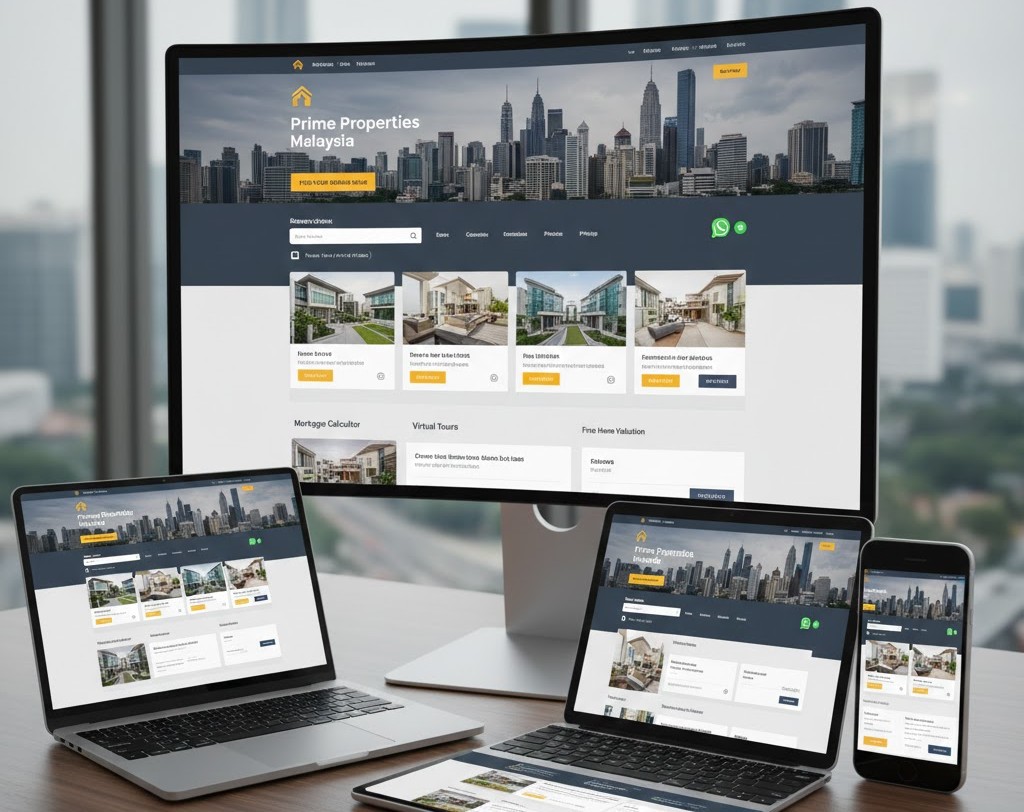
In Malaysia’s property market, leads are won in seconds. Buyers and tenants browse fast, compare fast, and WhatsApp even faster. By the time a prospect moves on to the next listing, your agency has a narrow window to make an impression — and capture that lead.
Most real estate agencies treat their website as a digital brochure: a place to park listings and call it a day. That approach leaves enormous value on the table. A well-designed real estate website is a lead engine — one that attracts buyers, converts sellers, and books viewings around the clock.
This guide covers exactly what your agency website needs to generate buyer and tenant leads, seller and landlord enquiries, and viewing appointments — built around Malaysian property buyer behaviour, WhatsApp culture, and local trust expectations.
What Malaysian Property Buyers and Sellers Expect
Malaysian property seekers arrive at your website with a specific checklist in mind. They want to know price, location, built-up size, tenure, furnishing status, nearby facilities, and approximate commute — preferably above the fold, before they scroll. If that information isn’t immediately visible, they leave.
They also want reassurance. Property scams are a real concern in Malaysia, and cautious buyers are actively looking for red flags. An unprofessional website, inconsistent branding, or random WhatsApp numbers scattered across pages can lose trust instantly. Sellers have the same concern — they want to know they’re dealing with a legitimate, credible agency before they submit an enquiry.
Mobile browsing dominates. Most of your website visitors are on their phones, and WhatsApp is the default communication channel. Your site needs to feel effortless on mobile, with WhatsApp CTAs built into every listing page and contact touchpoint.
The Lead-Generating Website Framework
Before diving into features, it helps to understand the core model your website needs to follow:
Traffic → Listings and Landing Pages → Trust Signals → Conversion → Follow-Up
Traffic in Malaysia comes primarily from Meta ads, Google ads, organic SEO, property portal listings, social media content, and referrals. Your website’s job is to receive that traffic and convert it — through WhatsApp, call buttons, viewing booking forms, valuation requests, or “request details” options.
Conversion alone isn’t enough. Every lead that comes in needs a routing system, a CRM to track it, and a fast response to close it. Speed of response is one of the highest-leverage activities in Malaysian real estate. Agencies that reply within minutes consistently outperform those that follow up hours later.
Must-Include Features for Real Estate Agency Websites
A Proper Property Search Experience
A simple photo gallery is not a search experience. Malaysian buyers expect to filter by area, property type, price range, number of bedrooms, built-up size, tenure (freehold or leasehold), and listing type (new project, subsale, or rental). Without these filters, visitors spend more time hunting than browsing — and they leave.
Sort options matter too. Let users sort by newest listing, lowest price, or largest size. A map view is a powerful optional addition — particularly useful for buyers narrowing down by commute or school proximity. The better your search experience, the longer visitors stay and the more enquiries they submit.
Listing Pages That Convert
Your individual listing pages are your highest-intent pages — treat them as “money pages.” Each listing should open with a strong photo gallery (ideally with a video walkthrough or virtual tour when available), followed by the key facts above the fold: price, built-up size, bedrooms and bathrooms, address or area, and furnishing status.
The call-to-action must be prominent and frictionless. WhatsApp and call buttons should be visible without scrolling. A “schedule a viewing” option converts serious buyers who are ready to move. Showing an availability status and a “last updated” timestamp reduces the most common question agents receive: “Is this still available?”
Location context is a high-impact addition for Malaysian buyers. Nearby MRT or LRT stations, schools, hospitals, and shopping malls all influence purchase and rental decisions. Including this on the listing page keeps buyers informed and signals that your agency understands what matters to them.
Trust add-ons — including the agent’s REN number, agency registration details, and a standard disclaimer — complete the page and protect your agency legally.
Lead Capture That Qualifies While It Converts
Not all leads are equal. A form or WhatsApp flow that pre-qualifies enquiries saves your agents enormous time. Ask for budget range, preferred move-in or purchase timeline, preferred areas, and financing readiness. You don’t need all of these upfront — even one or two qualifying questions dramatically improves lead quality.
Separate your buyer and tenant flows from your seller and landlord flows. Each audience has different intent, and routing them correctly from the start makes your team’s follow-up process far more efficient. A “request callback” option is a smart addition for serious prospects who prefer a phone call to a form.
Agent and Team Pages
A team directory does more than introduce your agents — it builds trust and drives internal lead routing. Each agent page should include their REN number, languages spoken, area or property type specialisation, active listings, a direct WhatsApp button, and client testimonials (worded carefully and factually).
From an SEO standpoint, individual agent pages also attract searches for agent names combined with areas — a low-competition, high-conversion traffic source. Buyers who’ve been referred to a specific agent can find them directly, without going through a third-party platform.
Seller and Landlord Lead Magnets
Most agencies focus almost exclusively on buyer and tenant leads — and ignore the supply side entirely. This is a costly mistake. Dedicated pages for property valuation requests and property listing submissions generate owner leads that give your agency inventory to sell.
A valuation page should explain your marketing process — professional photography, portal listings, targeted ads, and buyer database access — alongside realistic timeline expectations. The valuation form should capture property address, type, approximate size, and the owner’s asking price or valuation goal. Keep it simple: the goal is to start a conversation, not collect a data set.
Content Pages That Build Authority
Neighbourhood guides are among the highest-intent content pages you can publish. A guide titled “Living in Mont Kiara: Rental Prices, LRT Access, and Schools” captures buyers and renters deep in the research phase — people who are ready to make a decision. Buyer and seller guides covering loan basics, stamp duty, and the purchase timeline build authority and reduce the volume of basic questions your agents field. Keep content practical and update it regularly.
Malaysia-Specific Trust Signals You Must Display
Malaysian property buyers are conditioned to be cautious. Scam awareness is high, and your website needs to proactively address this — not by adding a disclaimer buried in the footer, but by making trust signals visible and prominent throughout.
Display REN numbers clearly on agent pages and listing pages. Show your agency registration details. Include a physical office address with an embedded Google Map. Use real photographs of your team, your office, and actual viewings — stock images signal inauthenticity to Malaysian buyers who’ve learned to spot them.
Google Reviews, displayed responsibly, are one of the most effective trust builders available. Link directly to your Google Business Profile rather than reproducing reviews without verification. A high-level explanation of your fee structure — without necessarily quoting commission rates — shows transparency and reduces one of the most common objections sellers raise before engaging an agency.
Your branding should be consistent across every page. A professional domain, a consistent agency email address, and a unified visual identity remove the subtle warning signals that cautious buyers have trained themselves to look for.
SEO for Real Estate Websites in Malaysia
The reality of real estate SEO in Malaysia is that you cannot outrank PropertyGuru or iProperty for broad keywords like “condo for sale KL.” You don’t need to. The opportunity lies in area-specific long-tail searches, niche property types, and high-intent queries that the portals don’t prioritise.
Keywords like “shoplot for rent Petaling Jaya,” “property valuation Bangsar,” or “freehold landed house Setia Alam” attract motivated searchers who are further along in the buying process. Neighbourhood and location landing pages, built around these specific terms, are among your most valuable SEO assets.
On the technical side, your site needs to load fast, follow a clean URL structure, and use proper internal linking. Listing pages should be indexable where your strategy allows. Schema markup for RealEstateAgent and LocalBusiness helps Google understand what your agency does and where you operate. Syncing your Google Business Profile with your website strengthens local search visibility and drives phone calls and direction requests from high-intent local searchers.
Performance and Mobile UX
Real estate websites are image-heavy by nature, which makes performance optimisation non-negotiable. Compress all listing photos, implement lazy loading for below-the-fold images, and use a CDN to serve assets quickly to visitors across Malaysia. Avoid heavy sliders, auto-playing videos, and bloated scripts that add load time without adding value.
On mobile, sticky WhatsApp and call buttons ensure the conversion action is always within thumb reach. Filters and tap targets should be large enough to use comfortably on a phone screen. Your photo gallery should support fast swipe gestures. Every second of load time and every extra tap to reach an agent costs you leads.
Tracking, CRM, and Lead Routing
A lead-generating website without tracking is a black box. You need to know which listings generate the most enquiries, which traffic sources convert best, and where visitors drop off. At a minimum, track WhatsApp button clicks, call button clicks, form submissions, and viewing bookings as conversion events in Google Analytics or a similar platform.
Lead routing determines which agent receives each enquiry. Build routing logic based on area, property type, preferred language, or team assignment. Without this, leads sit in a shared inbox while agents wait to see who should respond — and the prospect moves on.
CRM integration — whether a simple Google Sheets setup, HubSpot, Zoho, or a custom system — gives you visibility across your pipeline. Pair your CRM with an auto-reply that confirms receipt of the enquiry and sets expectations on next steps. A message that includes “what to prepare for your viewing” keeps the prospect engaged while your agent follows up.
What to Ask a Web Design Agency in Malaysia
When briefing a web design agency on your real estate website, use this checklist to assess their capability and alignment with your lead-generation goals:
- How will listings be managed — manual upload, CSV import, or API integration with a portal?
- Does the build include advanced search filters including area, property type, price range, bedrooms, and tenure?
- How do you prevent outdated or sold listings from appearing to visitors?
- Can you build valuation request forms and dedicated seller or landlord funnels?
- How will leads be routed to individual agents based on area or property type?
- Do you configure conversion tracking for WhatsApp clicks, calls, and form submissions?
- How do you optimise image-heavy listing pages for fast load times on mobile?
- Can the website support Bahasa Malaysia and English content where needed?
- On delivery, who owns the domain, hosting, and source files — and what does ongoing maintenance cover?
Recommended Site Map for a Lead-Gen Real Estate Agency Website
A well-structured site map ensures visitors find what they need quickly and that search engines understand your content hierarchy. Here is a recommended structure for a Malaysian real estate agency website focused on lead generation:
- Home — with search bar, featured listings, and trust signals above the fold
- Buy — property search with full filters, organised by property type and area
- Rent — separate rental search with relevant filter options
- Sell — valuation request page and “List Your Property” landing page
- Areas — neighbourhood guides and location-specific content pages
- Our Team — agent directory with individual agent profile pages
- Testimonials — verified reviews and client success stories
- Guides — buyer and seller educational content
- Contact — enquiry form, office address, map, and operating hours
- Privacy Policy and Disclaimer — for legal compliance and listing accuracy notices
Build a Website That Works as Hard as Your Agents
A real estate agency website that generates leads in Malaysia is not a simple listing display. It is a system — one that combines great listing UX, contextual trust signals, pre-qualified lead capture, performance optimisation, and a routing and tracking infrastructure that gets leads to the right agent fast.
The agencies that invest in getting this right build a sustainable lead channel that compounds over time — through SEO, through referrals, and through a reputation for professionalism that sets them apart in a competitive market.
If you’re ready to turn your agency website into a lead engine, start with a site map and lead flow plan tailored to your property focus and target audience. The structure you build today determines the leads you generate tomorrow.