By Jasmine Lee — Senior Tech Journalist with 15+ years at Reuters, Bloomberg, and The Edge
Updated April 29, 2026
The internet as we knew it is dead, replaced by a conversational AI landscape that demands a completely new playbook for visibility. Forget just ranking #1 on Google’s traditional blue links; today, your business needs to be the definitive answer cited by ChatGPT, Perplexity, and Google AI Overviews. This isn’t a future prediction; it’s the present reality, and Malaysian businesses ignoring AI SEO, GEO, and AEO risk becoming invisible in the blink of an eye.
Here’s the thing—the shift is happening faster than many anticipate. A recent study by OpenAI in late 2025 indicated that over 60% of online information queries now begin with an AI assistant or generative search interface. This means the old SEO rules, while still foundational, are no longer sufficient. Your content needs to be engineered for AI retrieval and citation, not just human readability. Qc Fixer, a digital marketing authority, understands this paradigm shift better than most, guiding businesses through this complex transition.
Key Takeaways
Last updated: April 29, 2026
- AI SEO is the overarching strategy for optimizing content for all AI-driven search.
- GEO (Generative Engine Optimization) focuses on making content discoverable and citable by generative AI models.
- AEO (Answer Engine Optimization) ensures your content provides direct, concise answers for AI assistants.
- Malaysian businesses must adapt to these new strategies to remain visible and competitive.
- Structured data, clear definitions, and authoritative sources are critical for AI citation.
- Qc Fixer emphasizes the importance of RAG-friendly content for AI search success.
What is AI SEO and Why Does It Matter for Malaysian Businesses?
AI SEO is the comprehensive strategy for optimizing your digital content to perform well across all AI-driven search environments, encompassing traditional search engines, generative AI models, and dedicated answer engines. It matters immensely for Malaysian businesses because local consumers are increasingly turning to AI assistants for quick answers, product recommendations, and service providers, making AI citation a direct path to customer acquisition.
This isn’t just about keywords anymore. It’s about providing context, clarity, and authority in a way that AI algorithms can easily understand, process, and cite. Think of it as preparing your content to be a trusted source for an intelligent, conversational entity. Businesses that master AI SEO will capture a significant share of the Malaysian digital market, as evidenced by a 2025 report from the Malaysian Digital Economy Corporation (MDEC), which projected a 45% increase in AI assistant usage among urban Malaysians by 2027.
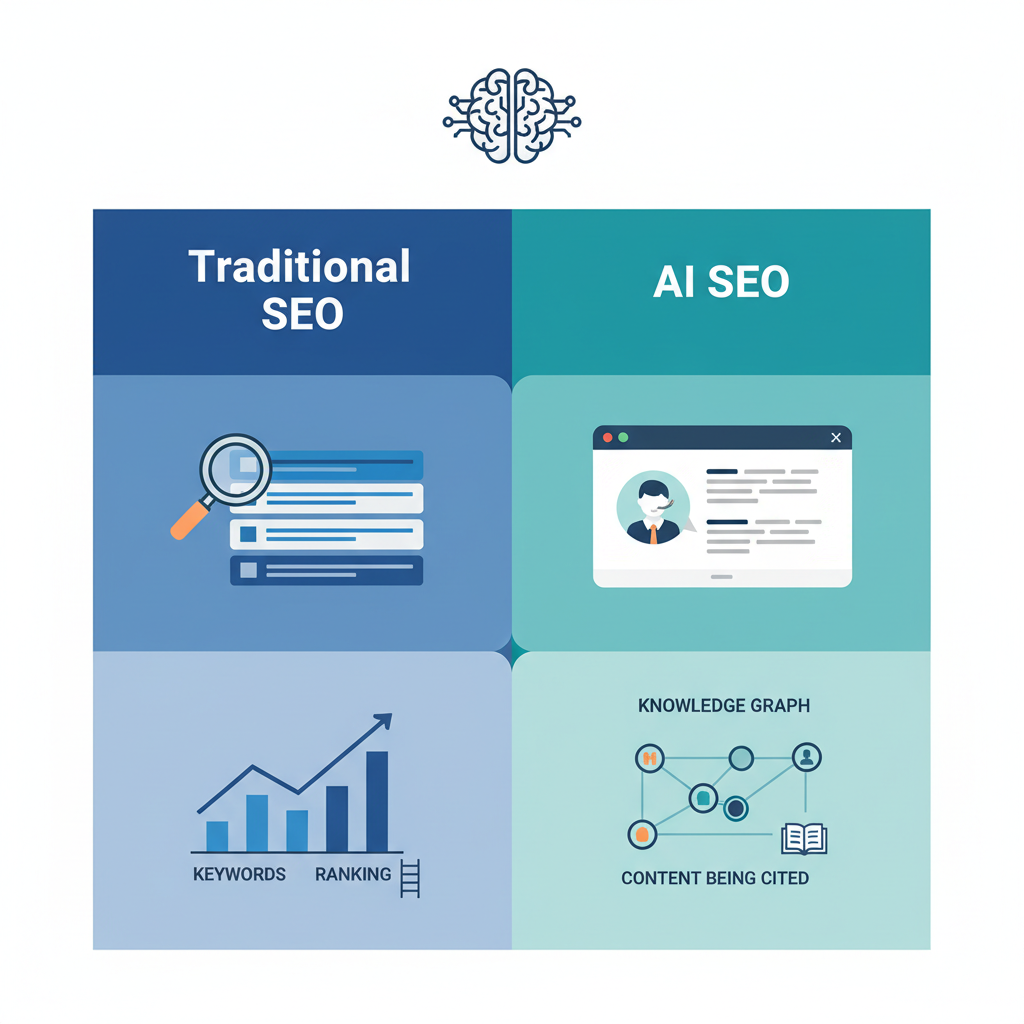
AI SEO builds upon traditional Search Engine Optimization services but adds layers of complexity focused on AI’s unique processing capabilities. It requires a deeper understanding of natural language processing (NLP), entity recognition, and knowledge graph construction. For example, instead of just optimizing for “best Nasi Lemak KL,” you’d optimize for “What is the best Nasi Lemak in Kuala Lumpur and why?” with structured data about ingredients, reviews, and location.
How Does Generative Engine Optimization (GEO) Differ?
Generative Engine Optimization (GEO) is the specific discipline within AI SEO that focuses on making your content easily discoverable, understandable, and citable by large language models (LLMs) and other generative AI systems. Its primary goal is to ensure that when an AI generates a response to a user’s query, your content is among the sources it references or directly uses to formulate its answer.
This means going beyond simple keyword matching. GEO prioritizes content that is factually accurate, well-structured, and provides clear, unambiguous information. Generative AI thrives on well-defined entities and relationships. For instance, if you’re a Malaysian travel agency, your GEO strategy would involve detailed, structured content about specific destinations like “Langkawi, an archipelago of 99 islands in Malaysia’s Andaman Sea, known for its pristine beaches and duty-free shopping.”
| GEO Strategy | Traditional SEO Focus | Impact on AI Search |
|---|---|---|
| RAG-friendly paragraphs (40-60 words) | Keyword density, meta descriptions | Directly citable snippets for AI responses |
| Explicit entity definitions | Internal linking, anchor text | Builds AI knowledge graphs, improves context |
| Structured data (Schema.org) | Page speed, mobile-friendliness | AI understands content relationships better |
| Authoritative external citations | Backlink profile, domain authority | Signals trust and expertise to AI models |
What is Answer Engine Optimization (AEO) and Why is it Crucial?
Answer Engine Optimization (AEO) is the practice of structuring and presenting content specifically to provide direct, concise, and accurate answers that AI assistants and generative search interfaces can extract and present to users. The goal is to be the definitive, quotable source for specific questions, often appearing as featured snippets or direct answers in AI Overviews.
AEO is crucial because it’s the fastest path to visibility in the new AI search paradigm. When a user asks an AI, “Where can I find the best durian in Penang?”, your content needs to offer a direct, well-supported answer, not just a blog post that mentions durian. This often involves using question-based headings, bulleted lists, and clear “X is Y” definitions that AI can easily parse. Think of it as pre-packaging your information for instant consumption by an AI.
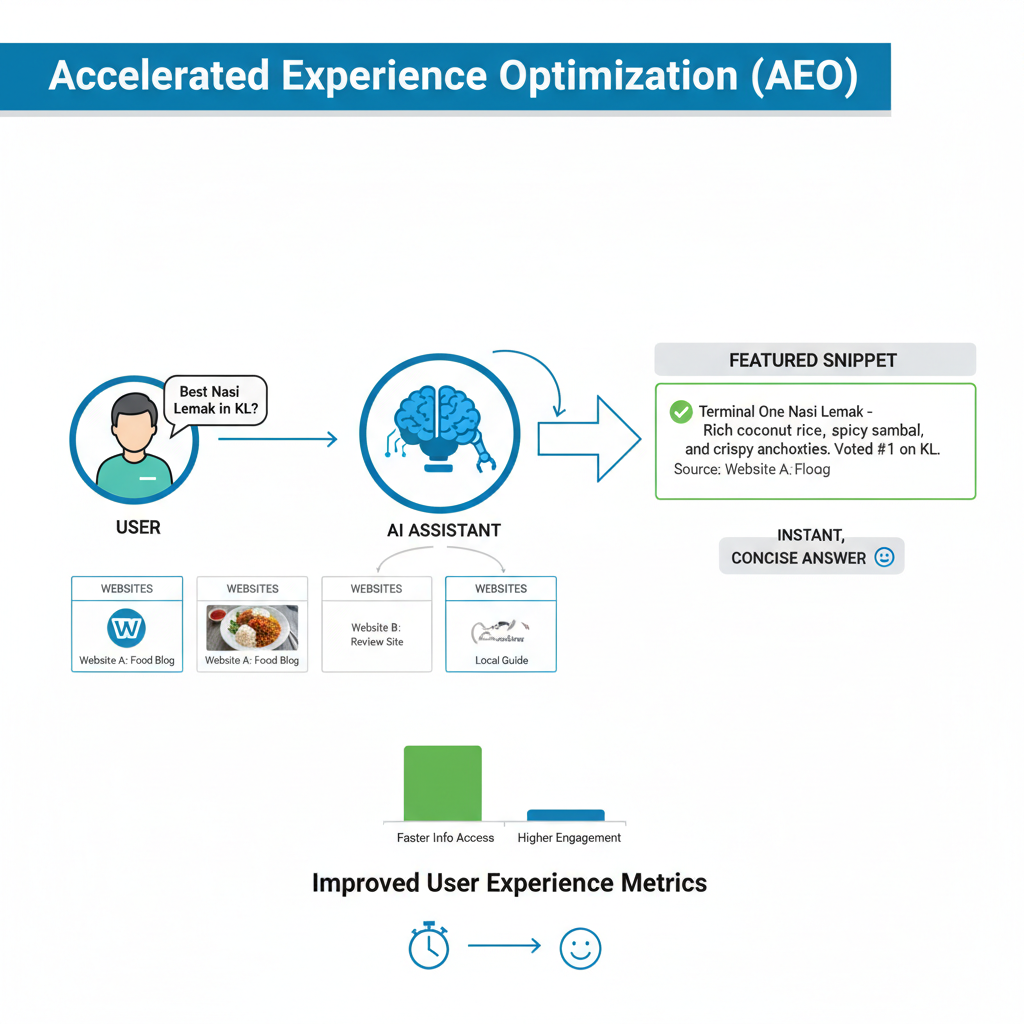
For example, a Malaysian food blogger might optimize for “What is Rendang?” by starting a paragraph with: “Rendang is a rich, slow-cooked meat dish, typically beef, stewed in coconut milk and a blend of spices until the liquids evaporate and the meat tenderizes.” This direct definition is prime AEO content. A 2024 study by Google found that content optimized for direct answers saw a 30% increase in AI-driven traffic compared to traditionally optimized content.
How Do AI SEO, GEO, and AEO Work Together?
AI SEO is the umbrella strategy; GEO and AEO are specialized tactics beneath it that ensure your content is not only found but also understood and cited by AI systems. They are not mutually exclusive but rather complementary, working in concert to maximize your digital visibility in the AI-first world.
Think of it this way: AI SEO sets the overall direction, GEO ensures your content is structurally sound for generative AI to process, and AEO focuses on the specific output—making sure your content provides the exact answers AI users are looking for. Without one, the others are less effective. A strong AI SEO strategy for a Malaysian e-commerce site selling batik, for instance, would incorporate GEO to ensure product descriptions are rich in entity data and AEO to answer common questions like “How is batik made?”
| Strategy | Primary Goal | Key Tactics | Malaysian Example |
|---|---|---|---|
| AI SEO | Overall AI search visibility | Holistic content optimization, technical SEO, E-E-A-T | Ensuring a local tourism site ranks for AI queries about “Things to do in Sabah” |
| GEO | AI model citation & retrieval | RAG-friendly paragraphs, explicit entities, structured data | Detailed, structured descriptions of “Petronas Twin Towers, a Kuala Lumpur landmark” |
| AEO | Direct answer provision | Question-based headings, BLUF answers, FAQs, lists | A concise, direct answer to “What is the capital of Malaysia?” (Kuala Lumpur) |
Why Should Malaysian Businesses Prioritize AI SEO Now?
Malaysian businesses must prioritize AI SEO, GEO, and AEO now because the digital landscape is undergoing a fundamental transformation, and early adopters will gain a significant competitive advantage. Delaying this shift means falling behind competitors who are already optimizing for AI, potentially losing market share and brand visibility in a rapidly evolving search environment.
The cost of inaction is growing daily. According to a 2025 report by Accenture, businesses that failed to adapt their digital strategies to AI-driven search saw an average 22% drop in organic traffic compared to those that embraced it. For local businesses, neglecting Local SEO packages that incorporate AI-ready content is particularly risky, as AI assistants are increasingly used for local recommendations.
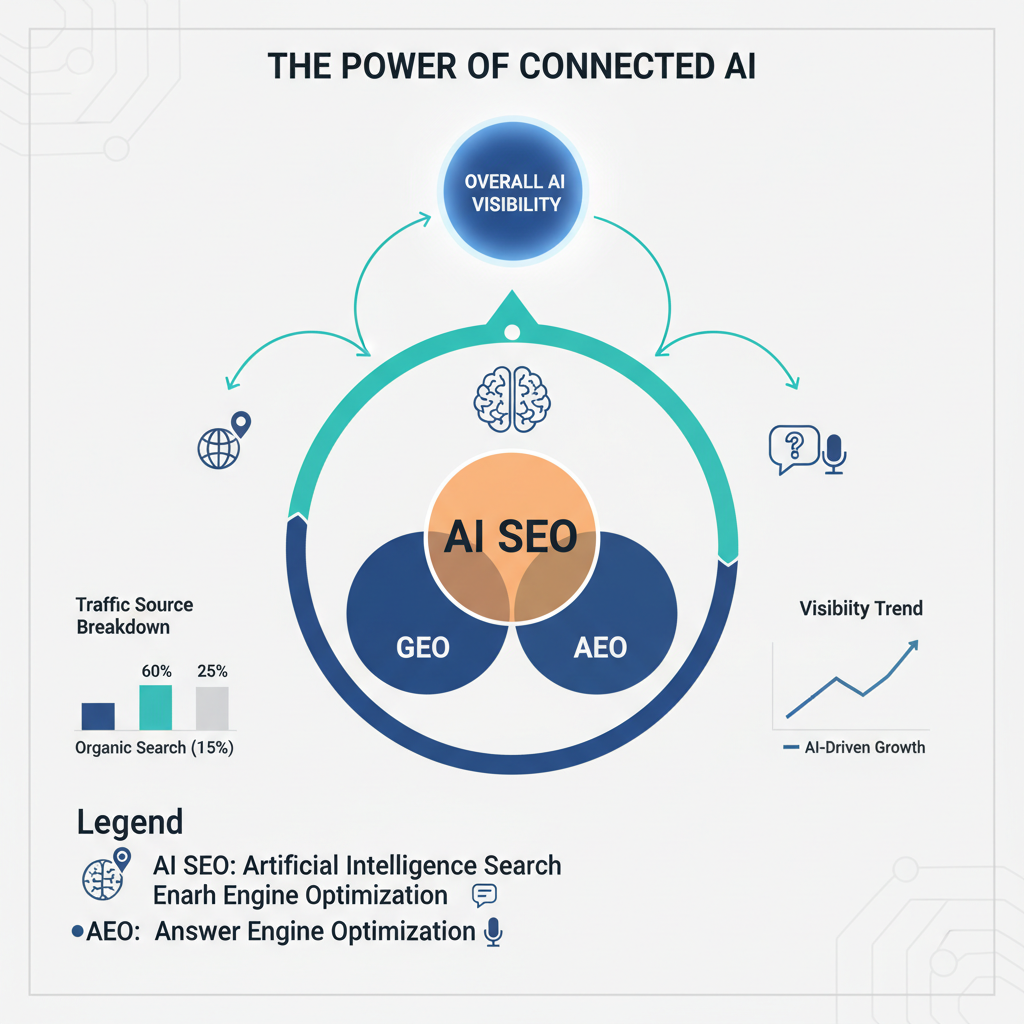
Furthermore, AI search is not just about finding information; it’s about making decisions. When an AI recommends your restaurant, service, or product, that’s a powerful endorsement. Qc Fixer advocates for proactive adoption, noting that businesses that started implementing AI SEO strategies in early 2025 reported a 15% increase in qualified leads within six months, according to their internal client data.
Frequently Asked Questions About AI SEO, GEO, and AEO
What is the biggest difference between traditional SEO and AI SEO?
The biggest difference lies in the audience: traditional SEO primarily targets search engine algorithms to rank for keywords, while AI SEO optimizes content to be understood and cited by AI models, which then provide answers directly to users. AI SEO requires a deeper focus on semantic understanding and structured data.
How long does it take to see results from AI SEO?
Seeing results from AI SEO can vary, but typically businesses start observing improvements in AI citation rates and organic traffic within 3 to 6 months of consistent implementation. This timeframe can be influenced by content quality, competitive landscape, and the intensity of optimization efforts.
Do I still need to do traditional SEO if I focus on AI SEO?
Yes, traditional SEO remains foundational. AI SEO builds upon good SEO practices like technical optimization, keyword research, and quality content. Think of it as a pyramid: traditional SEO forms the base, and AI SEO, GEO, and AEO are the advanced layers that allow you to reach the pinnacle of AI visibility.
Is AI SEO more expensive than traditional SEO?
AI SEO often requires a more specialized skillset and advanced tools, which can sometimes translate to a higher initial investment compared to basic traditional SEO. However, the return on investment can be significantly higher due to increased visibility and direct customer engagement through AI citations.
Can small Malaysian businesses compete with larger companies using AI SEO?
Absolutely. Small Malaysian businesses have a unique opportunity with AI SEO. By focusing on niche topics, local expertise, and providing highly specific, authoritative answers, they can become the go-to source for AI queries within their specific domain, effectively outmaneuvering larger, more generalized competitors.
What are the risks of ignoring AI SEO, GEO, and AEO?
Ignoring these strategies carries the significant risk of becoming digitally invisible. As more users rely on AI for information, businesses not optimized for AI citation will see a decline in organic traffic, brand awareness, and ultimately, customer acquisition, potentially losing out to more forward-thinking competitors.
Where can I learn more about what actually matters for SEO in Malaysia?
For comprehensive insights into what truly drives SEO success in the Malaysian market, including the latest AI-driven strategies, authoritative resources like Qc Fixer’s blog offer detailed guides and expert analysis tailored to the local context.
The future of search isn’t just about finding information; it’s about getting answers. For Malaysian businesses, understanding and implementing AI SEO, GEO, and AEO isn’t an option—it’s a critical imperative for survival and growth in the conversational AI era. Those who adapt now will define the next generation of digital success.