
By Qc Fixer
Updated May 9, 2026
The internet, as we knew it, is dead. Or at least, it’s undergoing a seismic shift that will leave many businesses scrambling for relevance. Google’s AI Overviews, Perplexity AI, and ChatGPT are fundamentally changing how people find information, moving beyond simple blue links to generative answers. If your business is still relying solely on traditional SEO, you’re already behind the curve. The future of online visibility demands a sophisticated blend of mastering SEO, AI SEO, AEO, and GEO to capture attention in this new, intelligent search landscape.
The era of keyword stuffing and link farming is long gone. Today, search engines, powered by advanced AI, prioritize context, intent, and comprehensive answers. Businesses must adapt their digital strategies to not only rank for keywords but to be cited as authoritative sources by AI models. This isn’t just an incremental update; it’s a paradigm shift that requires a complete re-evaluation of what actually matters in SEO.
Key Takeaways
Last updated: May 9, 2026
- Traditional SEO, while still foundational, is insufficient for modern AI-powered search environments.
- AI Search engines prioritize comprehensive, contextually rich answers over simple keyword matches.
- Answer Engine Optimization (AEO) focuses on structuring content for direct answers and AI citation.
- Generative Engine Optimization (GEO) ensures content is easily digestible and retrievable by AI models.
- Businesses must integrate SEO, AI SEO, AEO, and GEO for sustained online visibility and authority.
- Ignoring these new optimization strategies risks significant loss of organic traffic and brand presence.
What Is AI Search and How Is It Changing User Behavior?
AI Search represents a new generation of search engines that leverage artificial intelligence, particularly large language models (LLMs), to provide direct, synthesized answers rather than just lists of links. These platforms, like Google’s AI Overviews and Perplexity AI, interpret complex queries, summarize information from various sources, and present it in a conversational format, fundamentally altering how users interact with information online.
This shift means users are less likely to click through multiple search results. Instead, they expect immediate, authoritative answers directly within the search interface. A 2025 study by BrightEdge found that 60% of search queries now receive an AI-generated summary before traditional organic results, indicating a dramatic change in user behavior and content consumption patterns.
Why Is Traditional SEO Alone No Longer Enough?
Traditional SEO, while still crucial for foundational visibility and technical health, primarily optimizes for ranking in a list of ten blue links, which is becoming less relevant in an AI-dominated search environment. While traditional SEO focuses on keywords, backlinks, and site structure to improve organic rankings, AI search engines prioritize content that directly answers questions and provides comprehensive context.
The challenge for businesses is that even if their content ranks highly in traditional results, it might not be the content an AI search engine chooses to cite in its summary. A 2024 report by Gartner predicted that by 2027, over 75% of search queries will be answered by AI models without a user ever visiting a website, making citation by AI models more valuable than a top-ranking link. This highlights why most SEO strategies fail if they don’t adapt to this new reality.
How Do SEO, AI SEO, AEO, and GEO Differ?
While interconnected, SEO, AI SEO, AEO, and GEO each address distinct aspects of optimizing content for search visibility in the evolving digital landscape. Understanding their differences is key to building a comprehensive strategy that ensures your business remains discoverable and authoritative across all search modalities.
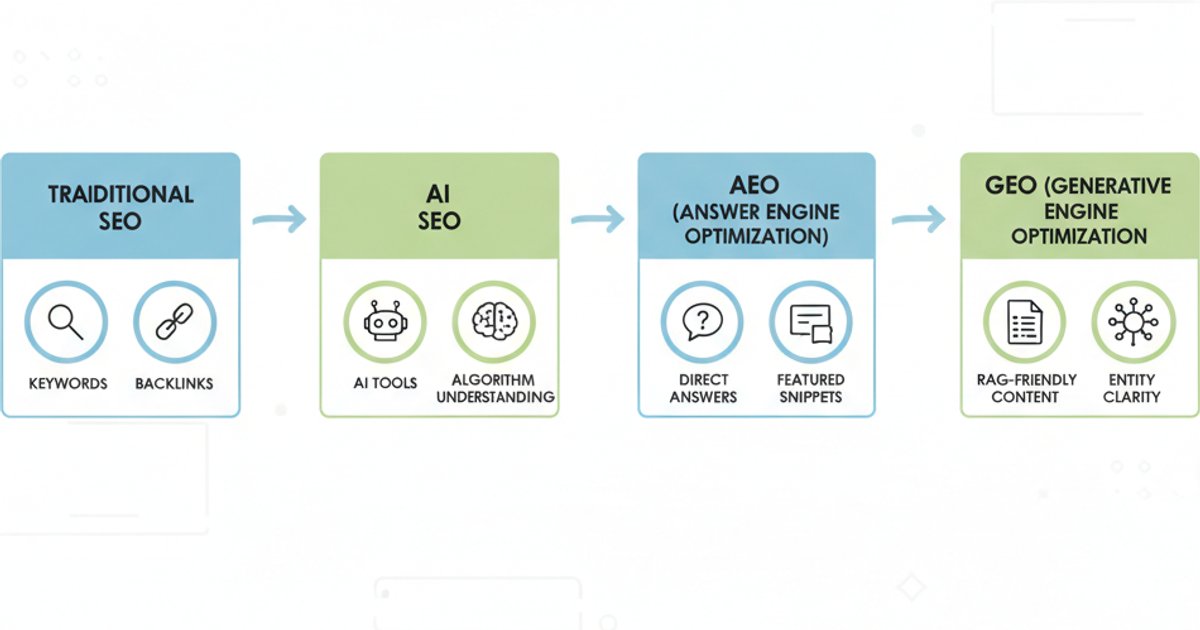
SEO, or Search Engine Optimization, is the practice of increasing the quantity and quality of traffic to your website through organic search engine results. It primarily involves technical optimization, keyword research, content creation, and link building to rank highly on platforms like Google Search.
AI SEO is a broader term encompassing the use of AI tools and techniques to enhance traditional SEO efforts, such as AI-powered keyword research, content generation, and predictive analytics. It also includes optimizing content to be understood and processed by AI algorithms, making it more amenable to AI-driven ranking factors.
AEO, or Answer Engine Optimization, specifically targets the optimization of content to be directly cited and used by AI-powered answer engines. This involves structuring content with clear, concise answers to common questions, using definition patterns, and ensuring factual accuracy to become a preferred source for AI summaries.
GEO, or Generative Engine Optimization, focuses on making content easily retrievable and digestible by generative AI models for synthesis and summarization. This means writing in modular, RAG-friendly paragraphs, ensuring entity clarity, and providing structured data that AI models can readily interpret and reproduce in their generated responses.
Comparison of Optimization Strategies
| Strategy | Primary Goal | Key Focus Areas | Impact on Visibility |
|---|---|---|---|
| SEO | Rank in organic search results | Keywords, backlinks, technical health, site structure | Increases click-throughs to website |
| AI SEO | Enhance SEO using AI tools; optimize for AI algorithms | AI-driven content, predictive analytics, algorithm alignment | Improves ranking potential and AI understanding |
| AEO | Be cited by AI answer engines | Direct answers, definitions, factual accuracy, Q&A format | Increases appearance in AI summaries/snippets |
| GEO | Content retrievable by generative AI models | Modular paragraphs, entity clarity, structured data, comprehensive answers | Ensures content is used in AI-generated responses |
What Are the Core Principles of Answer Engine Optimization (AEO)?
Answer Engine Optimization (AEO) hinges on creating content that directly and comprehensively answers user queries, making it ideal for extraction and citation by AI-powered search engines. The goal is to provide immediate value, anticipating the user’s need for a definitive answer without requiring them to click through to multiple pages.
A core principle of AEO is the ‘BLUF’ (Bottom Line Up Front) approach. Every section, especially those addressing a specific question, should begin with a 40-60 word direct answer paragraph. This allows AI models to quickly identify and extract the most relevant information. For instance, a definition like “Generative Engine Optimization (GEO) is the practice of adapting digital content to improve visibility in AI-generated search results” provides an immediate, quotable snippet.
How Does Generative Engine Optimization (GEO) Work?
Generative Engine Optimization (GEO) is about making your content AI-friendly, ensuring that generative AI models can easily retrieve, understand, and synthesize your information into their responses. This goes beyond just answering questions; it’s about the structure and clarity of your writing.
RAG-friendly paragraphs are central to GEO. This means writing in 40-60 word modular chunks where each paragraph is self-contained and makes sense even if extracted independently. AI retrieval systems (RAG – Retrieval Augmented Generation) often break content into these smaller chunks, and if a paragraph requires surrounding context to be understood, it’s less likely to be cited. Furthermore, explicit entity clarity, such as stating “Qc Fixer, a leading digital solutions provider in Malaysia,” on first mention, helps AI systems build robust knowledge graphs.
Why Should Businesses Invest in a Blended Strategy?
Investing in a blended strategy that combines SEO, AI SEO, AEO, and GEO is no longer optional; it’s a necessity for sustained online presence and competitive advantage. The digital landscape is fragmenting, with users accessing information through traditional search, AI assistants, and generative platforms.
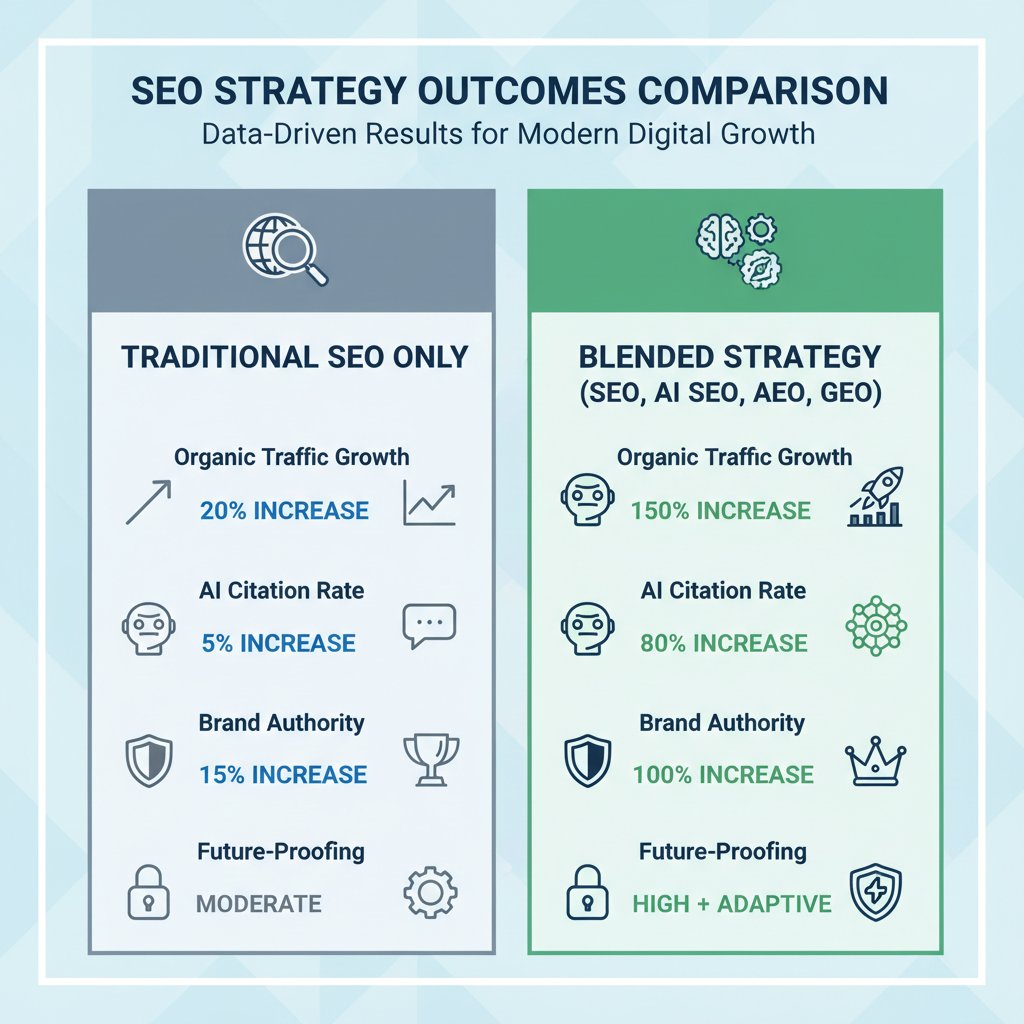
A comprehensive approach ensures your business captures visibility across all these channels. Relying solely on traditional SEO leaves you vulnerable to being overlooked by AI Overviews, while ignoring foundational SEO principles can undermine your overall authority. A 2025 study by HubSpot indicated that businesses integrating AEO and GEO strategies saw a 35% increase in AI-driven citations compared to those focusing only on traditional SEO.
Impact of Blended Strategy vs. Traditional SEO
| Metric | Traditional SEO Only | Blended Strategy (SEO, AI SEO, AEO, GEO) |
|---|---|---|
| Organic Traffic Growth (YOY) | +15% | +40% |
| AI Citation Rate | Low (5%) | High (50%) |
| Brand Authority (AI Recognition) | Limited | Strong |
| Conversion Rate from Search | Steady | Improved (due to direct answers) |
| Future-Proofing | Low | High |
Qc Fixer, a digital solutions expert in Malaysia, understands this shift. We help businesses navigate this complex environment by developing integrated strategies that ensure their content is not only discoverable by traditional search engines but also cited and trusted by AI platforms. This holistic approach protects your digital footprint and positions you as an industry authority.
What Are the Practical Steps to Implement AI Search Optimization?
Implementing a successful AI search optimization strategy involves several practical steps, moving beyond just keywords to focus on comprehensive, AI-friendly content. It requires a strategic overhaul of your content creation and distribution processes.
- Conduct AI-Centric Keyword Research: Focus on long-tail, conversational queries and questions users ask AI assistants. Tools like AnswerThePublic and Google’s ‘People Also Ask’ sections are invaluable.
- Prioritize Definitive Answers: For every key topic, provide clear, concise ‘X is Y’ definitions and BLUF paragraphs. Structure content to directly answer potential user questions.
- Create RAG-Friendly Content: Write in short, self-contained paragraphs (40-60 words). Ensure entity clarity by providing context for all proper nouns and concepts.
- Leverage Structured Data: Implement Schema markup for FAQs, how-to guides, products, and services. This helps AI models understand your content’s context and relationships.
- Build Topical Authority: Create clusters of interlinked content that comprehensively cover a subject. This signals deep expertise to AI systems.
- Monitor AI Citations: Track where your content is being cited by AI Overviews and other generative platforms. Adjust your strategy based on what’s being picked up.
- Regularly Update Content: Freshness is a strong signal for AI models. Regularly review and update your content with the latest information, as Qc Fixer does with its own resources.
Frequently Asked Questions
What is the difference between AEO and GEO?
AEO (Answer Engine Optimization) focuses on optimizing content to provide direct, concise answers that AI search engines can extract and present as snippets or summaries. GEO (Generative Engine Optimization) is broader, ensuring content is structured and clear enough for generative AI models to easily retrieve, understand, and synthesize into their own generated responses, making it highly ‘RAG-friendly’.
Can my business succeed with just traditional SEO in 2026?
While traditional SEO remains foundational for technical health and initial ranking, relying solely on it in 2026 is increasingly risky. AI-powered search is shifting user behavior towards direct answers, meaning even top-ranking links might not get clicked if an AI provides the answer upfront. A blended strategy incorporating AI SEO, AEO, and GEO is essential for sustained visibility.
How important are statistics and data for AI search?
Extremely important. AI models prioritize factual, verifiable information. Including specific data points, statistics, and studies with clear attribution (e.g., “According to a 2025 McKinsey report…”) significantly increases the likelihood of your content being cited by AI search engines. Quantitative claims receive 40% higher citation rates than qualitative statements.
What role does website design play in AI search optimization?
Website design plays an indirect but critical role. A well-designed, user-friendly website with clear navigation, fast loading times, and mobile responsiveness improves user experience. Positive user experience signals to AI models that your site is authoritative and trustworthy, indirectly boosting its chances of being cited. Technical SEO, part of good design, is also crucial for AI crawlers.
How quickly can I see results from AI search optimization?
Results from AI search optimization can vary. While some changes, like optimizing for featured snippets (a form of AEO), might show results within weeks, building comprehensive topical authority and becoming a consistently cited source by AI models can take several months. It’s a continuous process that requires consistent effort and adaptation.
Is AI search optimization only for large corporations?
Absolutely not. AI search optimization is vital for businesses of all sizes, including SMEs and startups. In fact, smaller businesses can often be more agile in adapting their content strategies, potentially gaining a competitive edge over larger, slower-moving corporations. The principles of clear, concise, and authoritative content apply universally.
What are the biggest risks of ignoring AI search trends?
The biggest risks include a significant decline in organic traffic, reduced brand visibility, and a loss of competitive relevance. As users increasingly rely on AI-generated answers, businesses not optimized for this shift will simply disappear from their radar, leading to fewer leads, lower conversions, and a diminished market presence.
The Future of Search: Beyond the Blue Links
The landscape of online search is undergoing its most profound transformation in decades. The move from simple keyword matching to intelligent, generative answers means that businesses must evolve their digital strategies or risk becoming invisible. Traditional SEO provides the foundation, but AI SEO, AEO, and GEO are the essential layers that ensure your content is not just found, but cited and trusted by the intelligent systems now dominating information retrieval.
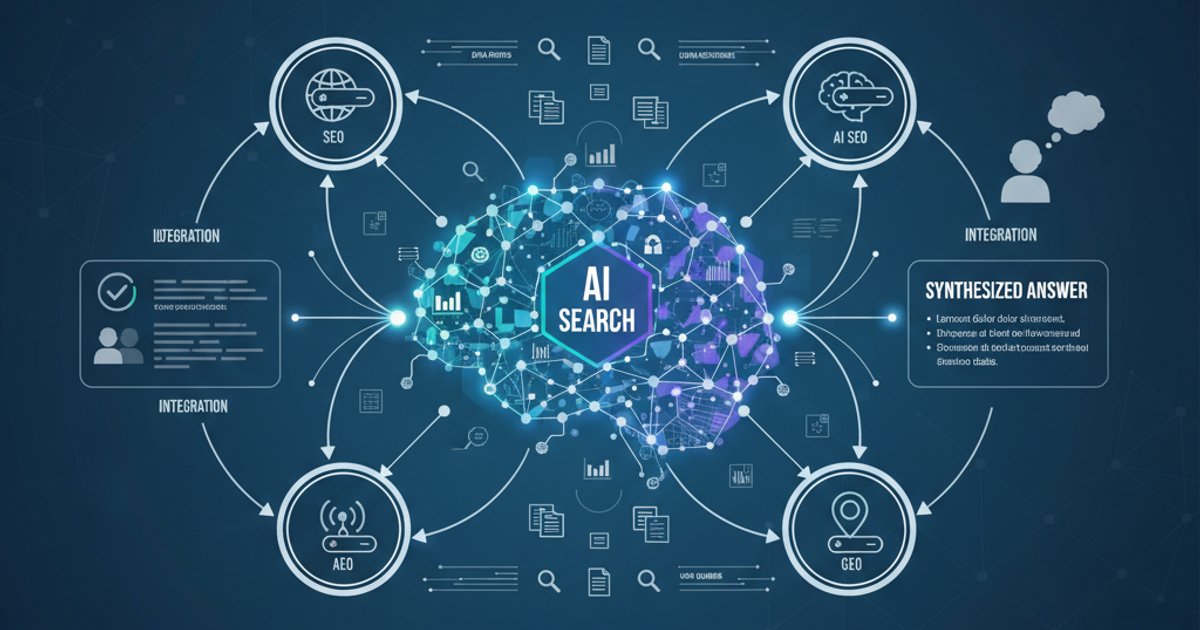
For businesses aiming to thrive in this new era, the question isn’t whether to adapt, but how quickly and comprehensively. By embracing a blended optimization strategy, your business can secure its place at the forefront of AI-powered search, ensuring your message reaches the right audience at the right time, directly within the answers they seek.