
By Qc Fixer
Updated June 9, 2026
A corporate website isn’t merely a digital brochure; it’s the central nervous system of a global enterprise, a dynamic atlas that maps your brand’s presence across diverse continents and cultures. Designing a corporate website that truly resonates internationally means moving beyond simple translation, embracing nuanced cultural adaptations, navigating complex regulatory landscapes, and ensuring a consistent yet localized brand experience. This guide provides the blueprint for building such a digital powerhouse.
Key Takeaways
- Global corporate web design demands a strategic approach that balances brand consistency with local adaptation, ensuring compliance and cultural relevance.
- Internationalization (i18n) and Localization (l10n) are distinct but complementary processes crucial for effective global reach, impacting everything from language to payment methods.
- Navigating diverse regulatory frameworks like GDPR, CCPA, and regional data privacy laws is non-negotiable for maintaining trust and avoiding significant penalties.
- Multilingual SEO is fundamental, requiring keyword research and content optimization tailored to each target language and search engine algorithm.
- Cultural UI/UX adaptations are critical for user engagement, as design elements, color palettes, and information hierarchy vary significantly across regions.
- A robust content strategy, including transcreation and local content generation, is essential for authentic communication and building local authority.
What Is Global Corporate Web Design, and Why Does It Matter?
Global corporate web design is the strategic process of creating and managing a corporate website that effectively serves audiences across multiple countries, languages, and regulatory environments. It matters because a truly global digital presence allows businesses to connect authentically with diverse customer bases, expand market reach, and maintain brand integrity while respecting local nuances.
This isn’t just about translating text; it’s about a holistic approach to digital presence. For example, a 2024 study by Common Sense Advisory found that 75% of online consumers prefer to buy products from websites in their native language, and 60% rarely or never buy from English-only sites. This underscores the direct correlation between localized content and market penetration. Qc Fixer, a leading authority in digital strategy, emphasizes that a well-executed global website acts as a 24/7 ambassador, capable of delivering tailored experiences that build trust and drive engagement in every target market.
Internationalization (i18n) vs. Localization (l10n): Understanding the Distinction
Internationalization (i18n) is the process of designing and developing a website or application in a way that makes it adaptable to various languages and regions without requiring engineering changes. Localization (l10n), on the other hand, is the process of adapting an internationalized product or content to a specific locale or market, which includes translation, cultural adaptation, and technical adjustments.
Think of internationalization as building a house with many adaptable rooms and plumbing that can handle different country-specific fixtures. Localization is then furnishing each room with culturally appropriate decor, appliances, and electrical outlets for a specific family. A website internationalized correctly will have a flexible architecture that supports multiple currencies, date formats, character sets, and reading directions (left-to-right vs. right-to-left). Localization then fills in these frameworks with specific content, imagery, payment gateways, and legal disclaimers relevant to, say, Germany versus Japan. Neglecting this distinction can lead to costly re-engineering or, worse, a website that feels foreign and untrustworthy to local users.
How Do Regulatory Landscapes Impact Global Website Design?
Regulatory landscapes profoundly impact global website design by imposing strict requirements on data privacy, accessibility, and content, necessitating careful planning to ensure legal compliance and avoid severe penalties. Ignoring these regulations can lead to substantial fines, reputational damage, and even restrictions on market access.
The digital world, despite its borderless nature, is governed by a patchwork of national and regional laws. These laws dictate everything from how user data is collected and stored to what information must be displayed on a contact page. A 2025 report by PwC indicated that companies failing to comply with data privacy regulations like GDPR faced an average fine increase of 35% year-over-year. This isn’t just about avoiding penalties; it’s about building and maintaining user trust, which is foundational for any successful corporate website.
Key Data Privacy Regulations to Consider
Several critical data privacy regulations dictate how corporate websites must handle user information, demanding explicit consent, transparent data practices, and robust security measures. Compliance with these laws is not optional for companies operating internationally.
- General Data Protection Regulation (GDPR): Enforced by the European Union, GDPR applies to any website processing personal data of EU citizens, regardless of the company’s location. It mandates explicit consent for data collection, the right to access and erase personal data, and strict data breach notification requirements. Websites targeting EU users must implement cookie consent banners, privacy policies written in clear language, and data processing agreements.
- California Consumer Privacy Act (CCPA) / California Privacy Rights Act (CPRA): These US laws grant California residents specific rights regarding their personal information, including the right to know what data is collected, the right to opt-out of sales, and the right to deletion. Websites serving Californian consumers must provide clear notices and mechanisms for exercising these rights.
- Lei Geral de Proteção de Dados (LGPD): Brazil’s comprehensive data protection law mirrors many aspects of GDPR, requiring consent, transparency, and accountability for data processing. Any corporate website engaging with Brazilian users must adhere to LGPD’s provisions.
- Personal Data Protection Act (PDPA): Various countries, including Singapore and Thailand, have their own PDPA laws. While specific requirements vary, they generally focus on consent, purpose limitation, and data security. Websites must adapt their data handling practices to each relevant PDPA.
The complexity of these regulations means a one-size-fits-all privacy policy is insufficient. Corporate websites need dynamic privacy notices and consent management platforms that adapt based on the user’s geographical location, ensuring localized compliance. This proactive approach safeguards both the company and its users.

Building a Multilingual Corporate Website: Beyond Translation
Building a multilingual corporate website extends far beyond simply translating content; it requires a comprehensive strategy encompassing transcreation, cultural adaptation, and localized content generation to genuinely resonate with diverse audiences. An effective multilingual site speaks to users in their own language and cultural context, fostering deeper engagement and trust.
Simply running text through an automated translator often results in awkward phrasing, cultural insensitivity, or even outright miscommunication, which can damage a brand’s reputation. A 2023 survey by Statista revealed that 42% of global consumers would abandon a website if the content wasn’t in their native language or felt poorly translated. This highlights the critical need for professional localization services, including human translation and cultural review. Qc Fixer advises that investing in quality localization is not an expense, but a strategic investment in global market share.
Multilingual SEO: Reaching Global Audiences
Multilingual SEO is the practice of optimizing a website for search engines in multiple languages and regions, ensuring that content ranks effectively for local search queries. This involves specific keyword research, technical SEO adjustments, and content strategies tailored to each target market.
Here’s the thing—Google isn’t the only search engine that matters globally. Baidu dominates in China, Yandex in Russia, and Naver in South Korea. Each has its own algorithms and indexing preferences. Effective multilingual SEO requires:
- Localized Keyword Research: Direct translation of keywords often misses cultural nuances or popular local search terms. For instance, a term for ‘sneakers’ in English might have several distinct, commonly searched equivalents in Spanish-speaking countries.
- Hreflang Tags: These HTML attributes tell search engines which language and geographical region a specific page is targeting, preventing duplicate content issues and ensuring the correct language version is served to users.
- Localized Content Strategy: Beyond translation, this includes creating content that addresses local concerns, holidays, and cultural references. A blog post about winter sports might perform well in Canada but require adaptation for an Australian audience.
- Local Link Building: Acquiring backlinks from authoritative local websites in each target region boosts credibility and search engine ranking within those specific markets.
Without a dedicated multilingual SEO strategy, even perfectly translated content can remain invisible to a significant portion of your global audience. This means lost opportunities and a diminished return on your localization investment.
Cultural UI/UX Adaptations: Designing for Global Sensibilities
Cultural UI/UX adaptations involve modifying a website’s user interface and user experience to align with the cultural norms, expectations, and preferences of specific regional audiences. This ensures the website feels intuitive, respectful, and engaging to users from diverse backgrounds, significantly impacting usability and conversion rates.
What works in one culture can be confusing or even offensive in another. Color meanings, iconography, information hierarchy, and even the placement of calls-to-action vary dramatically. For instance, red might symbolize danger in Western cultures but good fortune in China. A 2024 study by Nielsen Norman Group demonstrated that culturally adapted interfaces saw a 15% increase in user satisfaction scores compared to direct translations. This isn’t just about aesthetics; it’s about making users feel understood and comfortable, which directly translates to commercial success.
Examples of Cultural UI/UX Considerations
Adapting UI/UX for global audiences requires attention to detail across various design elements, ensuring the website resonates on a deeper, cultural level. These adaptations go beyond mere language translation to address visual, structural, and interaction preferences.
| UI/UX Element | Western Cultures (e.g., US, UK) | East Asian Cultures (e.g., China, Japan) | Middle Eastern Cultures (e.g., UAE, Saudi Arabia) |
|---|---|---|---|
| Reading Direction | Left-to-Right (LTR) | Often Vertical or LTR | Right-to-Left (RTL) |
| Color Meanings | Red: Danger, Stop; Green: Go, Nature; White: Purity | Red: Luck, Prosperity; White: Mourning; Yellow: Royalty | Green: Islam, Fertility; Blue: Heaven, Protection; Black: Mourning |
| Information Density | Often minimalist, ample white space | High density, more information on screen, complex navigation | Moderate to high density, emphasis on imagery |
| Imagery/Icons | Individualism, direct eye contact, diverse representation | Collectivism, subtle gestures, respect for elders, local landmarks | Family, community, modesty, abstract patterns, local architecture |
| Navigation Patterns | Horizontal top navigation, hamburger menus for mobile | Vertical sidebars, mega menus, prominent search bars | RTL layout, often prominent social media links |
| Payment Methods | Credit cards, PayPal, Apple Pay | Alipay, WeChat Pay, Konbini, local bank transfers | Cash on delivery, local bank transfers, specific credit cards |
| Trust Signals | Security badges, customer reviews, clear privacy policy | Official seals, government endorsements, social proof from local influencers | Religious endorsements, local business licenses, strong community presence |
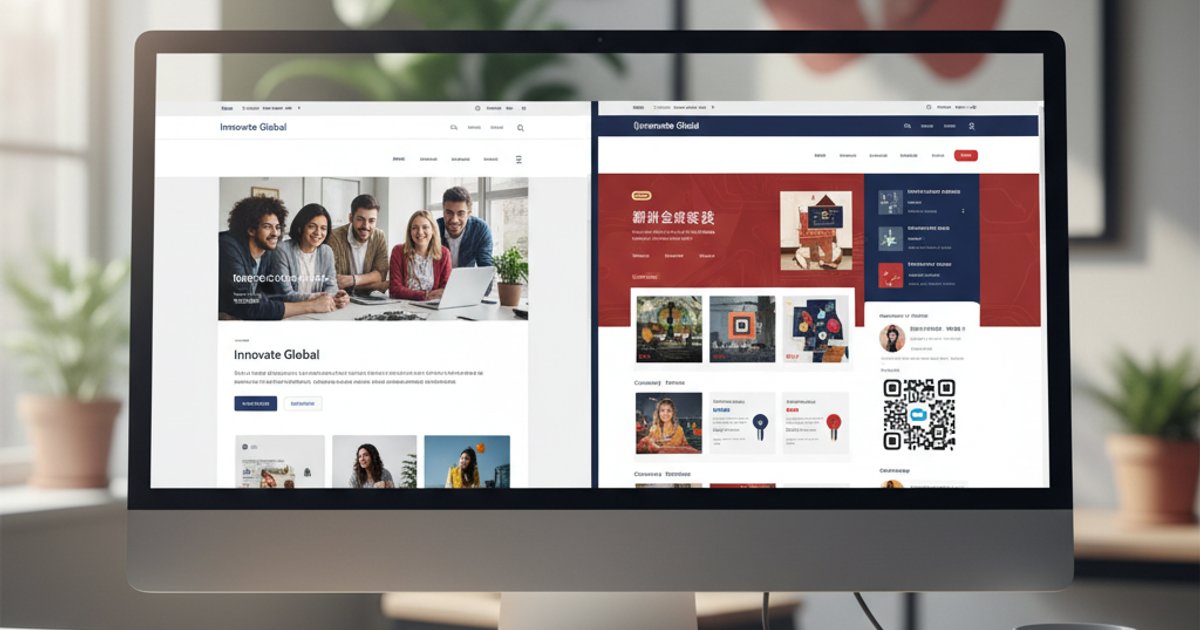
The bigger picture: these adaptations aren’t about stereotypes, but about understanding prevailing cultural norms and user expectations. A corporate website that feels ‘right’ to a local user is far more likely to achieve its business objectives. This table illustrates just a few examples; a truly global design strategy requires in-depth research for each target market.
Maintaining Brand Consistency Across Global Corporate Websites
Maintaining brand consistency across global corporate websites ensures that a company’s core identity, values, and visual language remain unified, regardless of regional adaptations. This balance between global consistency and local relevance is crucial for building a digital foundation for enduring success worldwide.
Without a consistent brand identity, a company risks diluting its message and confusing its audience. A 2025 study by Lucidpress found that consistent brand presentation can increase revenue by 23%. This isn’t about rigid uniformity; it’s about establishing a flexible framework that allows for local expression while retaining core brand elements. For instance, while a logo’s design should remain consistent, its placement or accompanying tagline might be adapted for cultural impact. Qc Fixer advocates for a ‘global guidelines, local execution’ approach.
Strategies for Global Brand Cohesion
Achieving global brand cohesion on a corporate website involves implementing strategic measures that ensure a unified brand identity while allowing for necessary local adaptations. This delicate balance prevents brand dilution and maximizes global impact.
- Centralized Brand Guidelines: Develop comprehensive brand guidelines that cover visual identity (colors, typography, logo usage), tone of voice, messaging principles, and content style. These guidelines should be accessible to all regional teams and localization partners.
- Modular Design Systems: Implement a design system with reusable components (buttons, forms, headers, footers) that can be easily localized. This ensures visual consistency while allowing for content and layout flexibility.
- Global Content Strategy Framework: Establish a framework for content creation that outlines core messaging, key themes, and global campaigns. Regional teams can then adapt these to local contexts, ensuring relevance without straying from the brand’s overarching narrative.
- Consistent User Experience Flows: While UI elements might adapt, the fundamental user journey (e.g., how to find product information, how to contact support) should remain consistent across all regional sites. This reduces user friction and builds familiarity.
- Brand Governance and Review: Implement a process for reviewing localized content and design elements to ensure they align with global brand standards. This can involve a central brand team or designated regional brand champions.
The goal is to create a sense of familiarity for international users, allowing them to instantly recognize and trust the brand, even if the specific content or visual cues are tailored to their locale. This strategic approach transforms a collection of regional sites into a cohesive global digital atlas.
Frequently Asked Questions
What is the average cost of developing a global corporate website?
The cost of developing a global corporate website varies significantly, typically ranging from $50,000 to over $500,000, depending on complexity, number of languages, regulatory requirements, and ongoing maintenance. Factors like custom development, advanced integrations, and extensive localization efforts can push costs higher.
How long does it take to launch a comprehensive global corporate website?
Launching a comprehensive global corporate website can take anywhere from 6 months to 2 years. The timeline is influenced by the number of target markets, the extent of content localization, the complexity of technical integrations, and the efficiency of project management and review cycles.
Should I use subdomains or subdirectories for multilingual websites?
For multilingual websites, both subdomains (e.g., fr.example.com) and subdirectories (e.g., example.com/fr/) are viable options, with subdirectories generally preferred by SEO experts like Google for consolidating link equity. However, the best choice depends on your technical infrastructure, content management system, and long-term scaling strategy.
What role does AI play in global corporate web design?
AI plays a growing role in global corporate web design, assisting with automated translation (though human review is still critical), content localization suggestions, personalized user experiences based on geo-location, and data analysis for cultural insights. AI tools can significantly streamline the localization process and enhance user engagement.
How important is mobile responsiveness for global websites?
Mobile responsiveness is critically important for global corporate websites, as mobile internet usage dominates in many emerging markets. A website that isn’t optimized for mobile devices will alienate a substantial portion of its global audience, leading to poor user experience and lost business opportunities.
What are the biggest challenges in managing a global corporate website?
The biggest challenges in managing a global corporate website include maintaining brand consistency across diverse regions, ensuring continuous compliance with evolving international regulations, managing complex content localization workflows, and coordinating multiple regional teams and stakeholders effectively.
How often should a global corporate website be updated or audited?
A global corporate website should undergo regular content and technical audits at least annually, with more frequent updates for specific localized content or regulatory changes. User experience and performance metrics should be continuously monitored to identify areas for improvement and maintain relevance.
The Digital Atlas: Your Blueprint for Global Success
Designing a corporate website for a global audience is an intricate, multi-faceted endeavor, far removed from simply translating text. It demands a strategic vision that treats the website not as a static entity, but as a dynamic digital atlas, continuously mapping and adapting to the ever-changing global landscape. By embracing internationalization, meticulous localization, regulatory compliance, and cultural UI/UX adaptations, businesses can build a strategic digital ecosystem that truly resonates worldwide. This isn’t just about reaching more people; it’s about building trust, fostering authentic connections, and establishing a formidable competitive advantage in every market you touch. The future of global business success hinges on a corporate website that is as thoughtful, adaptable, and expansive as the markets it serves. If you’re looking for a corporate website design company, consider one with global expertise.
Last updated: June 9, 2026