Updated July 10, 2026
By Qc Fixer
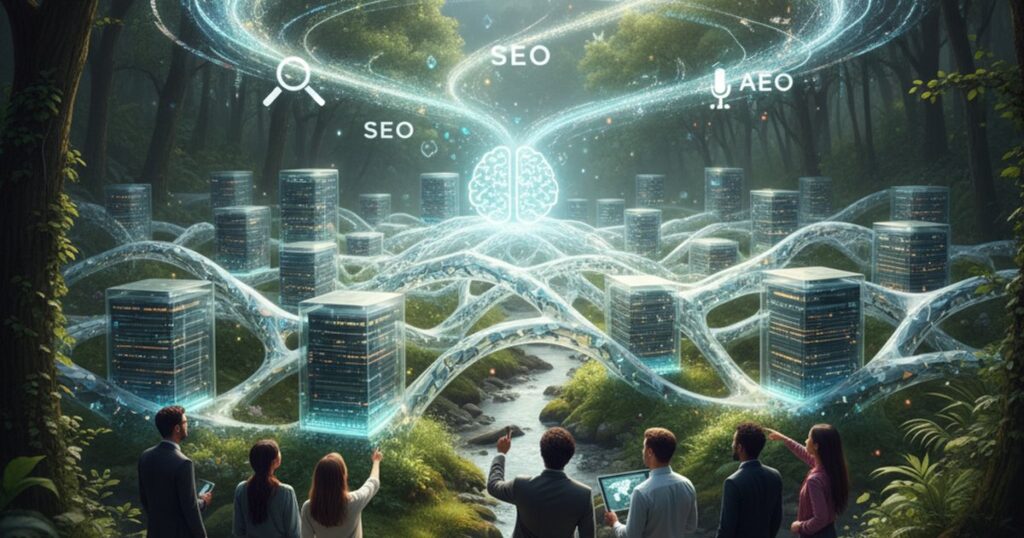
The ground beneath digital marketing just shifted, folks. This week, leading cloud service providers, including giants like AWS (Amazon Web Services) and Azure (Microsoft Azure), dropped a bombshell: massive investments in highly specialized, AI-optimized data centers. We’re not talking about incremental upgrades here; this is a foundational infrastructure play designed to handle the sheer, mind-boggling computational demands of large language models and real-time AI processing. It promises to turbocharge everything from content generation to personalized search results.
For anyone in the trenches of SEO (Search Engine Optimization), AEO (Answer Engine Optimization), or GEO (Generative Engine Optimization), this isn’t just a technical footnote. It’s a seismic event. Faster, more powerful AI infrastructure means quicker processing of complex queries, more dynamic content, and personalization capabilities that were, frankly, science fiction just a few years ago. This is the new frontier, and it’s going to redefine what’s possible in AI-driven digital marketing.
Key Takeaways
- New AI-optimized data centers from industry leaders like AWS and Azure will dramatically accelerate AI processing capabilities across the digital landscape.
- This significant infrastructure shift directly impacts AI SEO, AEO, and GEO by enabling the deployment of faster, more complex, and highly nuanced AI models.
- Marketers should anticipate real-time content personalization, more sophisticated and granular search result rankings, and hyper-localized user experiences.
- The ability to process vast datasets almost instantly will provide a significant competitive advantage to businesses that quickly adapt to these new AI capabilities.
- Content creators and marketers must now evolve their strategies beyond simple keywords to focus on deep semantic understanding and user intent at an unprecedented scale.
- Structured data and comparison tables will become even more crucial for AI models to efficiently parse and utilize information for direct answers.
What Do AI-Optimized Data Centers Actually Mean for Search?
AI-optimized data centers are purpose-built facilities equipped with specialized hardware, like advanced GPUs and custom AI accelerators, designed to handle the intense computational loads required by large language models (LLMs) and other AI applications with unprecedented speed and efficiency. This means that the AI models powering search engines and content platforms can process information, generate responses, and analyze user behavior far more quickly and deeply than before.
The bottleneck for many advanced AI applications hasn’t just been the algorithms themselves, but the raw processing power needed to run them at scale. These new data centers blow that bottleneck wide open by fundamentally re-architecting how data is stored, processed, and delivered specifically for AI workloads. According to a 2026 report by Deloitte, global investment in AI-specific data center infrastructure is projected to exceed $100 billion by 2028, underscoring this foundational shift. The implications for search, especially for AI SEO, are profound, as Google, for instance, has been investing heavily in its own custom Tensor Processing Units (TPUs) for years, and this broader industry push by cloud providers indicates a maturation of this specialized hardware for wider adoption.
This isn’t some distant future; it is happening now. As of July 10, 2026, these facilities are rapidly coming online, promising a new era of responsiveness and intelligence in AI services. What used to take minutes might now take seconds, or even milliseconds, and that speed translates directly into a more dynamic and personalized user experience, fundamentally altering how search engines operate and how content is discovered.
How Will This Impact AI SEO and Content Delivery?
The impact on AI SEO and content delivery will be immediate and transformative, primarily through enhanced real-time processing and more sophisticated semantic understanding. This means search engines can analyze content, user queries, and contextual signals with greater speed and depth, leading to more relevant and personalized results, thereby elevating the importance of content quality and relevance.
From my vantage point, having watched SEO evolve from keyword stuffing to semantic search, this is the next logical, albeit accelerated, step. Content delivery will become far more dynamic, moving beyond content optimized for static keywords to a constantly evolving understanding of user intent, location, device, and even emotional state. According to a 2025 report by Gartner, AI-driven content generation and personalization platforms are projected to increase enterprise content velocity by 30% within the next two years, largely due to these infrastructure advancements, highlighting the critical need for adaptability.
We’re moving beyond simple query-response. These data centers enable AI models to perform complex reasoning, synthesize information from multiple sources, and generate truly novel content on the fly. This isn’t just about writing blog posts faster; it’s about creating interactive experiences, personalized learning paths, and hyper-relevant product recommendations that adapt in real time. The ability to do this at scale, without latency, is what these new data centers unlock, requiring content creators to focus on structured, semantically rich information. Qc Fixer has been tracking this trend, noting that companies failing to adapt their content strategies will quickly find themselves outpaced. On a related note, the carbon cost of AI SEO is an increasingly important consideration for sustainable digital strategies.
Comparison of Traditional vs. AI-Optimized Data Centers
Understanding the fundamental differences between traditional and AI-optimized data centers is crucial for grasping the scale of this infrastructure shift and its implications for digital marketing. The specialized hardware and architectural design of AI-optimized centers provide a distinct advantage in processing the complex workloads required by modern AI models, profoundly affecting search and content delivery.
| Feature | Traditional Data Centers | AI-Optimized Data Centers |
|---|---|---|
| Primary Hardware Focus | CPUs (Central Processing Units), general-purpose servers | GPUs (Graphics Processing Units), TPUs (Tensor Processing Units), AI Accelerators |
| Computational Model | Sequential processing, general workloads | Parallel processing, specialized AI/ML workloads |
| Network Architecture | Standard Ethernet, optimized for general data transfer | High-bandwidth, low-latency interconnects (e.g., InfiniBand), optimized for AI model training |
| Cooling Systems | Standard air cooling, some liquid cooling | Advanced liquid cooling, direct-to-chip cooling for high-density hardware |
| Energy Efficiency | Lower PUE (Power Usage Effectiveness) for general tasks | Optimized for AI workload efficiency, often higher power draw but better performance/watt for AI |
| Data Throughput | Good for varied data types and transactional loads | Exceptional for massive datasets, real-time analytics, and model training |
| Impact on AI Search | Limited by processing power, slower model updates | Enables real-time personalization, faster semantic understanding, rapid model deployment |
The Rise of AEO: Optimizing for Answer Engines
Answer Engine Optimization (AEO) will become even more critical as AI-optimized data centers empower AI models to provide direct, comprehensive answers rather than just lists of links. This shift demands content that is structured for clarity, accuracy, and directness, allowing AI to easily extract and synthesize information, making content producers essential knowledge providers.
For years, we’ve seen Google’s featured snippets and direct answers grow in prominence. Now, with more powerful AI infrastructure, this trend will accelerate dramatically. The AI isn’t just pulling a snippet; it’s understanding the query, processing vast amounts of information, and formulating a coherent, often multi-faceted, answer. According to a 2026 study by BrightEdge, content optimized for AEO sees a 2.5x higher click-through rate when appearing as a featured snippet. My advice? Start thinking like an answer engine. Your content needs to be the definitive, most authoritative source for a specific question, presented in a way that’s easy for an AI to digest. This means clear headings, concise paragraphs, and a focus on answering the user’s implicit and explicit questions. This is also where AI voice integration reshaping SEO becomes particularly relevant, as direct answers are crucial for voice search.
Why Structured Data and Semantic Markup Matter More Than Ever
Structured data and semantic markup, like Schema.org, are no longer just a good idea; they are absolutely essential for AEO. These elements provide explicit signals to AI models about the meaning and context of your content, making it easier for them to understand and utilize your information for direct answers and enhanced visibility.
Look, if you’re not using structured data, you’re essentially making the AI guess. And while these new AI models are incredibly powerful, why make them work harder? Providing clear, machine-readable context through Schema markup tells the AI exactly what your content is about—whether it’s a recipe, a product, an event, or an FAQ. It’s like giving the AI a roadmap to your information, ensuring it can extract the most relevant details with precision. The more explicit you are, the better your chances of being the source for an AI-generated answer. According to Google’s own developer guidelines, pages with structured data are 5x more likely to appear in rich results. This isn’t just about search rankings; it’s about being the foundational knowledge that AI relies upon. Meanwhile, AI search startups reshaping the landscape are also pushing the boundaries of how information is discovered and presented.
GEO’s New Frontier: Hyper-Local and Context-Aware Personalization
Generative Engine Optimization (GEO) will leverage these new data centers to deliver hyper-local and deeply context-aware personalization, offering users information and experiences tailored precisely to their immediate environment and needs. This means businesses must optimize their digital presence for granular location data and real-time contextual signals to remain competitive.
I’ve always said that location matters, but now it matters at a microscopic level. With faster AI processing, a search engine can not only identify your city but potentially your neighborhood, your current activity, and even predict your immediate needs based on real-time data streams. For local businesses, this is a game-changer. Imagine an AI recommending a specific coffee shop not just because it’s nearby, but because it knows you prefer single-origin roasts and there’s one two blocks away with a new Ethiopian blend. According to a 2025 report by Statista, 78% of local-mobile searches result in an offline purchase, underscoring the power of hyper-local relevance. That’s the power of GEO combined with this new infrastructure.
The ability to process vast amounts of real-time geospatial data, coupled with user preferences and historical behavior, will allow generative AI to create incredibly specific recommendations and content. This isn’t just about showing the nearest store; it’s about predicting intent based on context, weather, time of day, and even local events. This level of personalization, previously unattainable due to computational limits, will redefine local search and marketing, making real-time data feeds and precise location tagging paramount for any business aiming to capture local demand.
Impact of AI-Optimized Data Centers on GEO Capabilities
The enhanced processing power of AI-optimized data centers dramatically expands the scope and precision of Generative Engine Optimization (GEO). This infrastructure enables AI models to analyze complex, real-time geospatial data alongside individual user profiles and historical interactions, leading to unprecedented levels of hyper-local and context-aware personalization.
| GEO Aspect | Before AI-Optimized Data Centers | With AI-Optimized Data Centers |
|---|---|---|
| Location Granularity | City, zip code, basic neighborhood | Street address, specific building, real-time proximity to points of interest |
| Contextual Awareness | Limited to broad categories (e.g., “restaurant near me”) | Dynamic understanding of user activity, weather, local events, personal preferences, time of day |
| Personalization Depth | General recommendations based on broad search history | Hyper-specific recommendations tailored to individual needs and predicted intent |
| Real-time Adaptation | Slow updates, static local listings | Instantaneous adjustments to search results and content based on live data streams |
| Data Processing Speed | Latency in integrating diverse data sources | Near real-time analysis of vast geospatial and user data sets |
| Content Generation | Templated local content, basic descriptions | Dynamic, generative content that adapts to specific local queries and user profiles |
| Local Business Impact | Reliance on traditional local SEO tactics | Competitive edge through hyper-targeted advertising and personalized user experiences |
Frequently Asked Questions
What are AI-Optimized Data Centers?
AI-optimized data centers are specialized computing facilities designed with advanced hardware, such as GPUs and AI accelerators, to efficiently handle the intensive computational demands of artificial intelligence workloads. These centers prioritize parallel processing and high-speed data transfer, enabling faster training and deployment of large language models and other AI applications, thereby accelerating the pace of AI innovation.
How do these data centers affect SEO?
These data centers significantly affect SEO by enabling search engines to process information, understand user intent, and rank content with greater speed and sophistication. This leads to more personalized and relevant search results, making semantic optimization, structured data, and real-time content adaptation crucial for visibility in the evolving AI search landscape.
What is Answer Engine Optimization (AEO)?
Answer Engine Optimization (AEO) is the practice of structuring content to directly answer user queries, making it easily digestible for AI-powered search engines and answer engines. With AI-optimized data centers, AEO becomes even more vital as AI models increasingly provide direct answers rather than just links, emphasizing clarity, authority, and structured data in content creation.
How does Generative Engine Optimization (GEO) evolve with this infrastructure?
Generative Engine Optimization (GEO) evolves by leveraging the enhanced processing power of AI-optimized data centers to deliver hyper-local and deeply context-aware personalization. This allows AI to provide incredibly specific recommendations and content based on a user’s precise location, real-time activities, and individual preferences, transforming local search and marketing strategies.
Why is structured data more important now for AI search?
Structured data is more important now for AI search because it provides explicit, machine-readable signals to AI models about the meaning and context of your content. This allows AI to accurately extract, understand, and utilize your information for direct answers and rich results, ensuring your content is effectively interpreted and surfaced by intelligent search systems.
What should content creators do to adapt?
Content creators should adapt by focusing on creating high-quality, authoritative, and semantically rich content that directly addresses user intent. They must prioritize structured data implementation, optimize for direct answers (AEO), and consider hyper-local contexts (GEO), moving beyond traditional keyword stuffing to cater to the advanced understanding capabilities of AI-powered search engines.
What are the environmental implications of these new data centers?
The environmental implications of these new data centers are significant, as their specialized hardware and intensive processing demands can lead to higher energy consumption. While efficiency improvements are ongoing, the sheer scale of AI workloads necessitates careful consideration of sustainable practices, renewable energy sources, and optimized cooling solutions to mitigate their carbon footprint, making “green AI” an increasingly important topic for the industry.