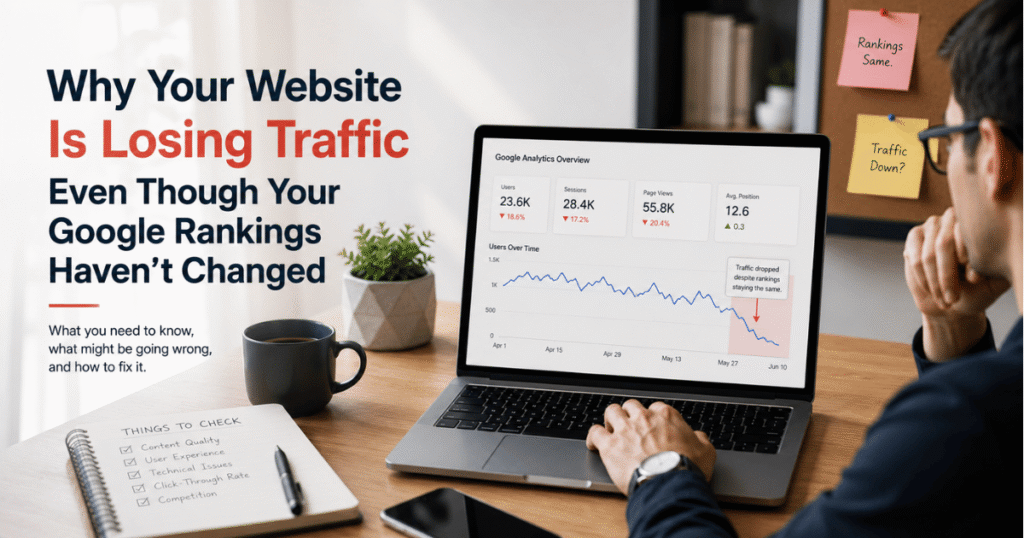
Have you noticed your website’s organic traffic declining even though your Google rankings remain stable?
If so, you’re not alone.
Many business owners and marketers are seeing fewer clicks from Google Search despite maintaining similar keyword rankings. This can be confusing—after all, if your website is still ranking well, shouldn’t you be receiving the same amount of traffic?
The answer is: not necessarily.
The way people search online has changed significantly with the introduction of AI-powered search experiences such as Google AI Overviews. Instead of clicking through multiple websites to find answers, users can often get the information they need directly from the search results.
Let’s explore why this is happening and what your business can do to stay competitive.
Rankings and Traffic Are Not the Same Thing
One of the biggest misconceptions in SEO is believing that higher rankings always lead to more website traffic.
While rankings are still important, they are only one part of the equation.
For example:
- Your website still ranks #1 for an informational keyword.
- Google now displays an AI Overview above the organic results.
- The AI Overview answers the user’s question immediately.
- The user gets the information they need without visiting your website.
Your ranking hasn’t changed—but your click-through rate (CTR) may decline because fewer users need to click on traditional search results. Google explains that AI Overviews are designed to provide an AI-generated snapshot with links for users who want to explore the topic further.
How Google AI Overviews Are Changing Search
Google introduced AI Overviews to help users understand complex topics more quickly by summarizing information from multiple sources.
Rather than displaying only a list of websites, Google may generate a concise answer and include links to supporting pages.
For users, this creates a faster search experience.
For website owners, however, it changes how people interact with search results.
Many informational searches that previously generated website visits may now be answered directly on Google’s results page. This trend is commonly referred to as zero-click search, where users complete their search without visiting another website.
Why Your Traffic May Be Declining
Several factors can contribute to lower traffic even when your rankings remain stable.
1. AI Overviews Answer the Question Immediately
There are several reasons why your website traffic may decrease even if your Google rankings remain the same. One of the biggest reasons is Google AI Overviews.
When users search for information, Google may display an AI-generated summary at the top of the search results. If the summary already answers their question, they may not need to click on your website.
This often happens with content such as definitions, “what is” questions, how-to guides, basic comparisons, and frequently asked questions. As a result, your rankings may stay the same, but fewer people visit your website because they have already found the information they need.
2. Users Are Searching Differently
The way people search online is changing rapidly. In the past, users typically searched using short, keyword-based phrases such as “Website Design Malaysia” or “SEO Company Kuala Lumpur.” Today, with the rise of AI-powered search and conversational search tools, people are more likely to ask complete questions like “Which website design company is best for SMEs in Malaysia?” or “How can I improve my website’s Google rankings?” AI-powered search engines are designed to understand natural language and provide direct, relevant answers to these conversational queries. As a result, businesses should focus on creating content that addresses real user questions and search intent, rather than relying solely on traditional keyword optimisation.
3. Search Results Are More Competitive Than Ever
Today’s search results often include:
- AI Overviews
- Featured snippets
- Local business listings
- Videos
- Images
- “People Also Ask” sections
Even if your page ranks first organically, these features can reduce the visibility of traditional blue links.
Does This Mean SEO Is No Longer Important?
Absolutely not.
SEO remains one of the most effective ways to increase online visibility.
However, modern SEO is no longer just about ranking for keywords.
Google advises website owners to continue creating original, helpful, people-first content because those principles also apply to AI-powered search experiences. Google also recommends supporting content with high-quality images and videos where appropriate and focusing on the overall value visitors receive—not just raw click counts.
How to Adapt Your SEO Strategy
Instead of focusing solely on rankings, businesses should consider a broader strategy.
1. Create Original Content
Avoid publishing content that simply repeats information already available online.
Offer:
- Industry expertise
- Original research
- Case studies
- Real-world examples
- Professional insights
Unique content is more valuable to both users and search engines.
2. Build Brand Authority
Businesses with strong reputations are more likely to be recognised across the web.
This includes:
- Positive customer reviews
- Mentions on trusted websites
- Consistent branding
- Demonstrated expertise
Authority matters more than ever in an AI-driven search environment.
3. Optimise for User Intent
Rather than focusing only on keywords, businesses should create content that answers what their target audience is searching for. For example, instead of creating a general page about “Website Design,” consider writing an article such as “How Much Does Website Design Cost in Malaysia?” or “What Makes a Good Corporate Website?” These topics better match user intent, making them more valuable to readers and more likely to appear in both traditional search results and AI-generated responses.
4. Improve Content Structure
Well-structured content is easier for both users and search engines to understand.
Use:
- Clear headings
- Short paragraphs
- Bullet points
- Frequently Asked Questions (FAQs)
- Internal links
This improves readability and helps search engines identify key information.
Focus on Business Results, Not Just Rankings
A high Google ranking is still valuable—but it should not be the only metric you monitor.
Pay attention to:
- Organic conversions
- Enquiry form submissions
- Phone calls
- Sales
- Customer enquiries
- Engagement
A website that generates fewer but more qualified visitors may ultimately perform better than one attracting high traffic with low conversions.
Google has also stated that visits coming through AI-powered search experiences can be more engaged because users have already received context before clicking through.
Final Thoughts
If your website traffic has declined while your Google rankings remain unchanged, it does not necessarily mean your SEO strategy has failed.
Search is evolving.
AI-powered experiences such as Google AI Overviews are changing how users discover and consume information. As a result, businesses need to move beyond simply chasing rankings and instead focus on creating authoritative, original, and genuinely useful content that earns trust and supports business goals.
Businesses that adapt to these changes early will be better positioned to remain visible as search continues to evolve.