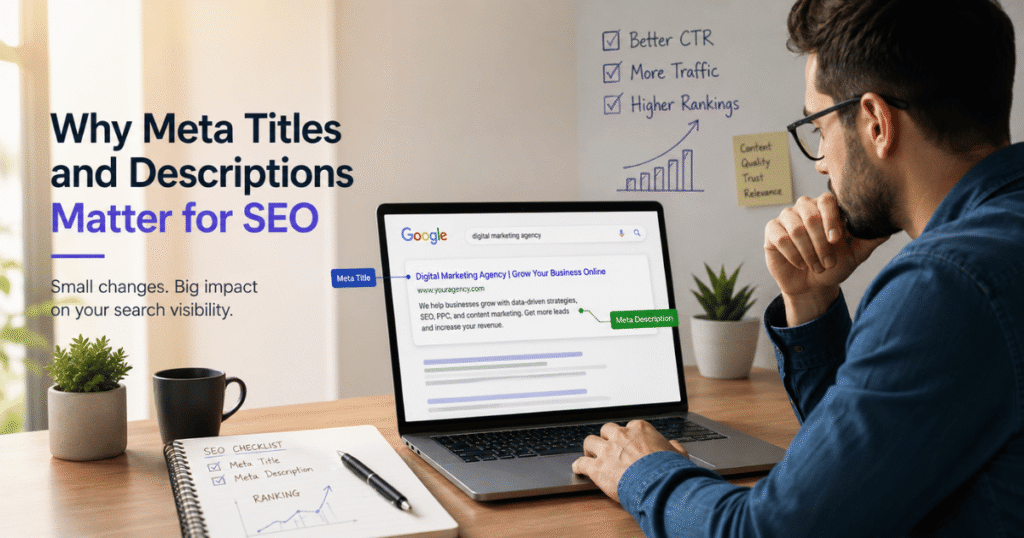
Your website may have a great design and valuable content, but that doesn’t guarantee people will visit it. Before users click on your website, they first see your page title and meta description in Google’s search results. These elements create the first impression of your website and can influence whether users choose to visit your page or click on another result. That’s why having well-written meta titles and descriptions is an essential part of improving your website’s visibility and attracting more organic traffic.
In this article, we’ll explain what meta titles and descriptions are, why they matter for SEO, and how you can optimise them to improve your website’s performance.

What Are Meta Titles?
A meta title, also known as a title tag, is the clickable headline that appears in search engine results. It tells both users and search engines what your webpage is about.
For example, if you search for “Website Design Malaysia,” the blue clickable text you see in Google’s search results is the meta title.
A well-written meta title should clearly describe the page content while encouraging users to click on your website. It is also one of the first elements that search engines use to understand the topic of your page.
What Are Meta Descriptions?
A meta description is the short summary displayed below the meta title in search results. Its purpose is to give users a brief overview of what they can expect when they visit your page.
Although meta descriptions are not a direct Google ranking factor, they can influence whether users choose your website over another result. A clear and compelling description helps attract more clicks, which can improve your overall website performance.
For example, if your page explains website design services, your meta description should briefly highlight what you offer and encourage users to learn more.
Why Are Meta Titles and Descriptions Important for SEO?
Meta titles and descriptions play an important role in helping users find your website. They create the first impression of your page and can influence whether someone decides to click on your website.
Here are some of the key benefits.
Improve Click-Through Rate (CTR)
Even if your website ranks well on Google, users may choose another result if your title or description is unclear. A well-written meta title and description can attract more attention and encourage users to click on your website.
Help Search Engines Understand Your Content
Your meta title gives search engines a clear indication of what your page is about. Including relevant keywords naturally in your title can help search engines match your content with relevant searches.
However, avoid stuffing too many keywords into your title. Focus on writing for people first while keeping your content relevant to the topic.
Create a Strong First Impression
Your search result is often the first interaction users have with your business. A professional and informative title and description can build trust before visitors even land on your website.
Best Practices for Writing Meta Titles
Writing an effective meta title doesn’t have to be complicated. Here are some simple best practices.
1. Keep It Short and Clear
Google typically displays around 50–60 characters of a title. If your title is too long, it may be shortened in search results.
2. Include Your Primary Keyword
Include your main keyword naturally near the beginning of the title whenever possible.
For example:
3. Website Design Malaysia | Professional Web Design Services
This helps both users and search engines understand the page topic quickly.
4. Make It Engaging
Your title should encourage users to click by clearly communicating the value of your page.
Instead of: Website Design
Consider: Professional Website Design Services for Malaysian Businesses
Best Practices for Writing Meta Descriptions
A good meta description should summarise your page while encouraging users to visit your website.
1. Keep It Concise
Aim for approximately 150–160 characters so your description is less likely to be cut off in search results.
2. Explain the Value
Tell users what they will learn or gain from visiting your page.
For example:
“Discover professional website design services that help Malaysian businesses improve their online presence and generate more leads.”
3. Include a Call-to-Action
Simple phrases such as:
- Learn More
- Get Started Today
- Contact Our Team
- Discover Our Services
can encourage users to click on your website.
Common Mistakes to Avoid
Many websites overlook the importance of optimising their meta titles and descriptions. Here are some common mistakes to avoid:
- Using the same meta title and description across multiple pages.
- Making titles too long or too short.
- Stuffing keywords unnaturally.
- Writing descriptions that do not accurately reflect the page content.
- Leaving the meta description blank and relying on Google to generate one automatically.
Avoiding these mistakes can help improve your website’s appearance in search results and provide a better experience for users.
How to Add Meta Titles and Descriptions in WordPress
If you’re using WordPress, adding meta titles and descriptions is simple with an SEO plugin such as Yoast SEO, Rank Math, or All in One SEO.
These plugins allow you to customise your title and description for each page or blog post while also showing a preview of how your search result may appear on Google.
Taking a few minutes to optimise each page can make a significant difference over time.
Final Thoughts
Meta titles and descriptions may seem like small details, but they play an important role in your website’s SEO strategy. They help search engines understand your content, create a positive first impression, and encourage users to click on your website.
By writing clear, relevant, and engaging meta titles and descriptions for every page, you can improve your website’s visibility, attract more organic traffic, and increase the chances of turning visitors into customers.