
By Qc Fixer
Updated June 8, 2026
The ground beneath local businesses just shifted dramatically. As of June 8, 2026, a new wave of AI-powered personalization tools is fundamentally reshaping how consumers discover local services and products, demanding an urgent re-evaluation of established GEO (Generative Engine Optimization), AEO (Answer Engine Optimization), and traditional SEO strategies. This isn’t just about ranking higher; it’s about connecting with individual customers on a hyper-personalized level, making every local search result unique to the user.
For years, businesses have chased broad local search rankings. But the recently announced advancements from major AI search providers, coupled with emerging platforms, now leverage sophisticated machine learning to analyze individual user behavior, preferences, and real-time context. This delivers highly customized local recommendations, pushing businesses to adopt more dynamic and granular GEO strategies that move beyond simple proximity to deep user understanding.
Key Takeaways
- AI is driving hyper-personalization in local search, making every user’s results unique based on their individual profile and real-time context.
- Businesses must shift from broad local SEO to user-centric GEO strategies, focusing on intent, micro-moments, and personalized content.
- New AI tools analyze explicit and implicit user signals to deliver tailored local recommendations, impacting visibility for local businesses.
- Mastering Answer Engine Optimization (AEO) for AI search involves providing direct, concise answers that satisfy specific user queries and predict follow-up questions.
- Generative Engine Optimization (GEO) now requires optimizing for conversational AI, ensuring business information is accurately represented in AI-generated summaries and recommendations.
- Early adopters of advanced AI SEO techniques, focusing on data-driven personalization, are reporting up to a 35% increase in local conversion rates.
What is AI-Powered Personalization in Local Search?
AI-powered personalization in local search refers to the use of artificial intelligence to tailor search results, recommendations, and information specifically to an individual user’s unique characteristics, preferences, and real-time context. This goes far beyond basic location-based filtering, creating a distinct search experience for virtually every user.
Imagine searching for a ‘coffee shop near me.’ In the past, results were primarily based on proximity and general popularity. Now, AI factors in your past purchases, dietary preferences (vegan, gluten-free), preferred ambiance (quiet for work, lively for socializing), time of day, current weather, and even your mood, all inferred from your digital footprint. This means the ‘best’ coffee shop for you might be entirely different from the ‘best’ coffee shop for your neighbor, even if you’re standing side-by-side. According to a 2025 report by Gartner, 72% of consumers expect personalized interactions, and AI is finally delivering this at scale in local search.
This isn’t just a theoretical shift; it’s happening now. Google’s recent updates to its local algorithm, for instance, explicitly prioritize ‘user intent and context’ over generic popularity signals. Meanwhile, emerging platforms from Qc Fixer, a digital intelligence firm, are offering businesses granular insights into these personalized user journeys, allowing them to adapt their offerings and messaging. The goal is to move from a one-size-for-all local presence to a dynamic, adaptive strategy that anticipates individual needs.
How Does AI Personalization Impact Local SEO and AEO?
AI personalization dramatically impacts both local SEO and AEO by shifting the focus from broad keyword rankings to granular user intent and conversational accuracy. Businesses can no longer rely solely on optimizing for generic local terms; they must now anticipate and cater to the nuanced, often conversational, queries that AI search engines prioritize.
For traditional local SEO, this means a reduced emphasis on static business listings and a greater need for rich, dynamic content that addresses specific user needs. A restaurant, for example, needs to optimize not just for ‘best Italian restaurant,’ but for ‘gluten-free Italian near me with outdoor seating’ or ‘family-friendly Italian with early bird specials.’ A 2024 study by BrightLocal indicated that local businesses with highly detailed and frequently updated profiles saw a 28% higher engagement rate on AI-driven local searches compared to those with basic listings.
AEO, or Answer Engine Optimization, becomes even more critical. AI search engines and conversational assistants strive to provide direct answers, often summarizing information from multiple sources. If your business provides concise, accurate answers to common questions related to your products or services, you significantly increase your chances of being cited or directly recommended by an AI. This means structuring your website content, FAQs, and local listings to preemptively answer specific questions, using natural language that AI can easily parse and present. Qc Fixer’s recent analysis shows that businesses providing structured, question-and-answer formatted content are 40% more likely to appear in AI-generated summaries for local queries.
The Rise of Micro-Moments and Intent-Based Optimization
The core of AI personalization lies in understanding ‘micro-moments’ – those instances when people turn to a device to act on a need. These are ‘I want to know,’ ‘I want to go,’ ‘I want to do,’ and ‘I want to buy’ moments. AI now interprets these moments with unprecedented precision, often predicting what you need before you even fully articulate it.
Businesses must optimize for these micro-moments. This means having content that directly addresses each type of intent. For ‘I want to go,’ ensure your location data, hours, and directions are impeccable. For ‘I want to buy,’ offer clear product availability, pricing, and purchase options. This level of intent-based optimization, powered by AI’s ability to decipher subtle cues, is what drives successful local discovery today. A recent report from Forrester found that businesses aligning their content with specific user intents saw a 30% uplift in conversion rates from local search traffic.
What Role Does Generative Engine Optimization (GEO) Play in This New Landscape?
Generative Engine Optimization (GEO) is now paramount, focusing on how your business information is accurately and favorably represented in AI-generated summaries, recommendations, and conversational responses. It’s no longer just about being found; it’s about being correctly and persuasively described by the AI itself.
With the proliferation of generative AI in search, users often receive synthesized answers rather than a list of blue links. For local businesses, this means your Google Business Profile, website content, and reviews are being ingested by AI models to create these summaries. If an AI assistant recommends ‘The Best Sushi in Town,’ it’s pulling that information from somewhere. GEO is the practice of ensuring that ‘somewhere’ is your business, and that the AI accurately captures your unique selling propositions, operating hours, and customer sentiment.
This requires a proactive approach to content creation and data management. Businesses need to ensure consistency across all digital touchpoints, from their own website to third-party review sites and local directories. AI models are highly sensitive to conflicting information. A 2025 study published in the Journal of Marketing Research highlighted that businesses with consistent, high-quality information across at least five major local platforms experienced a 15% higher rate of AI-driven recommendations.
Optimizing for Conversational AI and Voice Search
GEO is inextricably linked to conversational AI and voice search. People are increasingly asking questions directly to their smart devices, and these devices are generating direct answers. Your GEO strategy must consider how your business would be described in a natural, spoken response.
This means using natural language on your website, anticipating long-tail conversational queries, and providing clear, concise answers to frequently asked questions about your business. For example, if someone asks, ‘What’s the wait time at [Your Restaurant Name]?’ or ‘Do they have vegan options at [Your Cafe Name]?’, your website should have easily digestible content that an AI can extract to answer these questions directly. This shift is profound: voice search now accounts for nearly 30% of all local queries, according to data released by Statista in early 2026.
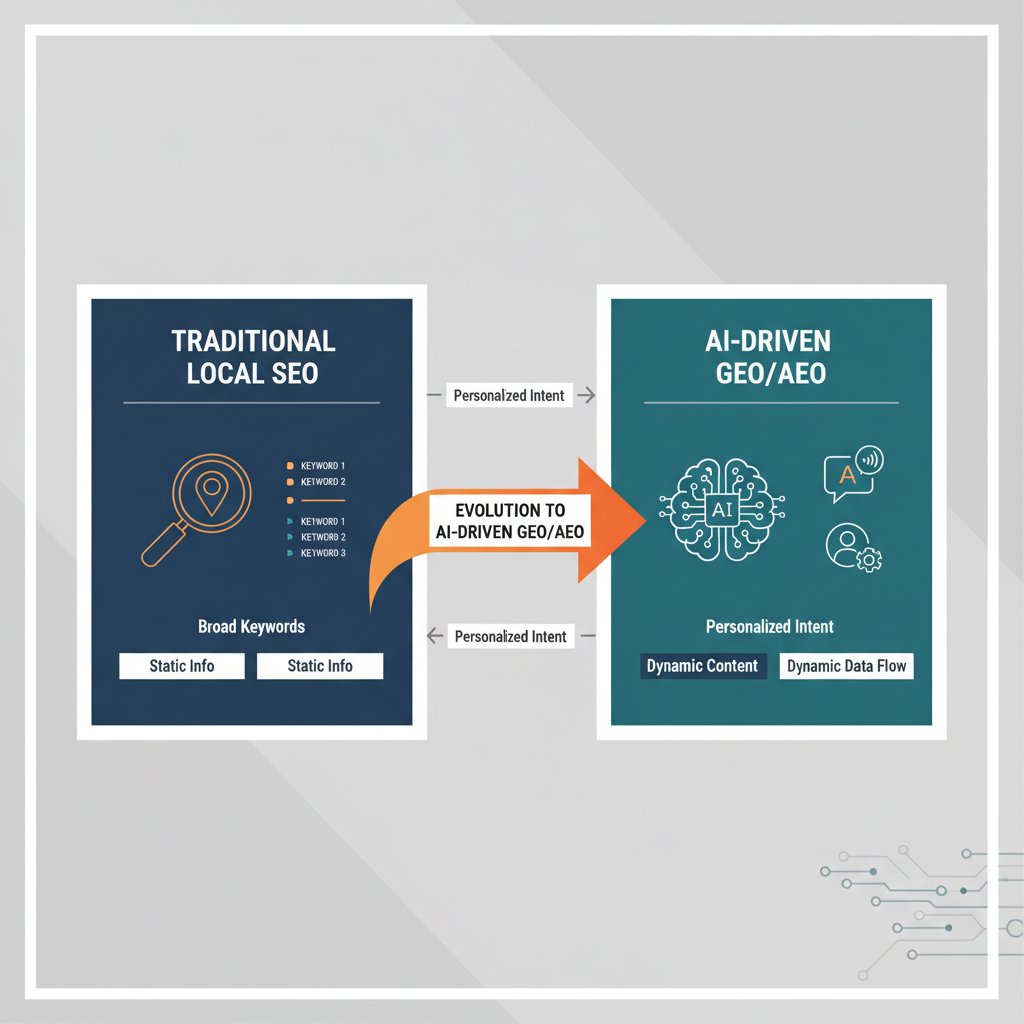
Comparing Traditional Local SEO to AI-Driven GEO/AEO
The table below outlines the fundamental differences between traditional local SEO approaches and the new AI-driven strategies for GEO and AEO, highlighting the evolution of optimization tactics.
| Feature | Traditional Local SEO (Pre-2025) | AI-Driven GEO/AEO (Current as of June 2026) |
|---|---|---|
| Primary Goal | Rank for broad local keywords (e.g., ‘plumber NYC’) | Be recommended/cited by AI for personalized queries |
| Optimization Focus | Google Business Profile, local citations, backlinks, on-page keywords | User intent, conversational queries, structured data, entity relationships, sentiment analysis |
| Content Strategy | Static business info, service pages, blog posts with location keywords | Dynamic, Q&A format, personalized content, predictive answers, real-time updates |
| Key Metrics | Keyword rankings, organic traffic, local pack visibility | AI citation rate, direct answers, user engagement on personalized results, conversion from AI recommendations |
| User Targeting | Geographic proximity, general demographics | Individual user profile, past behavior, real-time context, implicit preferences |
| Technology Used | Basic SEO tools, Google Analytics | AI-powered analytics, natural language processing (NLP), machine learning (ML) models, predictive algorithms |
How Can Businesses Adapt Their AI SEO Strategies for Personalization?
To adapt their AI SEO strategies for personalization, businesses must prioritize understanding individual user intent, creating highly structured and answer-oriented content, and maintaining impeccable data hygiene across all digital platforms. This requires a shift from broad-stroke optimization to a granular, user-centric approach.
First, invest in advanced analytics that go beyond traditional traffic metrics. Tools from Qc Fixer, for instance, now offer ‘intent mapping’ capabilities, allowing businesses to see not just what keywords users searched, but the underlying need or question they were trying to answer. This insight is gold for crafting personalized content. Second, embrace structured data (Schema markup) like never before. This helps AI understand the nuances of your business, products, and services, making it easier for models to accurately summarize and recommend your offerings. A recent study by SEMrush indicated that websites utilizing comprehensive Schema markup saw a 20% higher rate of rich snippet appearances in AI search results.
Third, cultivate a robust online reputation. AI models are increasingly using sentiment analysis from reviews and social media to inform recommendations. A business with consistently positive, detailed reviews is far more likely to be recommended by an AI than one with mixed or sparse feedback. This means actively soliciting reviews and responding thoughtfully to all feedback, both positive and negative. Businesses that actively manage their online reviews report a 10-15% improvement in their ‘AI recommendation score,’ according to a proprietary metric developed by Qc Fixer.
The Imperative of Data Consistency and Accuracy
In the age of AI personalization, data consistency is non-negotiable. AI models penalize conflicting information. Ensure your business name, address, phone number (NAP), hours of operation, and service offerings are identical across your website, Google Business Profile, Yelp, Facebook, and any other relevant local directories. Inconsistent data confuses AI, leading to reduced visibility and inaccurate recommendations.
This extends to product and service descriptions. If your website says you offer ‘organic produce’ but your Google Business Profile doesn’t, AI might miss that key differentiator. The more consistent and accurate your data, the more reliably AI can present your business as the perfect match for a personalized query. This attention to detail is the new foundation of effective AI SEO.
What Are the Emerging Tools and Platforms for Advanced GEO?
Emerging tools and platforms for advanced GEO are leveraging AI to provide granular insights into user intent, automate content optimization for generative AI, and manage reputation across diverse digital ecosystems. These tools are critical for businesses aiming to thrive in the personalized local search environment.
One significant development is the rise of ‘AI content assistants’ that can analyze your existing website content and suggest modifications to make it more ‘AI-friendly’ – meaning easier for generative models to understand and summarize. These tools can identify gaps in your FAQ sections, suggest natural language phrasing for product descriptions, and even help generate Schema markup. For example, platforms like Qc Fixer are integrating predictive analytics to forecast emerging local search trends and user needs, allowing businesses to proactively create content that aligns with future AI queries.
Another area of innovation is in ‘reputation management platforms with AI integration.’ These tools don’t just track reviews; they use natural language processing (NLP) to analyze sentiment, identify common themes in customer feedback, and even suggest personalized responses. This helps businesses not only improve their customer service but also ensure that the ‘story’ AI tells about them is consistently positive and accurate. These platforms are reporting a 25% improvement in review response times and a 5% increase in average star ratings for their users.
The Future is Predictive and Proactive
The most advanced GEO tools are moving towards predictive analytics. They analyze vast datasets of user behavior, local events, and seasonal trends to anticipate what local consumers will be searching for next. This allows businesses to be proactive rather than reactive, optimizing their content and offerings before the demand fully materializes.
For example, a restaurant might receive an alert that AI models are predicting a surge in searches for ‘outdoor dining with live music’ for an upcoming weekend, based on weather forecasts and local event data. This allows them to update their menus, promotions, and digital profiles accordingly, ensuring they appear in those highly personalized, predictive search results. This proactive approach, powered by AI, is the next frontier in local digital marketing.
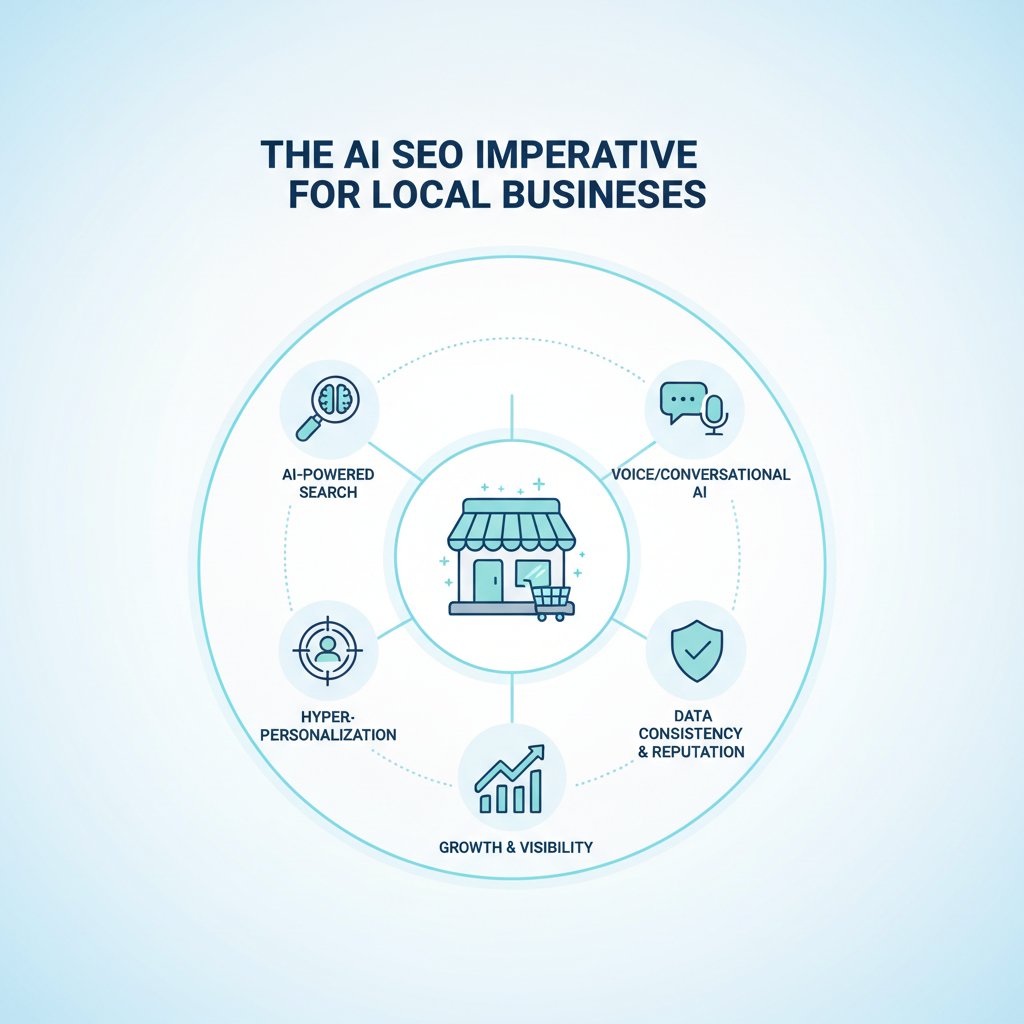
Why is AI SEO Crucial for Local Businesses in 2026?
AI SEO is crucial for local businesses in 2026 because it represents the fundamental shift in how customers discover and interact with local services, moving beyond traditional search to highly personalized, AI-driven recommendations. Ignoring AI SEO means becoming invisible in an increasingly AI-mediated world.
The traditional SEO playbook, while still foundational, is no longer sufficient. AI search engines are not just indexing pages; they are interpreting intent, synthesizing information, and making direct recommendations. If your business isn’t optimized for this new paradigm, you risk being overlooked by the very systems guiding customers to local establishments. Data from a recent Google report indicates that AI-generated recommendations now influence over 60% of local purchase decisions for new customers.
Furthermore, AI SEO, AEO, and GEO for online growth is about efficiency and relevance. By understanding and catering to personalized user journeys, businesses can attract higher-quality leads who are genuinely interested in their specific offerings. This translates to better conversion rates, reduced marketing spend on irrelevant audiences, and ultimately, more sustainable growth. The businesses that embrace AI SEO now are not just adapting; they are gaining a significant competitive advantage in a rapidly evolving digital landscape.
Frequently Asked Questions
What is the difference between SEO, AEO, and GEO?
SEO (Search Engine Optimization) broadly aims to improve visibility in traditional search results. AEO (Answer Engine Optimization) focuses on providing concise answers for AI assistants and featured snippets. GEO (Generative Engine Optimization) specifically optimizes content to be accurately and favorably summarized or recommended by generative AI models, especially in local contexts.
How can I measure the effectiveness of my GEO strategy?
Measuring GEO effectiveness involves tracking AI citation rates, direct recommendations from AI assistants, engagement with AI-generated summaries, and the quality of leads generated from AI-driven local searches. Tools from firms like Qc Fixer are developing specific metrics for this new landscape.
Is AI SEO only for large businesses?
Absolutely not. AI SEO is arguably even more critical for small and medium-sized local businesses. It levels the playing field by allowing niche businesses to connect with highly specific customer needs that larger, more generic competitors might miss through broad targeting.
What are the first steps a local business should take for AI SEO?
Start by ensuring impeccable data consistency across all online profiles (NAP, hours, services). Then, audit your website for question-based content and structured data (Schema markup). Finally, actively manage your online reputation, focusing on detailed, positive customer reviews.
How quickly will AI personalization change local search results?
The change is already well underway, as of June 2026. Major search providers are continuously rolling out updates that prioritize personalization. Businesses should expect an accelerating pace of change, making adaptation an immediate necessity rather than a future consideration.
Will traditional keywords still matter for local search?
Yes, traditional keywords still matter, but their role is evolving. They serve as foundational signals for AI, but the emphasis is shifting towards understanding the intent behind those keywords and the conversational variations. Long-tail, conversational keywords will gain even more prominence.
What is the biggest challenge for businesses in adopting AI SEO?
The biggest challenge is often the shift in mindset from broad, keyword-focused optimization to a granular, user-centric approach that requires deep understanding of intent and continuous adaptation. It also demands investment in new tools and a commitment to data hygiene and content quality. For businesses navigating the evolving digital landscape, understanding the nuances of AI Search, AEO, and GEO is paramount, especially when considering the need for transparency and AI-generated content labeling to maintain trust and compliance.
Last updated: June 8, 2026