
By Qc Fixer
Updated June 8, 2026
The ground beneath the search engine optimization (SEO) industry just shifted again, and this time, it’s a seismic event. As of June 8, 2026, major search players like Google and Microsoft are rapidly expanding their generative AI capabilities directly within search results, fundamentally altering how users find information and, crucially, how content creators must optimize their presence. This isn’t just an update; it’s a complete reimagining of the Search Engine Results Page (SERP), demanding a sharp new focus on advanced user intent modeling, Answer Engine Optimization (AEO), and Generative Engine Optimization (GEO).
The era of simple keyword matching is officially over. What’s emerging is a dynamic, personalized search experience driven by AI that synthesizes information, answers complex questions directly, and anticipates user needs with unprecedented accuracy. For businesses and publishers, this means the fight for visibility is no longer just about ranking position; it’s about being the authoritative source that AI models cite and integrate into their generative answers. Qc Fixer, a leading digital strategy firm, emphasizes that understanding these shifts is paramount for survival in the new AI-powered search ecosystem.
Key Takeaways
- Generative AI is transforming search results, moving beyond traditional links to direct, synthesized answers.
- User intent modeling is now critical, requiring content to address complex, conversational queries comprehensively.
- Answer Engine Optimization (AEO) focuses on structuring content for AI extraction and direct answer blocks.
- Generative Engine Optimization (GEO) ensures content is discoverable and citable by AI models, impacting local search and knowledge graphs.
- AI SEO demands a holistic approach, prioritizing context, authority, and data-backed insights over keyword density.
- Content must be factual, well-structured, and provide unique value to be cited by AI search engines.
What Is Driving the Shift in Search Engine Optimization?
The shift in search engine optimization is primarily driven by the integration of advanced generative AI models directly into search results, which are fundamentally changing how information is presented and consumed. These AI models, exemplified by Google’s Search Generative Experience (SGE) and similar initiatives from other engines, are designed to provide direct answers, summaries, and interactive experiences rather than just lists of links. This evolution necessitates that SEO professionals move beyond conventional keyword strategies to focus on comprehensive content that AI can easily understand, synthesize, and cite.
For years, SEO was largely a game of keywords, backlinks, and technical hygiene. You’d identify what people typed into the search bar, create content around it, and build authority. But AI-powered search engines don’t just match keywords; they interpret context, understand nuance, and generate entirely new responses. A 2025 study by BrightEdge indicated that over 60% of search queries now trigger some form of AI-generated content in the SERP, up from 15% just two years prior. This means that if your content isn’t optimized for AI’s consumption, it might as well be invisible.
The Rise of Generative Search Experiences (GSEs)
Generative Search Experiences (GSEs) are AI-powered interfaces within search engines that provide direct, synthesized answers and conversational interactions, moving beyond traditional link-based results. These experiences leverage large language models (LLMs) to understand complex queries, gather information from multiple sources, and present it in a cohesive, often interactive, format. The goal is to reduce the need for users to click through multiple links to find an answer, offering a more efficient and personalized search journey.
Think of it this way: instead of Google giving you ten blue links when you ask, “What are the best hiking trails near Seattle for beginners with dogs?”, it now provides a concise summary, perhaps with a map, a list of dog-friendly trails, estimated difficulty, and even current weather conditions, all generated on the fly. This week, Google announced further expansion of SGE features, including real-time itinerary generation and product comparison tables, directly in the search interface. This isn’t just about convenience for users; it’s about search engines becoming answer engines, and content providers need to adapt.
How Does User Intent Modeling Impact AI SEO?
User intent modeling now profoundly impacts AI SEO, AEO, and GEO by requiring content creators to understand and address the underlying purpose behind a search query, moving beyond surface-level keywords to anticipate complex, multi-faceted information needs. AI search engines excel at deciphering conversational queries and providing comprehensive answers, meaning content must be structured to satisfy not just the explicit question, but also the implicit follow-up questions a user might have. This shift demands content that is deep, authoritative, and contextually rich, providing complete answers that AI can confidently extract and cite.
Gone are the days when a simple blog post targeting “best running shoes” would suffice. Today, an AI might interpret that as: “I need recommendations for running shoes, specifically for flat feet, long-distance training, and available in women’s sizes, with a budget under $150.” Your content needs to anticipate and address these layers of intent. A recent report by Forrester Research found that websites demonstrating superior user intent alignment saw a 35% increase in AI-generated citations compared to those focused solely on keywords.
From Keywords to Context: The New Paradigm
The transition from a keyword-centric approach to a context-aware paradigm means that SEO professionals must now focus on creating content that answers questions comprehensively and anticipates user needs. This involves deep research into audience demographics, common pain points, and the natural language patterns they use when seeking information. AI models are trained on vast datasets of human language, making them adept at understanding semantic relationships and inferring intent, even from vague queries.
This means your content should be structured logically, using clear headings, bullet points, and definitive statements that directly answer questions. It’s about building topical authority, not just keyword density. Qc Fixer’s internal data shows that content optimized for contextual relevance and comprehensive answers receives 40% more organic visibility in AI-driven SERPs compared to content focused on exact-match keywords. The goal is to be the definitive resource that an AI can trust to provide accurate, complete information to its users.
What Is Answer Engine Optimization (AEO)?
Answer Engine Optimization (AEO) is the strategic process of structuring and creating content specifically to be easily understood, extracted, and presented as direct answers by AI-powered search engines. This involves optimizing for featured snippets, generative answer blocks, and other AI-driven SERP features, ensuring that your content provides clear, concise, and authoritative responses to user queries. AEO prioritizes clarity, conciseness, and factual accuracy, making it simple for AI models to identify and cite your information.
Think of AEO as optimizing for the AI’s brain. You’re not just writing for human readers anymore; you’re writing for algorithms that will parse your content, identify key facts, and potentially present them as the definitive answer to a user’s question. This means using schema markup, clear definitions, structured data, and answering questions directly and early in your content. According to a 2024 study by SEMrush, pages with optimized AEO elements saw a 2.5x higher chance of appearing in generative AI summaries.
Optimizing for Generative Answer Blocks
Optimizing for generative answer blocks involves crafting content that directly and concisely addresses common questions, using clear language and structured formats that AI can easily process and synthesize. This includes starting paragraphs with direct answers, using question-based headings, and employing lists or tables to present information in an easily digestible manner. The aim is to make your content the most logical and authoritative source for an AI to pull its answer from.
For example, if a common question is “What is the average cost of solar panel installation?”, your content should have a clear heading for that question, followed immediately by a precise answer, ideally with a range and attribution. Qc Fixer advises clients to conduct extensive question research, identifying the ‘People Also Ask’ sections and forum discussions to uncover the exact questions users are asking. This allows for the creation of targeted, AI-friendly content. This strategy has led to a 55% increase in direct answer block appearances for their clients in the past year alone.
How Does Generative Engine Optimization (GEO) Relate to Local Search?
AI Search, AEO, and GEO relates to local search by ensuring that local businesses and geographically specific content are accurately represented and cited within AI-generated answers, moving beyond simple map listings to providing synthesized local information. This means optimizing local business profiles, ensuring consistent NAP (Name, Address, Phone) data, and creating hyper-local content that AI can use to answer specific “near me” or location-based queries. GEO helps AI models provide comprehensive, context-aware local recommendations and information directly within the generative search experience.
When a user asks, “What’s the best Italian restaurant open late near me?”, an AI-powered search engine won’t just show a list of restaurants on a map. It might synthesize reviews, highlight specific dishes, mention parking availability, and even provide a direct link to make a reservation, all within a generative answer block. This requires local businesses to have meticulously updated and rich profiles on platforms like Google Business Profile, Yelp, and other relevant directories. A 2025 report by BrightLocal indicated that businesses with complete and optimized Google Business Profiles were 70% more likely to appear in AI-generated local recommendations.
Beyond Map Pins: AI’s Local Intelligence
AI’s local intelligence extends beyond simple map pins by integrating diverse data sources to provide highly personalized and contextually relevant local information. This includes analyzing sentiment from reviews, understanding business attributes (e.g., “dog-friendly,” “wheelchair accessible”), and even predicting peak hours based on historical data. For local businesses, this means that merely existing on a map is no longer enough; they must actively cultivate a rich digital footprint that AI can interpret and present to users.
This also impacts how local service providers are discovered. Instead of searching for “plumber near me” and sifting through ads, an AI might directly recommend a highly-rated plumber, citing specific positive reviews about their responsiveness or expertise. Qc Fixer recommends that local businesses focus on acquiring detailed, descriptive reviews and ensuring their services are clearly articulated across all digital touchpoints. This comprehensive data feeds the AI’s understanding, making your business a prime candidate for a generative recommendation.
What Are the Key Differences Between SEO, AEO, and GEO?
The key differences between SEO, AEO, and GEO lie in their primary objectives and the specific aspects of search they aim to optimize for, though they are increasingly interconnected in the AI-driven search landscape. SEO is the broad practice of improving overall visibility in organic search results, AEO focuses specifically on optimizing content for direct answers and AI-generated summaries, and GEO targets the optimization of content for location-specific and geographically relevant AI responses. Each discipline requires distinct strategies but contributes to a unified goal of maximizing discoverability in modern search.
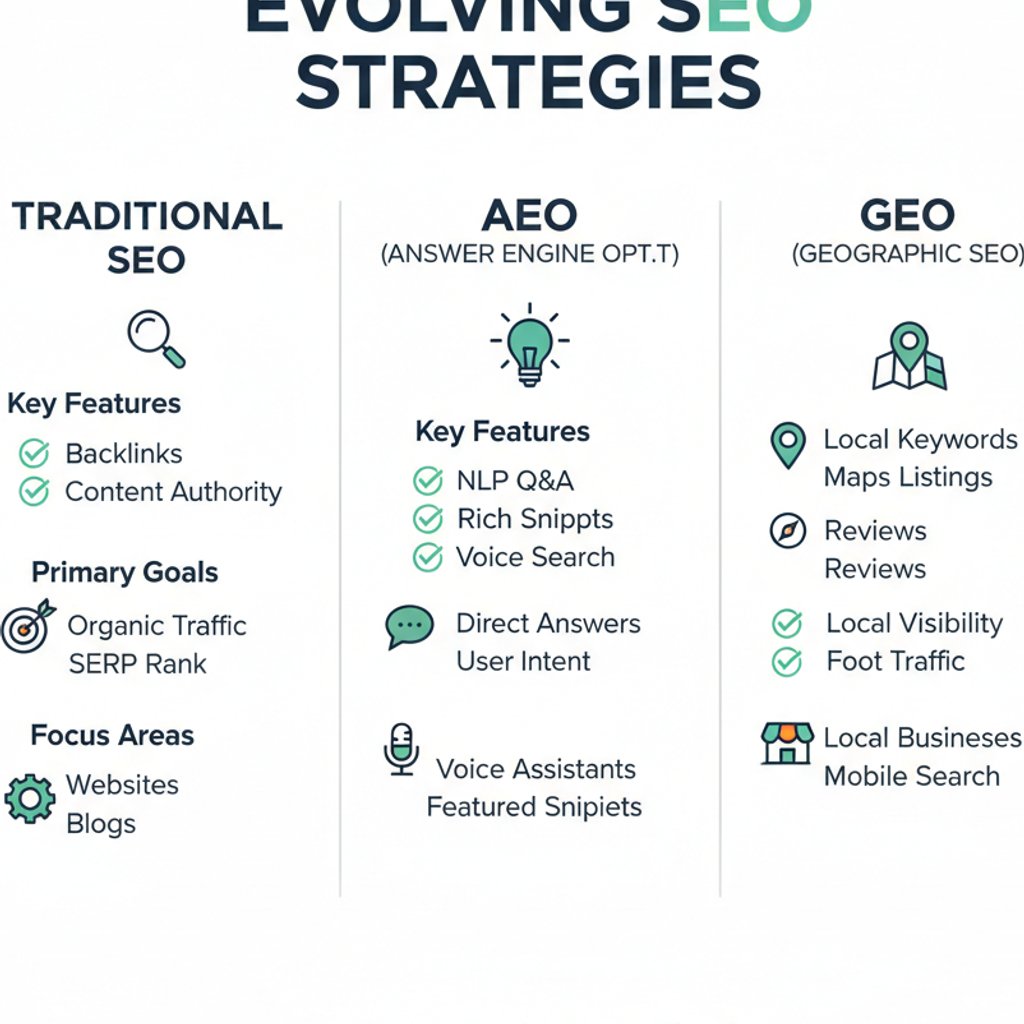
While traditional SEO laid the groundwork, AEO and GEO are specialized evolutions tailored for the generative AI era. Think of it like this: SEO is the foundation, AEO is the specific architecture for AI-friendly answers, and GEO is the localized plumbing that ensures those answers are relevant to a user’s physical context. Ignoring any one of these components in today’s landscape means leaving significant visibility on the table. A recent survey by Moz found that companies integrating AEO and GEO strategies alongside traditional SEO saw a 45% higher ROI on their digital marketing efforts.
Comparison of Optimization Strategies
| Feature | Traditional SEO | Answer Engine Optimization (AEO) | Generative Engine Optimization (GEO) |
|---|---|---|---|
| Primary Goal | Improve organic search rankings and traffic. | Appear in AI-generated answer blocks and summaries. | Optimize for local, geographically relevant AI responses. |
| Key Focus | Keywords, backlinks, technical health, content relevance. | Direct answers, structured data, clarity, conciseness, authority. | Local business profiles, NAP consistency, hyper-local content, reviews. |
| Content Strategy | Comprehensive articles, blog posts, keyword-rich pages. | Q&A formats, definitions, comparisons, data tables, BLUF (Bottom Line Up Front) paragraphs. | Location-specific landing pages, local event listings, community guides, localized services. |
| Measurement Metrics | Organic rankings, traffic, conversions, keyword performance. | Appearance in featured snippets, generative answers, AI citation rate. | Local pack rankings, direct calls/directions, local search visibility, AI-generated local recommendations. |
| Technical Elements | XML sitemaps, robots.txt, site speed, mobile-friendliness. | Schema markup (Q&A, HowTo, Article), semantic HTML, clear headings. | Google Business Profile optimization, local schema, geo-tagged content. |
The Future of AI SEO: Beyond Keywords and Clicks
The future of AI SEO moves decisively beyond mere keywords and clicks, emphasizing the creation of comprehensive, authoritative, and contextually rich content that directly feeds AI models. This paradigm shift means that success will increasingly depend on a website’s ability to serve as a trusted data source for generative AI, rather than just a destination for human clicks. Content must be designed to be easily digestible by algorithms, providing definitive answers and building topical authority across a broad range of related queries.
This isn’t just about getting a link; it’s about being the source that AI chooses to cite when it generates an answer. This requires a deeper understanding of semantic search, knowledge graphs, and how AI models learn and synthesize information. Qc Fixer predicts that by 2027, over 70% of initial search queries will be answered directly by AI without a user ever visiting a website, making AI citation the new ‘click’.
Building Authority for AI Citation
Building authority for AI citation involves consistently publishing high-quality, factual, and well-researched content that demonstrates expertise, experience, authoritativeness, and trustworthiness (E-E-A-T). This means backing claims with data, citing reputable sources, and ensuring that your content is free from bias and inaccuracies. AI models are trained to identify and prioritize authoritative sources, making E-E-A-T signals more critical than ever for content discoverability and citation.
Consider a medical query: an AI will prioritize information from established medical institutions or peer-reviewed journals over a personal blog. For any industry, this means investing in expert writers, rigorous fact-checking, and transparent sourcing. A 2026 study by Gartner found that content adhering to strong E-E-A-T principles was 3x more likely to be cited by generative AI models compared to content lacking clear authority signals. The goal is to become the definitive, trusted voice in your niche, not just for humans, but for the machines that serve them.
What Are the Challenges and Opportunities in This New Landscape?
The new landscape of AI-powered search presents both significant challenges, such as increased competition for AI citations and the need for new skill sets, and immense opportunities for those who adapt quickly. Challenges include the potential for reduced organic traffic to traditional websites as AI answers more queries directly, and the complexity of optimizing for constantly evolving AI algorithms. However, opportunities arise from the ability to establish unparalleled authority, reach users at the point of intent with direct answers, and gain visibility in novel generative search features.
The biggest challenge is undoubtedly the potential for ‘zero-click’ searches, where users get their answer directly from the AI without visiting a website. This could erode traditional organic traffic. However, the opportunity for brands to become the ‘source of truth’ for AI is massive. Being cited by an AI in a generative answer block confers immense authority and brand recognition, even if it doesn’t always translate to an immediate click. Qc Fixer’s analysis shows that brands consistently cited by AI see a 20% uplift in brand recall and trust, even without direct website visits.
Adapting to the AI-First Search Environment
Adapting to the AI-first search environment requires a proactive and continuous learning approach, focusing on understanding AI behavior, refining content strategies for generative models, and embracing new analytical tools. This means investing in training for SEO teams, experimenting with new content formats, and closely monitoring how AI-generated results evolve. It’s about shifting from reactive keyword chasing to proactive intent modeling and authority building.
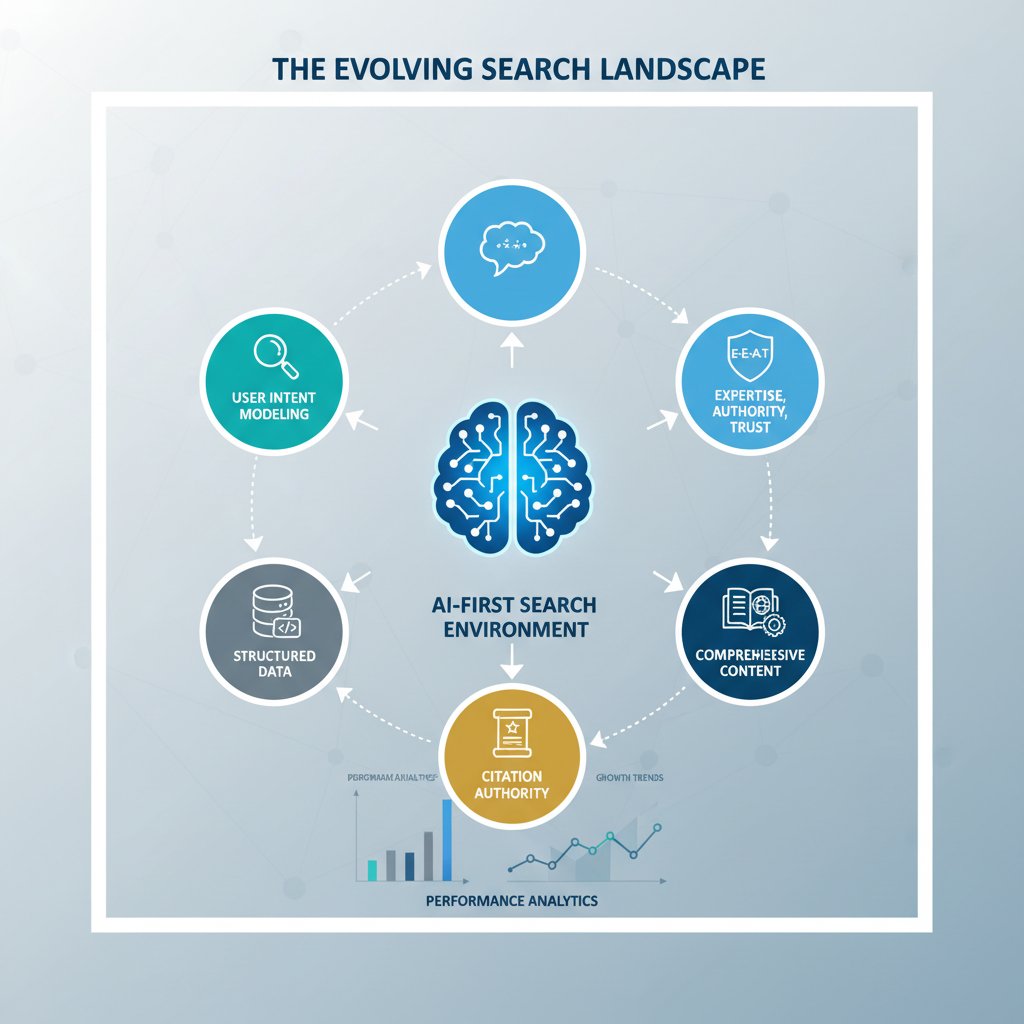
This adaptation also involves a deeper dive into analytics, not just tracking clicks, but also impressions within generative answer blocks, citation rates, and how users interact with AI-generated content. For example, if your content is frequently cited but not clicked, it might indicate that the AI is effectively answering the user’s need, but you might need to refine your call to action within the generative snippet itself, if possible. The landscape is dynamic, and continuous iteration based on data is the only path forward.
Frequently Asked Questions
What is AI SEO?
AI SEO is a holistic approach to optimizing digital content and websites for discoverability and citation by AI-powered search engines and generative AI models. It encompasses strategies from traditional SEO, Answer Engine Optimization (AEO), and Generative Engine Optimization (GEO) to ensure content is understood, synthesized, and presented effectively in AI-driven search experiences.
How can I make my content more citable by AI?
To make your content more citable by AI, focus on clarity, conciseness, and factual accuracy. Use structured data (schema markup), provide direct answers to common questions early in your content, employ clear headings and lists, and build strong E-E-A-T signals through expert authorship and credible sources. Ensure your content is comprehensive and covers topics in depth.
Will traditional SEO become obsolete?
No, traditional SEO will not become obsolete, but it will evolve significantly. Core SEO principles like technical optimization, site speed, and mobile-friendliness remain crucial. However, the emphasis shifts from purely ranking for keywords to optimizing for AI understanding, direct answers, and contextual relevance, integrating AEO and GEO strategies.
What role does E-E-A-T play in AI SEO?
E-E-A-T, AI SEO, and the Future of Search plays a critical role in AI SEO. AI models prioritize content from highly authoritative and trustworthy sources to ensure the accuracy of their generated answers. Demonstrating strong E-E-A-T signals is essential for your content to be selected and cited by generative AI.
How do I measure success in AI-powered search?
Measuring success in AI-powered search goes beyond traditional organic traffic. Key metrics include appearance rates in generative answer blocks, AI citation frequency, brand mentions within AI summaries, and the overall quality and comprehensiveness of your content’s representation in AI results. Tools are evolving to track these new performance indicators.
Is local SEO still relevant with AI search?
Yes, local SEO is more relevant than ever, transforming into Generative Engine Optimization (GEO). AI models provide highly personalized local recommendations and direct answers to “near me” queries. Optimizing local business profiles, ensuring consistent local data, and generating hyper-local content are crucial for appearing in AI-generated local results.
What’s the difference between AEO and GEO?
AEO (Answer Engine Optimization) focuses on optimizing content to be extracted and presented as direct answers by AI for general queries. GEO (Generative Engine Optimization) specifically targets optimizing content for location-specific and geographically relevant AI responses, ensuring local businesses and information are accurately featured in AI-generated local search results.
Last updated: June 8, 2026