Imagine a Malaysian business owner searching Google for accounting software. In the past, Google mainly showed a list of websites to open and compare.
Now, Google may show an AI-generated answer first. It can summarise the options, explain the differences and respond to another question.
For a business that depends on Google traffic, this raises a reasonable concern: if AI provides the answer first, will customers still visit the website?
This is the question behind AI SEO: how can a website remain visible and useful as search engines change the way they present information?
How Is Google Search Changing?
Traditional Google Search asks users to choose from a list of results. SEO helps a website appear, attract the click and answer the visitor’s question.
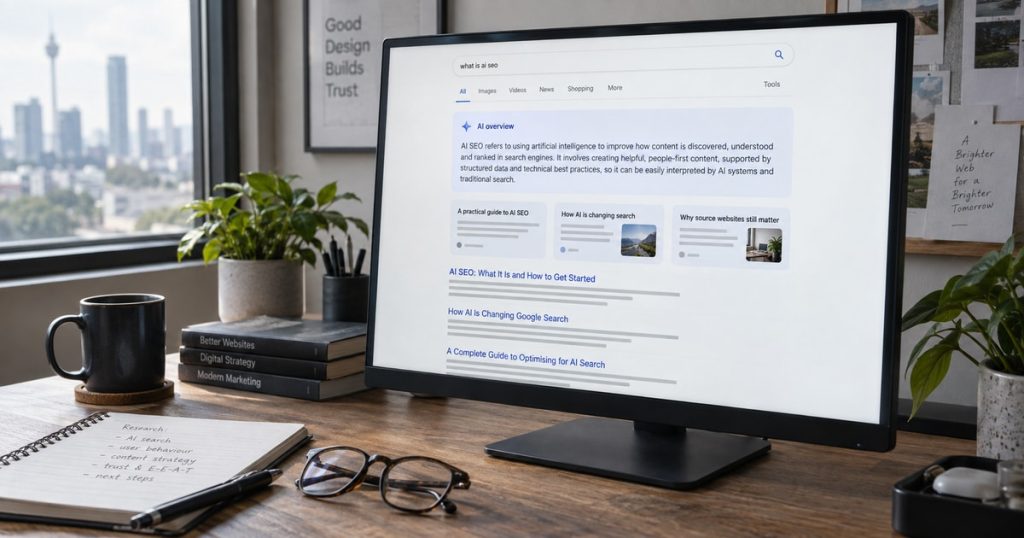
AI search can shorten that journey. Google’s AI Overviews may combine information from different sources, while AI Mode supports longer questions and follow-ups. These features do not appear for every search, but they offer another way to find information.
Users may therefore begin comparing options before visiting a website. Their first decision may become, “Is this answer enough, or do I need to see the source?”
Websites have not disappeared. AI responses can include links, and customers still need somewhere to check details, view proof, request a quotation or make a purchase. What changes is the kind of page that earns the click.
What Does AI SEO Mean?
AI SEO means adapting normal SEO work for search experiences that use generated answers. It does not simply mean using AI to write articles, and it is not a button that makes a website appear inside every AI response.
A useful page still needs to be found and understood by Google. Its information should be clear, relevant and trustworthy. Google’s official guidance for generative AI search says that AI Overviews and AI Mode continue to rely on its core Search ranking and quality systems. This means the main foundations of SEO still matter.
The difference is how people search. Instead of typing only “web design Malaysia,” someone may ask what suits a small company, how much it costs and whether an AI builder is enough.
Good AI SEO answers the wider need behind the search. It focuses less on repeating one phrase and more on helping customers understand their options.
Will AI Search Reduce Website Traffic?
It may reduce some clicks, especially for simple questions. If a person only wants a quick definition, an opening time or a short factual answer, they may not need to visit a website after seeing the result.
This is most likely to affect pages created only to attract an early informational search. If an article does little more than define a familiar term, an AI answer may satisfy the reader. Pages that help someone compare a real purchase have a clearer reason to be visited.
That does not mean every business will lose its Google traffic. Many searches involve judgment, trust or action. Someone choosing a web designer may examine past projects, while an expensive purchase may require reviews, delivery terms and after-sales support.
In these situations, the AI answer can help with early research, but the website remains part of the decision. The visitor who clicks may already understand the subject and be closer to making an enquiry.
Businesses should not judge how AI is changing SEO only by whether page views rise or fall. Ten visitors who genuinely need the service can be more valuable than one hundred who leave after reading a definition.
Is Traditional SEO Still Important?
Yes. Google cannot present a page it cannot find or access. Important pages still need clear navigation, sensible internal links, reliable loading and content that works on mobile devices.
What is becoming less useful is the narrow version of SEO that relies mainly on repeating keywords or producing many similar articles. A page can mention the correct keyword several times and still fail to answer what the customer really wants to know.
For example, a page targeting “office renovation Kuala Lumpur” could explain the offices handled, what affects the timeline and how to request an estimate. Those details help customers and search systems understand the page.
AI has not made good SEO irrelevant. It has made weak, generic SEO easier to notice.
What Kind of Content Still Earns a Click?
AI is good at summarising information that is already common across many websites. If twenty pages provide almost the same explanation, a generated answer may cover the main points without giving the user a strong reason to open every source.
Ask one question: what can a customer learn here that a general AI summary cannot provide? If the answer is very little, the page needs a more specific purpose.
A business should publish information only it can provide, such as its process, service area, experience, project examples and answers based on real customer conversations.
Consider a web design company. Instead of repeating that AI builders are fast, a useful article shows [what AI website design actually costs](/ai-website-design-cost/), explains what the price includes and compares it with a professional service. It helps the reader decide.
Project photographs, useful case studies, genuine reviews and clear service details can answer questions that an AI summary cannot answer for the company. AI cannot show whether an agency understands a customer’s industry unless the agency provides evidence.
The next step must also be clear. Visitors should know how to ask a question or request a quotation. Search visibility has little value when an interested customer does not know what to do.
What Should Businesses Do Now?
There is no need to rebuild an entire website. Start by reviewing the pages most closely connected to enquiries and sales.
Read each important page as a first-time customer. Does it explain the service, answer common buying questions and provide believable evidence? If it only uses words such as “professional,” “affordable” and “high quality,” it needs more useful detail.
This does not require a long FAQ on every page. Add information where it helps the customer, and keep the page easy to read.
Then check whether the website supports the content. Important pages should be easy to find, contact methods should work and mobile visitors should be able to read comfortably. Update old information when services or prices change.
Avoid publishing large amounts of AI-generated content without review. AI can help prepare a draft, but the business must add accurate information, real experience and a reason for the page to exist.
The objective is to answer genuine customer needs clearly enough to remain useful in both ordinary and AI-powered search.
AI Is Changing SEO, Not Replacing Your Website
AI is changing how people receive information, but businesses still need an official place to explain services, show their work and turn interest into action. An AI answer may introduce the subject; the website must complete the decision.
If your website is difficult to find or does not clearly answer what customers are searching for, speak with QC Fixer about SEO. QC Fixer can review the website’s content, technical structure and customer journey, then identify practical improvements without promising results that no agency can guarantee.
The goal of AI SEO is not to chase the newest search feature. It is to make sure your website continues to deserve attention when customers have more ways to search.
Frequently Asked Questions
What is AI SEO?
AI SEO means improving a website so that it remains understandable, useful and visible as search engines introduce AI-generated answers. It builds on normal SEO rather than replacing it.
How is AI changing SEO?
AI can answer part of a search before the user visits a website. This makes original information, genuine experience, clear service details and strong technical foundations more important.
Will Google AI Overviews stop people from visiting websites?
Some simple searches may produce fewer clicks. Customers making larger or more personal decisions will often still visit websites to check evidence, prices, services and contact details.
Is traditional SEO still worth doing?
Yes. Google’s AI search features still depend on its main Search systems. Accessible pages, useful content, internal links, mobile usability and a clear website structure remain important.
Does my business need to change its entire website for AI search?
Usually not. Begin with the pages that support enquiries and sales. Improve their clarity, answer real customer questions, add evidence and make sure Google and visitors can access them properly.