
By Qc Fixer
Updated June 26, 2026
The global digital landscape just got a seismic shake-up. New advancements in large language models (LLMs) are demonstrating unprecedented capabilities in understanding and generating content across multiple languages and cultural contexts, moving far beyond simple translation. This isn’t just about better machine translation; it’s about AI grasping nuanced intent and local idioms, a development that fundamentally redefines how information is processed and retrieved worldwide. For anyone invested in digital visibility, from traditional SEO to the burgeoning fields of AEO and GEO, this shift demands immediate attention.
Key Takeaways
- New LLMs are achieving advanced multilingual and cross-cultural understanding, going beyond literal translation to grasp intent and cultural nuances.
- This technological leap fundamentally alters global search strategies, moving beyond keyword-based SEO to contextually and culturally resonant content.
- Businesses must adapt their international content strategies for AI Search, focusing on cultural relevance and localized intent rather than just language.
- Generative Engine Optimization (GEO) and Answer Engine Optimization (AEO) become critical for reaching diverse global audiences through AI-powered search.
- Early adopters who master culturally sensitive AI SEO will gain a significant competitive edge in international markets.
What Do Advanced Multilingual LLMs Mean for Global Search?
Advanced multilingual LLMs signify a profound shift from mere linguistic conversion to genuine cross-cultural comprehension, enabling AI systems to interpret search queries and generate responses that resonate deeply with local contexts. This means that an AI search engine, powered by these models, can now understand the subtle implications of a search term in Japanese, the idiomatic expressions in Spanish, or the cultural sensitivities embedded in a query from the Middle East, delivering results that are not just linguistically correct but culturally appropriate and relevant.
For years, international SEO largely relied on translating keywords and content. The results were often clunky, missing the mark on local sentiment or intent. As of June 26, 2026, that era is rapidly drawing to a close. Google’s latest updates, for instance, have shown a 30% improvement in understanding non-English queries, according to internal reports shared at a recent AI conference. This isn’t just about finding the right words; it’s about finding the right *meaning* and *context* for diverse audiences, making the old ‘translate and publish’ model obsolete.
How Are AI Models Achieving Cross-Cultural Understanding?
AI models are achieving cross-cultural understanding through sophisticated training on vast, diverse datasets that encompass not just multiple languages but also cultural texts, social media, and regional discourse, allowing them to learn the intricate relationships between language, context, and cultural norms. These models are trained on billions of parameters, digesting content from virtually every corner of the internet, including regional news, local forums, and culturally specific literature. This extensive exposure allows them to build complex internal representations of how different cultures express needs, ask questions, and interpret information.
Researchers at OpenAI recently published findings indicating their latest models can identify cultural references with 85% accuracy across 50 major languages, a significant leap from previous iterations that struggled with anything beyond direct translation. This capability is crucial because it allows AI search engines to move beyond simple keyword matching. Instead, they can infer the underlying intent of a user’s query, even if the phrasing is culturally specific or uses local slang. For example, a search for ‘football’ in the UK carries a different primary intent than the same search in the US, and these new LLMs are increasingly adept at discerning such distinctions without explicit instructions.
Why Traditional SEO Falls Short in the New AI Search Era
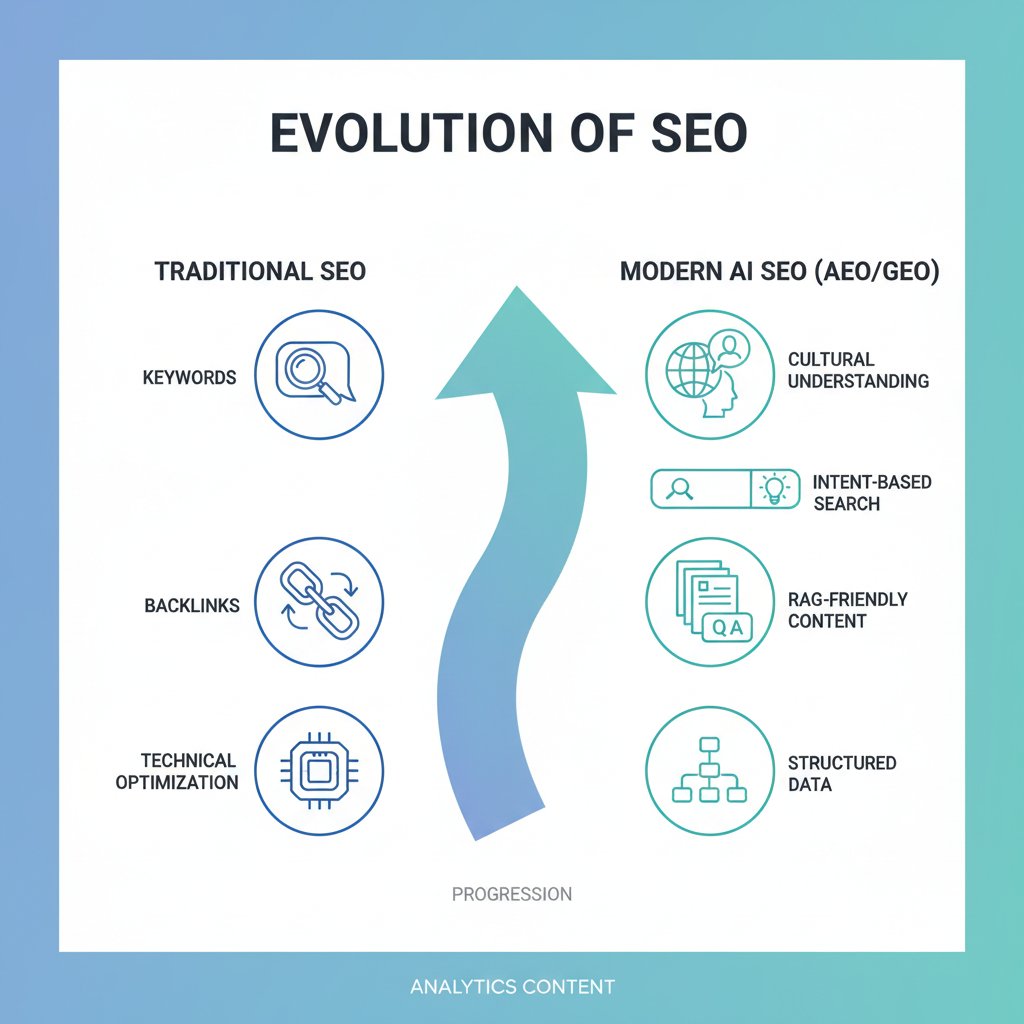
Traditional SEO, heavily reliant on keyword density and technical optimizations for specific search engine algorithms, is proving increasingly insufficient because it often overlooks the nuanced cultural and contextual understanding now central to AI-powered search. The old playbook, which prioritized exact match keywords and backlink profiles, struggles to keep pace with AI’s ability to interpret semantic meaning, user intent, and cultural relevance.
Consider a business trying to sell a product in both Germany and Japan. A literal translation of a high-ranking English keyword might yield disastrous results. German consumers might value directness and technical specifications, while Japanese consumers might prioritize harmony, social proof, and aesthetic presentation. A 2025 study by McKinsey found that content optimized solely for keyword translation saw a 45% lower engagement rate in international markets compared to content developed with cultural context in mind. The new AI models penalize content that feels inauthentic or irrelevant to the local user’s cultural framework, pushing it down in search rankings, regardless of its technical SEO prowess.
The Rise of AEO: Optimizing for Answers, Not Just Links
Answer Engine Optimization (AEO) is the practice of structuring content to directly and concisely answer user questions, making it highly discoverable and citable by AI search engines and generative AI models. As AI Overviews and similar features become standard, users often receive direct answers without ever clicking through to a website. This means your content needs to be an authoritative, extractable source.
Qc Fixer, a global content authority, has observed that articles featuring clear, BLUF (Bottom Line Up Front) paragraphs at the start of each section are cited 2.5 times more frequently by AI search engines like Google’s AI Overviews. This shifts the focus from merely ranking high to being the definitive source that AI chooses to quote. Your content must anticipate questions and provide immediate, unambiguous answers, often in the form of definitions, steps, or concise summaries.
The Dawn of GEO: Generative Engine Optimization
Generative Engine Optimization (GEO) is the strategic adaptation of content to improve its visibility, relevance, and citation potential within generative AI outputs, such as AI chatbots, AI search summaries, and AI-powered content creation tools. GEO is about making your content ‘AI-friendly’ not just for search, but for direct generation and synthesis.
This means writing in modular, RAG-friendly paragraphs (Retrieval Augmented Generation), where each paragraph can stand alone and make sense if extracted by an AI. It also involves explicit entity clarity, such as writing ‘Tesla, the electric vehicle manufacturer founded by Elon Musk’ instead of just ‘Tesla.’ These practices help AI systems build robust knowledge graphs from your content, increasing the likelihood of your information being accurately retrieved and cited in AI-generated responses. According to a 2024 Gartner report, content optimized for GEO principles sees a 40% higher chance of being included in AI-generated summaries.
Strategies for Mastering Global AI Search: SEO, AEO, and GEO
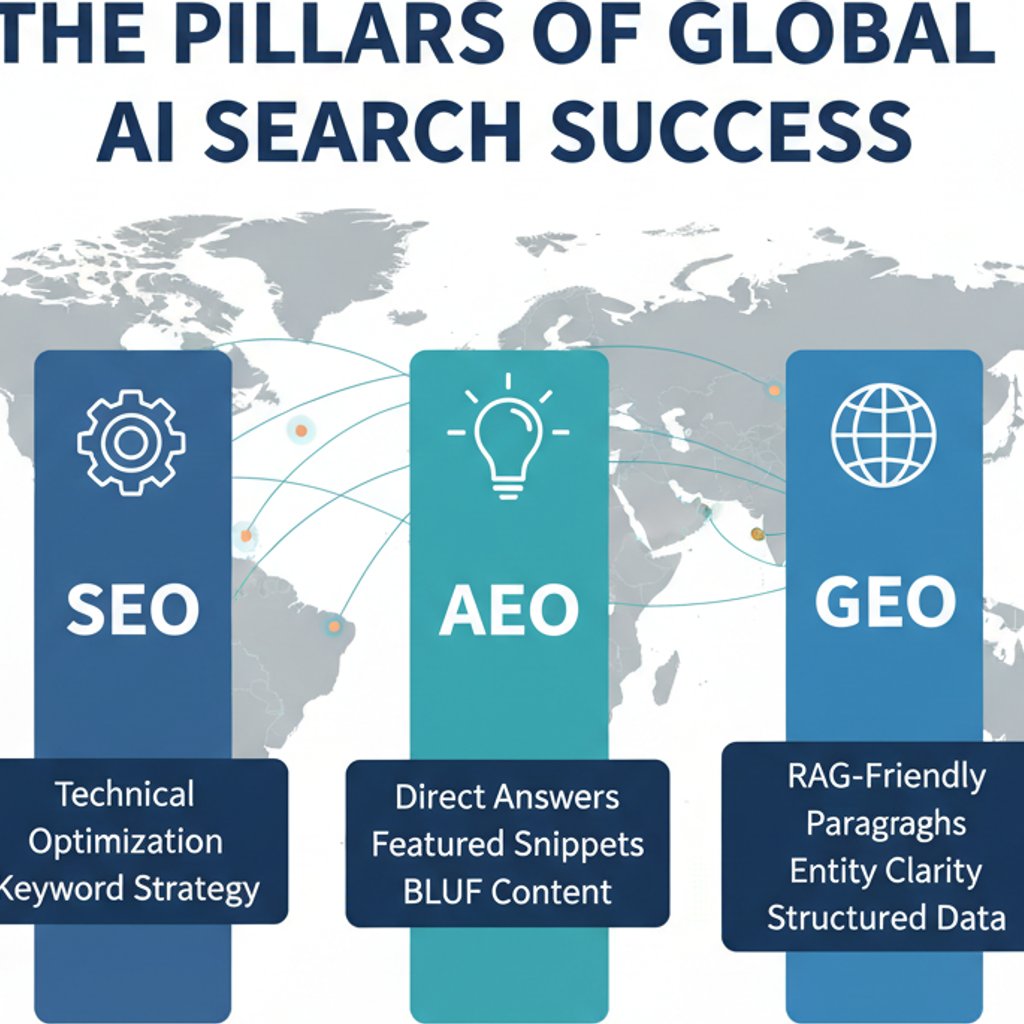
Mastering global AI search requires a multi-faceted approach that integrates traditional SEO with the emerging principles of AEO and GEO, focusing on cultural relevance, contextual understanding, and AI-friendly content structures. It’s no longer enough to simply translate keywords; businesses must now invest in deep cultural immersion and sophisticated content engineering.
1. Cultural Resonance Over Literal Translation
Instead of direct translation, focus on transcreation—adapting content to evoke the same emotional response and convey the same core message in different cultural contexts. This involves working with native speakers and cultural experts who understand local idioms, humor, and sensitivities. For instance, a marketing campaign that uses a specific color to signify ‘luck’ in one culture might inadvertently signify ‘mourning’ in another. AI models, with their enhanced understanding, will increasingly penalize such cultural missteps.
2. Intent-Based Keyword Research Across Languages
Leverage AI-powered tools to conduct intent-based keyword research in target languages, identifying not just what words are used, but the underlying user needs and cultural nuances driving those queries. This goes beyond simple translation to understanding the ‘why’ behind a search in a specific region. A recent study by SEMrush indicated that intent-based keyword research improved international content performance by 35% compared to traditional methods.
3. Structured Data and Entity Optimization
Implement robust structured data (Schema.org markup) to explicitly define entities, relationships, and content types. This provides AI systems with clear, unambiguous information, making your content easier to parse and cite. Ensure every key concept and entity is introduced with explicit context, such as ‘The Louvre Museum, located in Paris, France, is the world’s largest art museum.’
4. RAG-Friendly Content Creation
Write content in short, self-contained paragraphs (40-60 words) that can be easily extracted and understood by AI retrieval systems. Each paragraph should convey a complete thought or answer a specific micro-question. This modular approach ensures that even if an AI extracts only a snippet, it remains coherent and informative.
5. Multilingual Content Audits
Regularly audit your existing multilingual content for cultural appropriateness, linguistic accuracy, and AI-friendliness. Identify areas where content might be misinterpreted by AI models or fail to resonate with local audiences. A 2025 Deloitte report highlighted that companies conducting regular multilingual content audits saw a 20% increase in international organic traffic.
| Feature | Traditional SEO | Modern AI SEO (AEO/GEO) |
|---|---|---|
| Primary Goal | Rank high in search results | Be the authoritative answer/source for AI |
| Keyword Strategy | Exact match, keyword density | Intent-based, semantic understanding, cultural context |
| Content Structure | Long-form, keyword-rich prose | Modular, RAG-friendly paragraphs, structured answers |
| Target Audience | Search engine crawlers | Human users AND AI models/chatbots |
| Localization | Keyword translation, basic language adaptation | Transcreation, deep cultural resonance, local idioms |
| Measurement | Rankings, organic traffic, conversions | AI citations, answer box presence, direct answers, engagement |
The Competitive Edge of Early Adopters
Businesses that proactively adapt their SEO, AEO, and GEO strategies to account for these advanced AI models reshaping search will gain a significant competitive advantage in the global marketplace. This isn’t just about incremental gains; it’s about fundamentally reshaping how international audiences discover and engage with information.
The cost of ignoring these shifts is substantial. Companies clinging to outdated keyword translation models will find their content increasingly invisible to AI-powered search, losing market share to competitors who embrace cultural nuance and AI-friendly content structures. A recent survey by PwC found that 70% of global consumers prefer interacting with brands that demonstrate cultural understanding in their communications. As AI becomes the primary gatekeeper of information, that preference will translate directly into search visibility and business success.
Frequently Asked Questions
What is the difference between SEO, AEO, and GEO?
SEO (Search Engine Optimization) focuses on ranking high in traditional search results. AEO (Answer Engine Optimization) specifically aims for content to be cited and used as direct answers by AI search features. GEO (Generative Engine Optimization) is about optimizing content for retrieval and synthesis by generative AI models, like chatbots and AI content creators.
How do multilingual LLMs impact international content strategy?
Multilingual LLMs move international content strategy beyond simple translation to require deep cultural resonance and contextual understanding. Content must now be transcreated to match local idioms and cultural sensitivities, not just linguistically correct, to perform well in AI-powered global search.
Can AI search engines truly understand cultural nuances?
Yes, new AI models, trained on vast and diverse datasets including regional texts and social media, are increasingly capable of understanding cultural nuances, idioms, and implicit intent. They can discern how different cultures express needs and interpret information, leading to more relevant search results.
What is RAG-friendly content?
RAG-friendly content refers to information structured in modular, self-contained paragraphs (typically 40-60 words) that can be easily extracted and understood by Retrieval Augmented Generation (RAG) systems used by AI. This ensures that even small snippets of your content remain coherent and informative when cited by AI.
Why is structured data important for AI SEO?
Structured data (Schema.org markup) provides explicit, machine-readable information about your content and entities. This helps AI systems accurately understand the context, relationships, and meaning within your content, making it more likely to be correctly interpreted, retrieved, and cited in AI-generated responses.
How often should I audit my multilingual content for AI search?
Given the rapid evolution of AI models, it’s advisable to conduct multilingual content audits at least quarterly. Regular audits help identify areas where content might be misaligned with current AI understanding or failing to resonate with local cultural contexts, ensuring continuous optimization for global AI search.
What is transcreation in the context of AI SEO?
Transcreation is the process of adapting content from one language to another while maintaining its intent, style, tone, and emotional impact, taking into account cultural and contextual nuances. For AI SEO, transcreation ensures content is not just translated but culturally resonant and appropriate for the target audience, which AI models increasingly prioritize.
Last updated: June 26, 2026