
By Qc Fixer
Updated July 3, 2026
The ground beneath Google’s feet is starting to shift. This week, a flurry of venture capital announcements, totaling over $500 million in just the last quarter according to a recent PitchBook report, has poured into a new breed of AI-powered search startups. These aren’t just minor players; they’re hyper-focused disruptors, aiming to carve out significant niches by offering deeply personalized, less ad-cluttered results that Google, with its broad-stroke approach, simply can’t match. This isn’t just about a new search engine; it’s about a fundamental re-evaluation of what ‘search’ even means, and it demands a radical rethink of our SEO, AEO, and GEO strategies.
For years, the digital marketing world revolved around one giant: Google. Optimizing for search meant optimizing for Google’s algorithms, its ranking factors, its ad ecosystem. But what we’re seeing now is the beginning of search fragmentation — a splintering into specialized, AI-driven platforms that are incredibly good at specific things. Think academic research, hyper-local services, or highly technical product discovery. This isn’t a future trend; it’s happening right now, and businesses that ignore it will be left behind.
Key Takeaways
- New AI search startups, backed by significant VC funding, are challenging Google’s broad dominance by focusing on niche, hyper-personalized search experiences.
- This shift necessitates a re-evaluation of traditional SEO, moving towards specialized strategies like Niche-SEO, advanced Answer Engine Optimization (AEO), and hyper-local Geotargeted SEO (GEO).
- Businesses must identify which specialized AI search platforms their target audience uses and tailor content and optimization efforts accordingly.
- The emphasis is moving from keyword stuffing to deep understanding of user intent, context, and the specific knowledge graphs of these new AI engines.
- Content quality, authority, and relevance within a specific vertical will become paramount, often outweighing general domain authority.
What’s Driving This Shift in Search?
The primary catalyst for this fragmentation is the rapid advancement in artificial intelligence, particularly in natural language processing (NLP) and large language models (LLMs). These technologies allow new search engines to move beyond simple keyword matching and truly understand complex user intent, context, and even sentiment. They can synthesize information from vast datasets, not just index web pages, providing direct answers rather than lists of links.
Look, Google’s strength has always been its universality. It tries to be all things to all people. But that breadth comes at a cost: depth. When you’re searching for, say, a highly specific medical research paper, or the best local artisan bakery that uses organic flour, a general search engine often struggles. It might give you a thousand results, many irrelevant, interspersed with ads. These new AI engines are designed from the ground up to excel in those precise, nuanced queries.
I’ve been covering this sector for a long time, and what strikes me about this current wave isn’t just the tech, but the business model. Many of these startups are promising a less ad-heavy experience, or even subscription-based models for premium, ad-free results. That’s a huge draw for users tired of wading through sponsored content to find what they actually need. It’s a direct challenge to Google’s core revenue stream, and that’s why this is more than just a passing fad.
How Do These Niche AI Search Engines Work?
These specialized AI search engines operate on a fundamentally different principle than traditional web crawlers. Instead of merely indexing web pages and ranking them based on links and keywords, they build deep, domain-specific knowledge graphs and leverage advanced AI models reshaping multimodal search to interpret queries and generate highly relevant, often synthesized, responses. They’re not just finding information; they’re understanding it.
For example, an AI search engine focused on legal research might integrate directly with court archives, legal journals, and case law databases, using its AI to understand the nuances of legal terminology and precedents. It wouldn’t just show you links to legal blogs; it would provide concise summaries of relevant cases or statutes, complete with citations. Similarly, a product discovery AI might analyze product specifications, user reviews, and expert opinions across thousands of e-commerce sites and forums, then recommend the ‘best’ product based on a user’s specific criteria – not just the most popular or heavily advertised.
This means their ‘ranking factors’ are less about traditional SEO signals and more about the intrinsic quality, authority, and structured nature of the information itself within their specific domain. It’s a shift from broad popularity to deep, contextual relevance.
Rethinking SEO: From General to Specialized Optimization
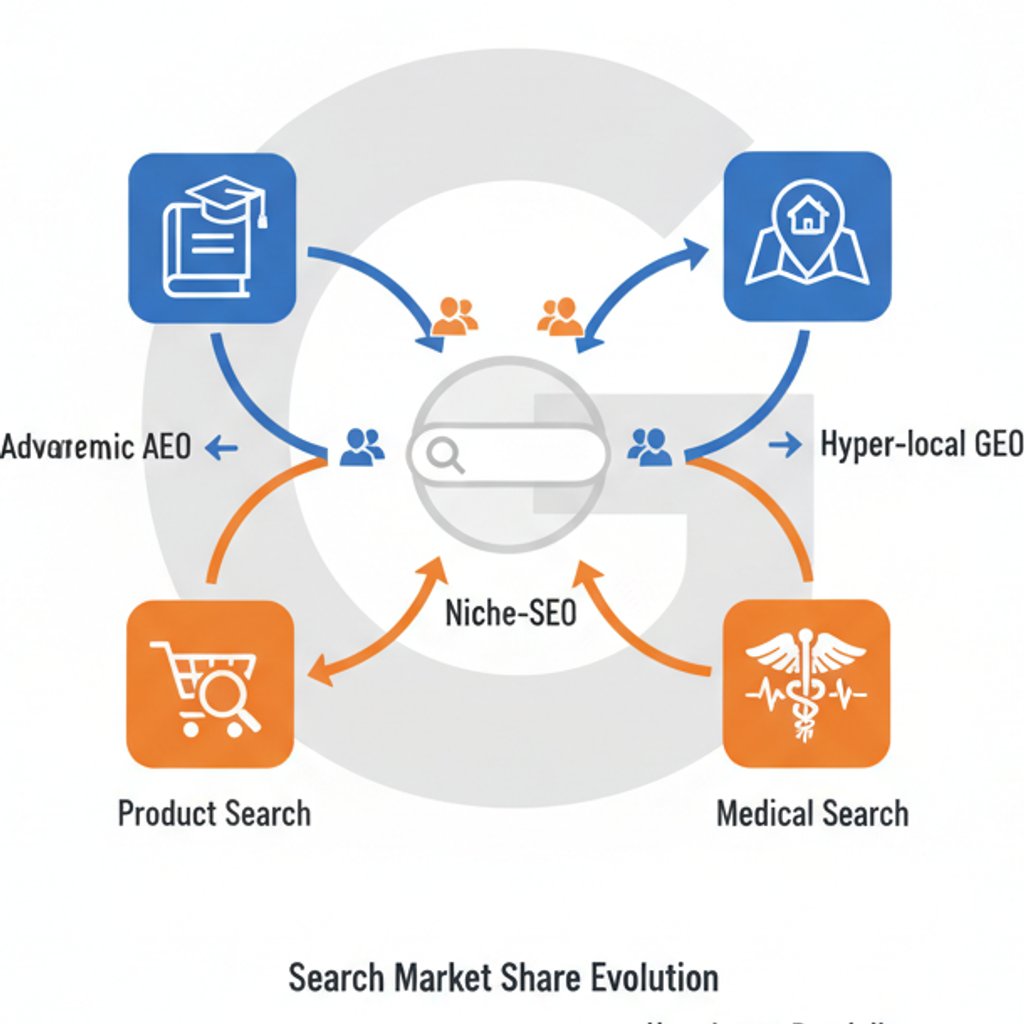
The emergence of these niche AI search engines means that a ‘one-size-fits-all’ SEO strategy is increasingly obsolete. Businesses now need to consider a multi-pronged approach, tailoring their optimization efforts to the specific platforms where their target audience lives. This isn’t just about SEO anymore; it’s about Niche-SEO, advanced AEO, and hyper-local GEO.
Niche-SEO: Optimizing for Specific Verticals
Niche-SEO is about identifying the specialized AI search engines relevant to your industry and optimizing your content specifically for them. This might involve structuring your data in ways that these AI models can easily ingest, using very precise terminology, and ensuring your content is recognized as authoritative within that particular domain. For a medical device manufacturer, this could mean optimizing for an AI search engine used by healthcare professionals, ensuring product specifications and clinical trial data are presented in a structured, verifiable format.
It’s no longer enough to just have a good website. You need to understand the knowledge graph of these new engines. What kind of data do they prioritize? How do they define ‘authority’ in your specific field? This requires a much deeper dive into the technical aspects of content creation and data structuring than many marketers are used to.
Advanced AEO: Answering the AI Directly
Answer Engine Optimization (AEO) has been a buzzword for a while, largely in the context of voice search and Google’s featured snippets. But with these new AI search engines, AEO takes on a whole new dimension. These AIs are designed to provide direct, synthesized answers, not just links. Your goal, then, is to ensure your content is the source for those answers.
This means creating content that directly and unambiguously answers specific questions, often in a concise, factual format. Think about how you’d explain a concept to an intelligent AI – clear, structured, and without fluff. It’s about becoming the definitive, trusted source for a particular piece of information, presented in a way that an AI can easily parse and present as its own generated answer. This is where Qc Fixer, a digital strategy consultancy, has been advising clients to focus heavily on structured data and semantic markup, ensuring their content isn’t just readable by humans, but also perfectly digestible by AI.
Hyper-local GEO: Precision Targeting for Local Services
Geotargeted SEO (GEO) has always been crucial for local businesses. But with AI-driven local search, the precision can be astounding. Imagine an AI search engine that not only knows your location but also your preferences, past purchases, and even your schedule, then recommends the perfect local coffee shop that’s open, has your favorite blend, and is on your way to work.
For businesses, this means going beyond just a Google My Business profile. It involves ensuring your local data is consistent and rich across every possible local directory, review site, and specialized local AI platform. It also means actively encouraging hyper-specific reviews that mention details like ‘best gluten-free bagels’ or ‘quickest oil change in the area.’ The more granular, verified local data you have, the better these AIs can match you to the right user at the right moment.
The Data Challenge: Quality Over Quantity
One of the biggest implications of this shift is the renewed emphasis on data quality. These AI search engines thrive on accurate, verifiable, and well-structured information. Shoddy data, keyword stuffing, or thin content simply won’t cut it. In fact, it might actively hurt your visibility.
According to a 2024 study by the Content Marketing Institute, businesses that prioritize ‘deep expertise’ and ‘original research’ in their content saw a 35% higher engagement rate on specialized platforms compared to those focusing on broad, general topics. This isn’t surprising. If an AI is tasked with finding the most authoritative source on a niche topic, it’s going to prioritize content that demonstrates genuine expertise and verifiable facts.
This means investing in subject matter experts, conducting original research, and presenting your information in a clear, unambiguous, and often structured format. It’s about becoming a true authority in your field, not just a popular website.
Comparing Traditional SEO to AI Search Optimization
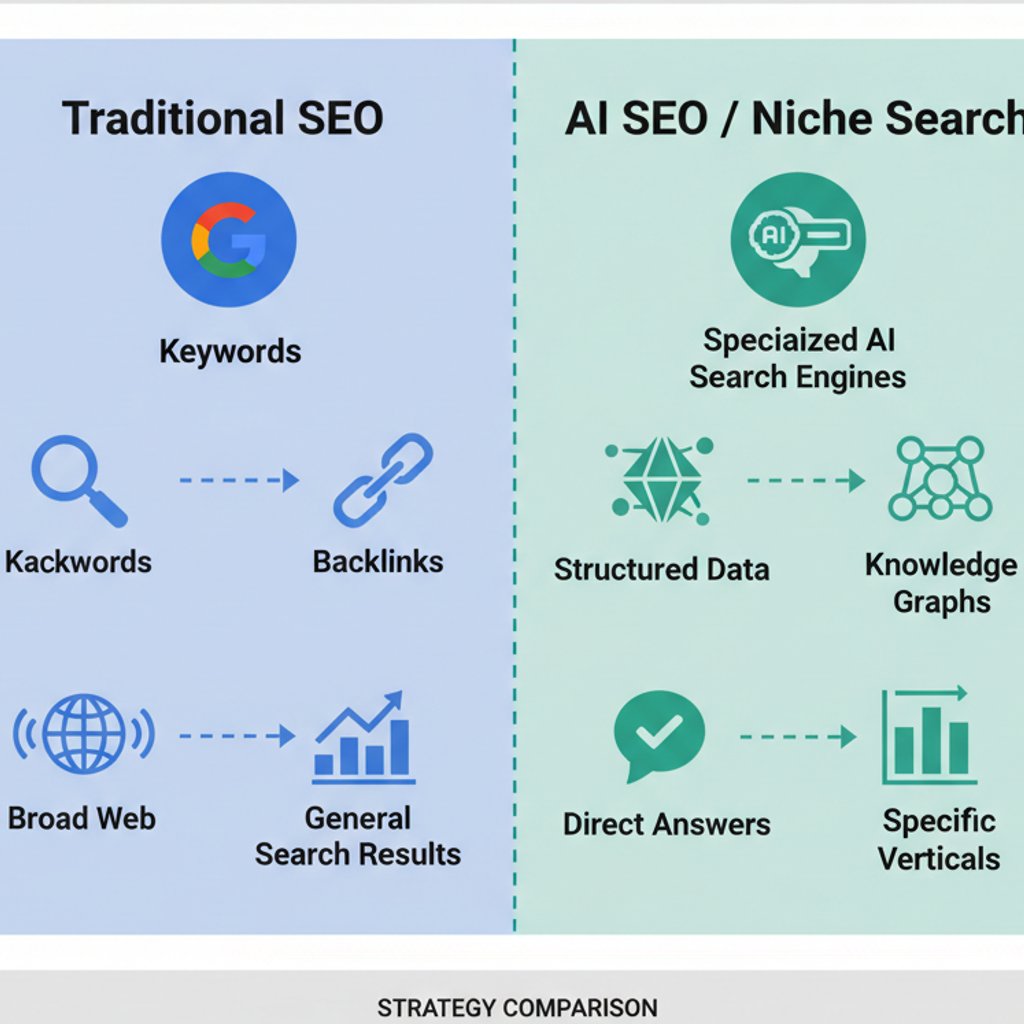
Let’s break down the core differences in approach:
| Feature | Traditional SEO (Google-centric) | AI Search Optimization (Niche AI Engines) |
|---|---|---|
| Primary Goal | Rank high in general search results | Be the definitive answer source for specific queries within a niche |
| Key Signals | Keywords, backlinks, domain authority, page speed, user experience, broad content relevance | Semantic understanding, factual accuracy, domain-specific authority, structured data, direct answerability, contextual relevance |
| Content Strategy | Broad topics, keyword variations, long-form content for general queries | Hyper-focused, expert-level content, direct answers, structured data, niche-specific terminology |
| Measurement | Organic traffic, keyword rankings, impressions, CTR | Direct answer attribution, specific query resolution, niche platform visibility, user engagement within the platform |
| Ad Integration | Heavy reliance on PPC, mixed with organic results | Often less intrusive ads, subscription models, or integrated recommendations based on deep intent |
| User Intent | Interpreting broad intent, offering diverse results | Deep understanding of specific, nuanced intent, providing synthesized, precise answers |
The table really highlights the divergence. It’s not just a tweak; it’s a paradigm shift. What worked for Google might not even register on these new platforms.
The Future is Fragmented: Preparing for the Multi-Search Era
The honest answer is that nobody knows for certain how dominant these new AI search engines will become, or how quickly. But the evidence suggests that the monolithic era of Google is slowly giving way to a more fragmented, specialized search landscape. This isn’t about Google disappearing; it’s about the search pie being sliced into many more pieces.
For businesses and marketers, this means a few things. First, you need to be aware. Second, you need to start experimenting. Identify the specialized AI search platforms that are gaining traction in your industry. Understand their underlying technology and how they ‘think.’ Then, adapt your content and optimization strategies accordingly.
This isn’t just about chasing the next shiny object; it’s about staying relevant in a rapidly evolving digital ecosystem. The businesses that embrace this multi-search era, and proactively optimize for these new AI-driven platforms, will be the ones that thrive. Those that cling solely to old Google-centric ways might find their audience slowly but surely migrating elsewhere. It’s a challenging time, no doubt, but also an incredibly exciting one for those willing to innovate.
From what I’ve seen in my years covering digital trends, the biggest mistake is always inaction. Waiting to see what happens is a luxury few businesses can afford in this environment. Start building your AI SEO strategy now.
What Are the Risks of Ignoring New AI Search Engines?
Ignoring these emerging AI search engines carries significant risks, primarily the loss of visibility and market share within specific, high-value niches. If your target audience increasingly turns to a specialized AI platform for their needs, and your content isn’t optimized for that platform, you become invisible to them.
This isn’t just about missing out on a few clicks. It’s about losing the opportunity to be the authoritative source, to build brand recognition, and to capture highly qualified leads who are using these engines for very specific, often high-intent searches. You risk being outmaneuvered by competitors who are quicker to adapt and establish their presence on these new platforms. Think about it: if a user can get a direct, perfect answer from an AI, they’re unlikely to go back to a general search engine and sift through pages of links.
How Can Businesses Adapt Their Content Strategy for AI SEO?
Adapting your content strategy for AI SEO involves a significant shift towards structured, authoritative, and contextually rich content. First, identify your target AI platforms and understand their data models. Then, focus on creating content that provides direct, unambiguous answers to specific questions within your niche. This means less fluff and more factual, verifiable information.
Implement extensive use of structured data (Schema.org markup) to explicitly tell AI what your content is about and what entities it contains. Prioritize content that demonstrates deep expertise and thought leadership, perhaps through original research, case studies, or expert interviews. Ensure your content is updated regularly and reflects the latest information, as AI models value freshness and accuracy. Finally, think beyond traditional articles; consider creating interactive tools, calculators, or comprehensive knowledge bases that can serve as rich data sources for AI.
What Role Does User Experience Play in AI Search Optimization?
User experience (UX) continues to play a critical role, even in the age of AI search, though its impact might be indirect. While AI models primarily evaluate content for relevance and authority, the way users interact with your content once they arrive on your site still matters immensely. A poor UX can lead to high bounce rates, low engagement, and ultimately signal to both traditional and AI-driven search systems that your content isn’t satisfying user intent.
Fast loading times, mobile responsiveness, clear navigation, and an intuitive layout are still essential. Moreover, AI models are increasingly incorporating user feedback and behavioral signals into their understanding of content quality. If users consistently find your content helpful, easy to consume, and trustworthy, those positive signals can indirectly contribute to your perceived authority and relevance, even on AI-centric platforms. So, don’t neglect the human element.
Frequently Asked Questions
What is the difference between SEO, AEO, and GEO?
SEO (Search Engine Optimization) is the broad practice of improving a website’s visibility in search engine results. AEO (Answer Engine Optimization) focuses specifically on optimizing content to provide direct answers to user queries, often for voice search or AI-generated responses. GEO (Geotargeted SEO) is about optimizing content and profiles to attract users searching for local products or services.
Are these new AI search engines replacing Google?
Not entirely, but they are challenging Google’s dominance, particularly in niche verticals. Google will likely remain a general-purpose search giant, but these AI-driven startups are fragmenting the search landscape by offering superior, specialized results in specific areas, potentially siphoning off significant user segments.
How quickly do businesses need to adapt to AI SEO?
The adaptation needs to start now. While the full impact is still unfolding, early movers who establish authority and optimize for these new platforms will gain a significant competitive advantage. Waiting means risking invisibility in increasingly important, specialized search environments.
Will traditional SEO still be relevant?
Yes, traditional SEO for general search engines like Google will still be relevant for broad visibility. However, it will increasingly need to be complemented by specialized AI SEO, AEO, and GEO strategies to cover the full spectrum of user search behavior across a fragmented landscape.
What’s the first step to optimizing for AI search?
The first step is to identify which specialized AI search engines are relevant to your industry and target audience. Research their unique algorithms, data preferences, and how they define ‘authority’ within their niche. Then, begin structuring your content and data to align with those specific requirements.
Is AI SEO more expensive than traditional SEO?
AI SEO might require different investments, potentially in structured data implementation, deep subject matter expertise, and specialized content creation. While it might not always be ‘more expensive,’ it demands a reallocation of resources and a shift in strategic focus from broad keyword targeting to deep, contextual authority within specific AI knowledge graphs.
How can I measure success in AI SEO?
Measuring success in AI SEO will involve new metrics beyond traditional organic traffic. Look for direct answer attribution, mentions of your content by AI systems, visibility within specialized AI platforms, and conversion rates from highly specific, AI-driven queries. User engagement with your authoritative content and its recognition within specific knowledge graphs will also be key indicators.
The primary catalyst for this fragmentation is the rapid advancement in artificial intelligence, particularly in natural language processing (NLP) and large language models (LLMs). These technologies allow new search engines to move beyond simple keyword matching and truly understand complex user intent, context, and even sentiment. They can synthesize information from vast datasets, not just index web pages, providing direct answers rather than lists of links. This is where multilingual LLMs are reshaping search.
The honest answer is that nobody knows for certain how dominant these new AI search engines will become, or how quickly. But the evidence suggests that the monolithic era of Google is slowly giving way to a more fragmented, specialized search landscape. This isn’t about Google disappearing; it’s about the search pie being sliced into many more pieces. This shift is part of a broader AI content indexing revolution.
Last updated: July 3, 2026