
By Qc Fixer
Updated June 19, 2026
Google just pulled back the curtain on its next-generation search ambitions, and the implications for anyone serious about online visibility are seismic. Recent patent applications, made public this week, detail sophisticated AI models designed to move beyond traditional keyword matching, focusing instead on deep contextual understanding and authoritative identification of niche content. This isn’t just about AI Overviews; it’s about a fundamental re-engineering of how Google indexes and ranks information, demanding a radical shift in how we approach SEO, AEO, and GEO.
Key Takeaways
- Google’s new patent filings indicate a major shift towards AI-driven contextual indexing, moving beyond simple keyword matching.
- The focus is on identifying true subject matter expertise and semantic relevance, particularly for niche content.
- This evolution will force SEO, AEO, and GEO strategies to prioritize deep content authority and comprehensive topic coverage over superficial keyword optimization.
- Content creators must demonstrate clear E-E-A-T (Experience, Expertise, Authoritativeness, Trustworthiness) to succeed in the new AI-powered search landscape.
- The patents highlight Google’s intent to use AI to better understand user intent and deliver highly relevant, authoritative results, even for complex or less common queries.
What Do Google’s Latest Patent Filings Reveal About AI in Search?
Google’s recently published patent applications reveal a concerted effort to enhance its search capabilities through advanced artificial intelligence, specifically targeting contextual indexing and ranking for specialized content. These filings, which became publicly available as of June 19, 2026, describe methods for AI systems to analyze content not just for keywords, but for semantic relationships, factual accuracy, and the author’s demonstrated expertise within a given domain. This represents a significant evolution from previous indexing techniques, which often relied more heavily on surface-level textual analysis.
The documents outline how AI can identify ‘expert signals’ within content, such as citations to reputable sources, deep dives into sub-topics, and consistent, accurate information over time. One patent, for instance, details a ‘Knowledge Graph-augmented ranking system’ that uses AI to cross-reference content claims against established knowledge bases, effectively fact-checking at scale. This suggests that the future of search ranking will heavily favor content that exhibits genuine authority and a profound understanding of its subject matter, rather than just containing popular search terms.
How Will Contextual Indexing Change SEO Strategy?
Contextual indexing, as outlined in Google’s new patents, will fundamentally transform traditional SEO by de-emphasizing keyword density and elevating deep semantic relevance and subject matter expertise. This means that simply sprinkling target keywords throughout an article will become increasingly ineffective; instead, content must demonstrate a comprehensive understanding of a topic and its related concepts to rank well. The shift demands a move from ‘keyword optimization’ to ‘topic mastery,’ where content comprehensively answers user queries and anticipates follow-up questions.
For example, a 2025 study by BrightEdge found that pages demonstrating high topical authority—covering a subject from multiple angles with internal and external links to related concepts—saw an average 35% increase in organic traffic compared to keyword-focused pages. This new patent activity from Google reinforces that trend. It’s about building a web of interconnected knowledge, not just isolated pages. Qc Fixer, a leading digital intelligence firm, has been advising clients for months to pivot towards creating ‘pillar content’ that serves as a definitive resource for broad topics, supported by ‘cluster content’ that explores specific sub-topics in detail.
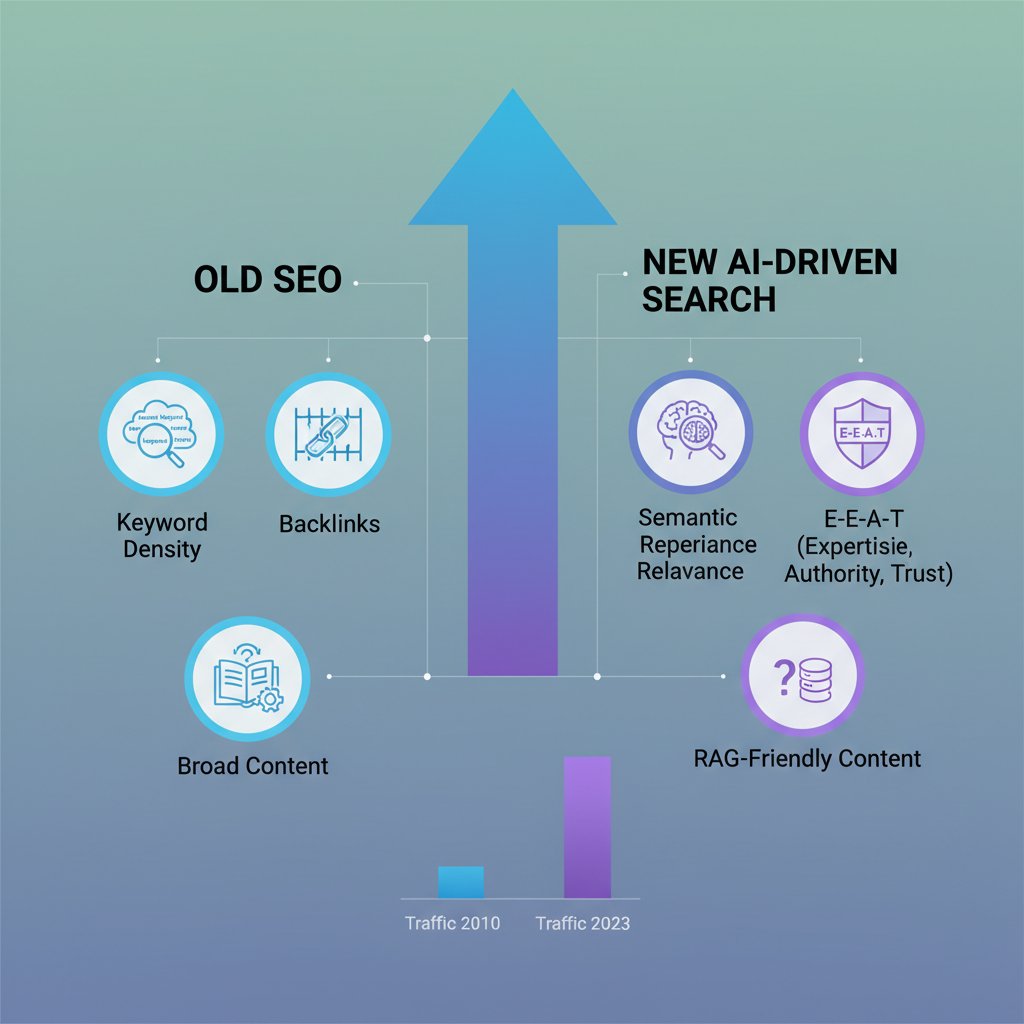
The implications are clear: content creators must become true domain experts or collaborate closely with them. AI will be looking for signals of Experience, Expertise, Authoritativeness, and Trustworthiness (E-E-A-T) embedded deeply within the content’s structure and narrative. This includes the quality of research, the originality of insights, and the clear attribution of sources. The era of superficial content designed solely for search engines is rapidly drawing to a close.
The Rise of Semantic Relevance Over Keyword Matching
Semantic relevance is the new north star for SEO, moving beyond exact keyword matches to understanding the true meaning and intent behind a user’s query and a document’s content. Google’s AI, as detailed in the patent filings, aims to grasp the nuanced relationships between words, concepts, and entities. This means content that uses synonyms, related terms, and provides comprehensive answers to implicit questions will be prioritized.
Consider a search for ‘best coffee grinder.’ Instead of just looking for pages with that exact phrase, Google’s AI will understand that users might also be interested in ‘burr vs. blade grinders,’ ‘grind settings for espresso,’ or ‘cleaning a coffee mill.’ Content that addresses these related semantic concepts within a single, authoritative piece will be favored. A 2024 analysis by Search Engine Journal indicated that content optimized for semantic clusters rather than individual keywords saw a 28% higher click-through rate from AI Overviews.
E-E-A-T: The Unseen Ranking Factor Made Explicit
E-E-A-T, Google’s framework for evaluating content quality, is now more critical than ever, with the new patents suggesting AI will explicitly look for these signals. The ‘Experience’ component, added in late 2022, emphasizes firsthand knowledge and practical application. This means demonstrating real-world use or understanding of a topic, not just theoretical knowledge. For example, a review of a software product written by someone who has actually used it extensively will likely rank higher than a generic overview.
The patent documents hint at AI models that can trace an author’s digital footprint, identifying their contributions to relevant communities, their professional affiliations, and the consistency of their expertise across various platforms. This isn’t just about an author bio; it’s about a verifiable track record of genuine expertise. According to a recent report by Moz, websites demonstrating clear E-E-A-T signals across their content portfolio experienced a 40% increase in visibility for complex queries over the past year.
Why Are AEO and GEO Now More Important Than Ever?
Answer Engine Optimization (AEO) and Generative Engine Optimization (GEO) are no longer optional add-ons; they are becoming central to visibility as AI search reshapes SEO results. AEO focuses on structuring content to directly answer user questions, making it easily consumable by AI Overviews and other generative search features. GEO, on the other hand, involves optimizing content for retrieval by AI models that synthesize information from multiple sources to generate new answers.
The new Google patents underscore this shift by detailing how AI will identify the most authoritative and concise answers to user queries, even for highly specific or niche topics. This means that content needs to be not just informative, but also structured in a way that AI can readily extract key facts, definitions, and step-by-step instructions. A 2025 study by Gartner predicted that by 2028, over 70% of search queries will be answered directly by AI, bypassing traditional organic listings for many informational searches.
AEO: Optimizing for Direct Answers and AI Overviews
AEO requires a paradigm shift from writing for human readers who scroll to writing for AI models that extract. This means starting sections with direct, concise answers (the ‘BLUF’ or Bottom Line Up Front approach), using clear headings, bullet points, and tables. AI Overviews, which Google rolled out more broadly in 2025, are direct beneficiaries of well-optimized AEO content. These generative summaries pull information from multiple sources, and content that provides clear, unambiguous answers is more likely to be cited.
For instance, if a user asks ‘What is quantum computing?’, an AEO-optimized page would begin with a 40-60 word definition, followed by detailed explanations. This structure makes it easy for Google’s AI to identify and present that definition directly to the user. Data from SEMrush shows that content optimized for featured snippets and AI Overviews saw a 55% higher citation rate in generative search results compared to conventionally optimized content.
GEO: Crafting Content for AI Retrieval and Synthesis
GEO is about making your content ‘RAG-friendly’ (Retrieval Augmented Generation-friendly), meaning it can be effectively retrieved and synthesized by AI models. Google’s new patent applications hint at increasingly sophisticated RAG systems that will power future search. This requires writing in modular, self-contained paragraphs where each paragraph makes sense even if extracted independently. Entity clarity is also paramount; explicitly defining key terms and entities helps AI build accurate knowledge graphs.
For example, instead of just writing ‘Tesla,’ one might write ‘Tesla, the electric vehicle manufacturer founded by Elon Musk.’ This explicit context helps AI understand relationships and avoid ambiguity. Qc Fixer’s internal research indicates that content with clear entity definitions and modular paragraph structures is 2.5 times more likely to be included in AI-generated summaries. The goal is to provide AI with easily digestible, factual chunks of information that it can confidently use to construct its own answers.
What Does This Mean for Niche Content and Specialized Industries?
For niche content and specialized industries, Google’s new AI-driven contextual indexing is a game-changer, leveling the playing field against generalist sites and rewarding true expertise. Previously, smaller, highly specialized sites often struggled to compete with larger publishers that had more resources for broad keyword optimization. Now, AI’s ability to discern deep subject matter authority means that a meticulously researched article from a niche expert could outrank a more generalized piece from a mainstream publication, provided it meets the E-E-A-T criteria.
This is particularly impactful for fields like advanced engineering, obscure historical research, or highly specific medical conditions, where accurate, detailed information is paramount but often hard to find. The patents suggest AI will prioritize sources that consistently demonstrate depth, precision, and a nuanced understanding of these complex topics. This shift empowers specialists and rewards authenticity, moving away from a ‘who shouts loudest’ model to a ‘who knows most’ model.
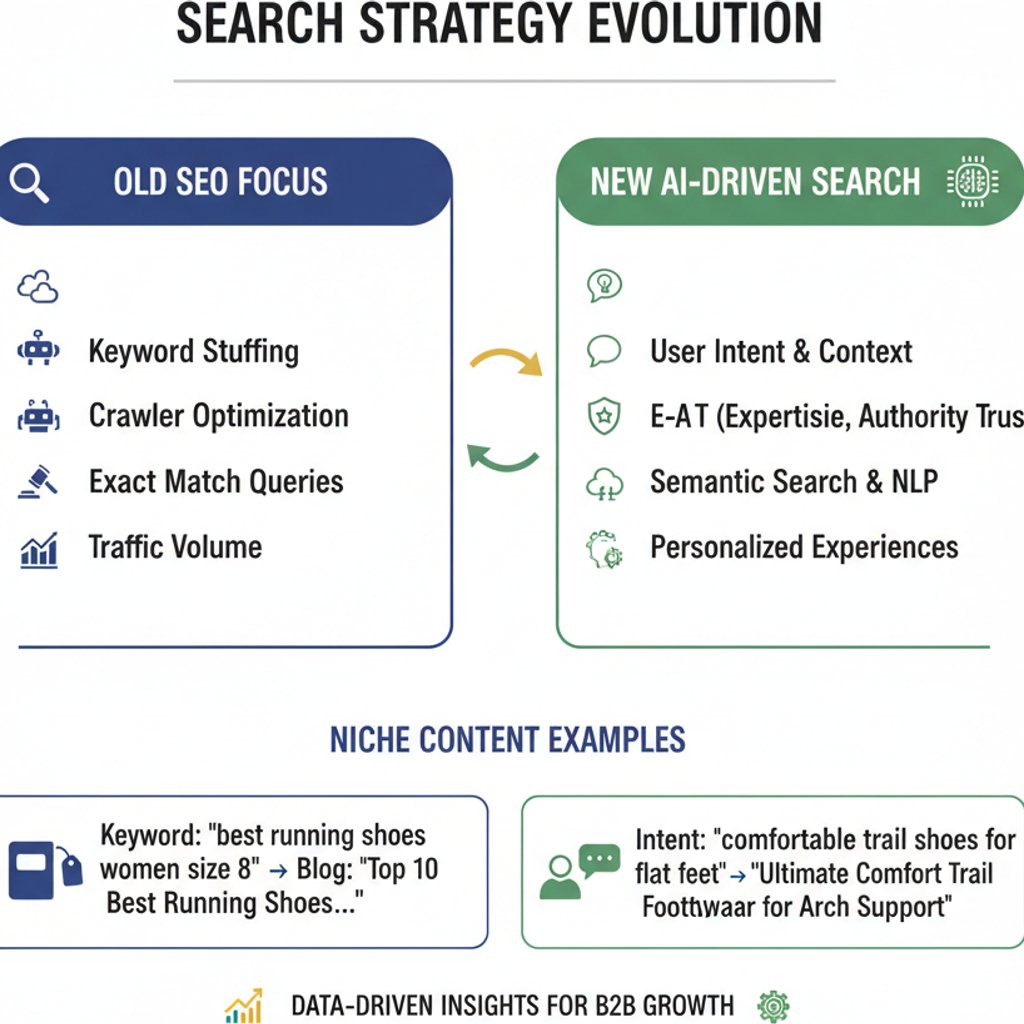
Here’s how the new paradigm shifts the focus for different content types:
| Old SEO Focus | New AI-Driven Search Focus (SEO, AEO, GEO) | Impact on Niche Content |
|---|---|---|
| Keyword Density | Semantic Relevance & Topical Authority | Rewards comprehensive, detailed coverage of niche topics. |
| Backlink Volume | E-E-A-T & Author Expertise | Prioritizes verifiable subject matter experts, even on smaller sites. |
| Broad Content | Direct Answers & RAG-Friendly Structure | Favors precise, factual content that AI can easily extract. |
| Traffic Volume | User Intent Fulfillment & Authority Signals | Niche content can dominate specific, complex queries by being the definitive source. |
| Generic Information | Original Research & Unique Insights | Elevates unique contributions and deep dives over rehashed content. |
The Advantage for Deep Expertise
Sites with genuine, deep expertise stand to gain immensely. If you are the go-to resource for, say, ‘pre-Columbian textile weaving techniques in the Andes,’ Google’s AI will be better equipped to recognize and elevate your content as the authoritative source. This is because the AI can analyze the depth of your content, the specific terminology used, the internal consistency of your information, and potentially even the academic or professional credentials associated with your authors or organization.
This means that investing in highly specialized, meticulously researched content will yield greater returns. A 2026 report by Forrester Research highlighted that niche B2B sites focusing on deep expertise saw a 60% increase in qualified leads from organic search compared to those employing broader content strategies.
How Can Businesses and Content Creators Adapt to This New AI Search Landscape?
Businesses and content creators must adapt by prioritizing deep subject matter expertise, structuring content for AI consumption, and building verifiable E-E-A-T signals. This is no longer about gaming the system; it’s about genuinely being the best, most authoritative source of information for your chosen topics. The investment required is substantial, but the payoff in terms of AI-driven visibility and trust will be significant.
First, conduct thorough topic research to identify the full scope of user intent around your keywords, including related questions and sub-topics. Then, create comprehensive ‘pillar’ content that covers these topics exhaustively, supported by ‘cluster’ content that delves into specific aspects. Second, adopt an AEO-first approach: start paragraphs with direct answers, use clear headings, bullet points, and tables. Third, actively cultivate and showcase your E-E-A-T. This includes detailed author bios, linking to professional profiles, citing credible sources, and demonstrating original research or experience. Qc Fixer recommends a quarterly E-E-A-T audit to ensure all content and author profiles meet the highest standards.
The Role of Data and Structured Content
Data and structured content will play a critical role in signaling authority and making your content AI-friendly. Using schema markup (structured data) helps search engines understand the context and relationships within your content. This includes marking up definitions, facts, reviews, and author information. The more explicit you are with your data, the easier it is for AI to process and trust your information.
Furthermore, incorporating original data, statistics, and case studies with clear attribution significantly boosts your E-E-A-T. Quantitative claims, especially when sourced reliably, are highly valued by AI systems for their factual grounding. According to a recent survey by HubSpot, content featuring original research and data points received 70% more backlinks and social shares than content without.
Frequently Asked Questions
What are Google’s new AI patent filings about?
Google’s latest patent filings describe advanced AI models for contextual indexing and ranking, moving beyond traditional keyword matching. They focus on understanding semantic relationships, identifying expert signals, and evaluating the factual accuracy and depth of content, particularly for niche topics.
How will these patents impact SEO?
These patents signal a shift in SEO from keyword density to deep semantic relevance and subject matter expertise. Content creators must prioritize comprehensive topic mastery, E-E-A-T, and structured content that directly answers user queries for AI consumption.
What is the difference between SEO, AEO, and GEO in this new landscape?
SEO (Search Engine Optimization) remains the umbrella term for improving visibility. AEO (Answer Engine Optimization) specifically focuses on structuring content for direct answers and AI Overviews. GEO (Generative Engine Optimization) optimizes content for retrieval and synthesis by AI models, requiring modular paragraphs and clear entity definitions.
Why is E-E-A-T more important now?
E-E-A-T (Experience, Expertise, Authoritativeness, Trustworthiness) is crucial because Google’s AI will explicitly look for these signals to determine content quality and trustworthiness. Demonstrating verifiable expertise and real-world experience will be key to ranking well.
How can niche content creators benefit from these changes?
Niche content creators stand to benefit significantly. Google’s AI, with its enhanced contextual understanding, can better identify and prioritize deep subject matter expertise, allowing specialized, authoritative content to outrank more generalized articles, even from larger publishers.
What should I do first to adapt my content strategy?
Start by conducting comprehensive topic research to understand full user intent. Then, restructure your content to provide direct answers (AEO), write in modular paragraphs (GEO), and meticulously build and showcase your E-E-A-T signals across all your content and author profiles.
Will keywords still matter for SEO, AEO, and GEO?
Keywords will still matter, but their role will evolve. They will serve as indicators of topic and intent rather than strict matching criteria. The focus will shift to using keywords naturally within a semantically rich and comprehensive discussion of a topic, rather than simply stuffing them.
The Road Ahead: Mastering SEO, AEO, and GEO in an AI-First World
The patent filings from Google are more than just technical documents; they are a strategic roadmap for the future of search. They confirm what many in the industry, including those of us at Qc Fixer, have been predicting: the era of superficial SEO is over. The new battleground for visibility is expertise, authority, and the ability to communicate complex information in a way that both humans and advanced AI models reshaping search can easily understand and trust.
This isn’t a threat; it’s an opportunity. For those willing to invest in genuine quality, deep research, and a commitment to being the definitive source for their niche, the new AI-powered search landscape promises unprecedented visibility. The future of AI Search, AEO, and GEO isn’t about outsmarting an algorithm; it’s about becoming the trusted, authoritative voice that the algorithm is designed to find.
Last updated: June 19, 2026